
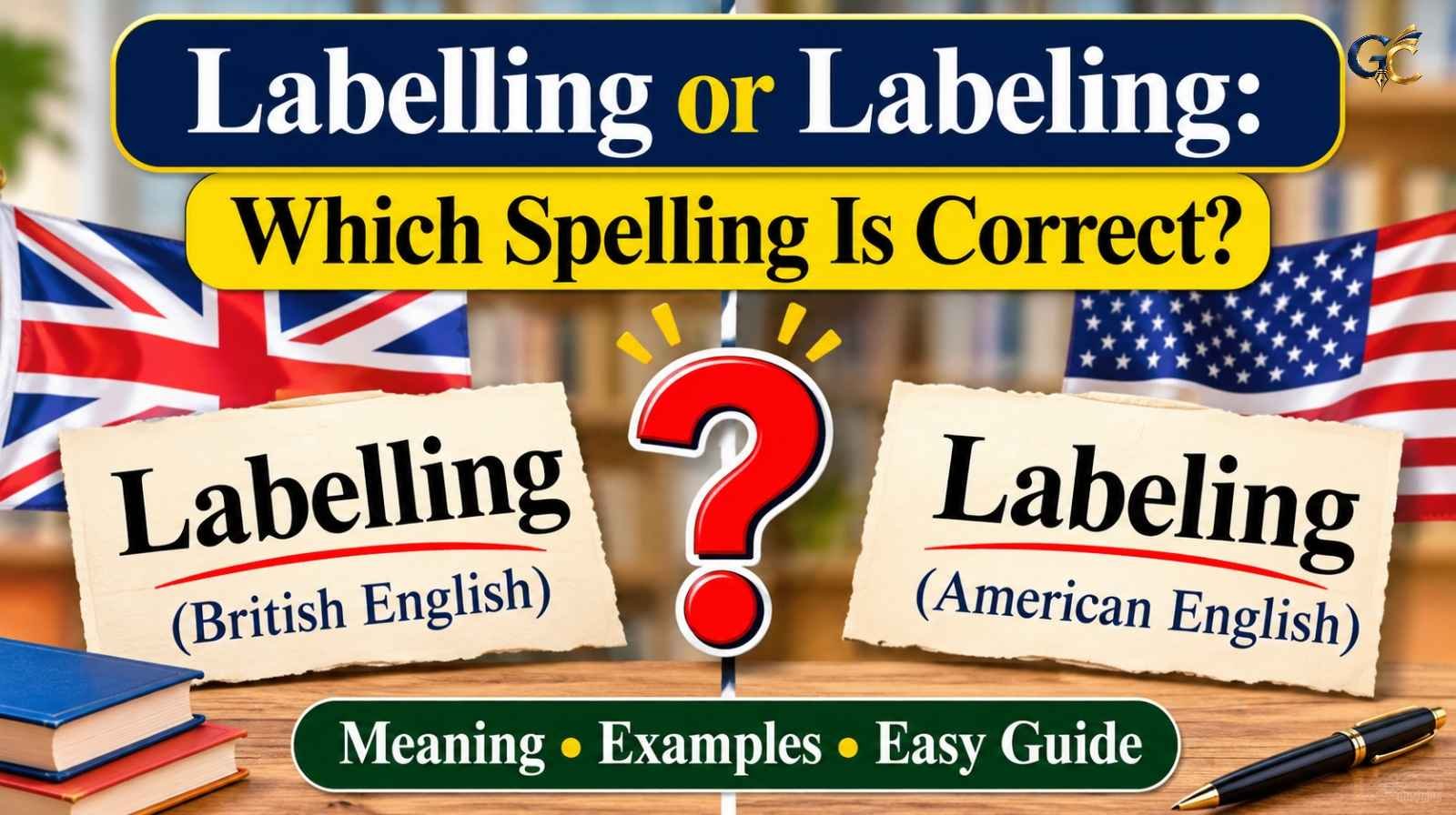
Have you ever stopped while writing an email, preparing a report, or creating product packaging because you were unsure whether to write labelling or labeling? You’re not alone. Both spellings appear in English writing, and although they look slightly different, they share the same meaning.
The confusion usually comes from the differences between British English and American English. Each variety follows its own spelling conventions, which can affect words such as colour color, travelling/traveling, and labelling labeling.
So, which spelling should you use? Is labelling incorrect, or is labeling the preferred version?
The answer is simple: both labelling and labeling are correct. However, your choice depends on your audience, location, and preferred English style.
In this guide, you’ll learn the difference between these spellings, understand when to use each one, and explore practical examples from emails, workplaces, schools, and everyday situations.
What Is the Difference Between Labelling and Labeling?
The main difference between labelling and labeling is their spelling convention, not their meaning.
- Labelling: The preferred spelling in British English.
- Labeling: The preferred spelling in American English.
Both words are forms of the verb label, which means to attach a label to something, identify an object, describe something, or classify a person or item.
For example:
- British English: Sarah is labelling the boxes before sending them.
- American English: Sarah is labeling the boxes before sending them.
Both sentences communicate exactly the same idea. The only difference is the additional letter L in the British spelling.
This spelling variation occurs because British and American English follow slightly different rules when adding certain endings to words.
Is Labelling or Labeling Correct?
Both spellings are grammatically correct, but they are used in different English varieties.
If you’re writing for a British, Australian, or New Zealand audience, labelling is generally the appropriate choice.
On the other hand, if your readers are primarily in the United States, labeling is the standard spelling.
Neither version is a spelling mistake. The important thing is to choose the spelling that matches your intended audience and remain consistent throughout your writing.
For example:
British English:
James is responsible for labelling all the products before they leave the warehouse.
American English:
James is responsible for labeling all the products before they leave the warehouse.
Both examples are correct and sound natural to their respective audiences.
Why Does British English Use Labelling?
British English generally doubles the final consonant L when adding certain suffixes to words ending in that letter.
This is why the spelling changes from label to labelling.
The same convention appears in several other British English words.
Examples include:
- Travel → Travelling
- Cancel → Cancelling
- Model → Modelling
- Signal → Signalling
- Label → Labelling
This spelling convention is particularly common in British English and other varieties that follow similar spelling traditions.
For example, imagine that Emily works for a British clothing company. Her manager asks her to prepare product descriptions and packaging information.
She might write:
“Please check that all the clothing items are correctly labelled before the delivery team collects them.”
In this situation, using labelled follows British English spelling conventions.
Why Does American English Use Labeling?
American English generally follows a different convention. When adding certain suffixes to words ending in L, American English usually does not double the final letter.
Therefore, label becomes labeling rather than labelling.
This pattern can also be seen in other common American English words.
Examples include:
- Travel → Traveling
- Cancel → Canceling
- Model → Modeling
- Signal → Signaling
- Label → Labeling
For instance, imagine that Michael works at an American supermarket. His supervisor asks him to organize products and update their identification information.
He might write:
“Please make sure every product is correctly labeled before placing it on the shelves.”
Here, labeled is the standard American English spelling.
Labelling vs Labeling: Examples in Different Situations
Understanding spelling rules is useful, but seeing how these words work in real situations makes the difference easier to remember.
Let’s explore some practical examples.
Labelling or Labeling in Professional Emails
Professional emails often include instructions about organizing documents, identifying products, or preparing packages.
The spelling you choose should match your company’s preferred English style.
British English email example:
EMAIL EXAMPLE
To: Olivia Martin
Subject: Product Labelling Requirements
Dear Olivia,
Please ensure that all new products are correctly labelled before they are added to the inventory system. We also need to check that the product names, prices, and safety information are clearly displayed. Thank you for your assistance.
Best regards,
Daniel
American English email example:
EMAIL EXAMPLE
To: Emma Wilson
Subject: Product Labeling Requirements
Hi Emma,
Please make sure all new products are correctly labeled before they are entered into the inventory system. We need to verify that the product names, prices, and safety information are clearly displayed. Thank you for your help.
Best,
Ryan
Both emails are professionally written. The difference is simply the spelling convention.
Labelling or Labeling in a Workplace
In workplaces, employees regularly identify files, packages, equipment, and products.
For example, a warehouse manager might ask employees to organize boxes before shipping them.
British English example:
“The warehouse supervisor asked the employees to finish labelling all the delivery boxes before lunchtime.”
American English example:
“The warehouse supervisor asked the employees to finish labeling all the shipping boxes before lunchtime.”
Both sentences are correct.
Labelling or Labeling in Schools
Teachers often use labels to organize classroom materials, identify students’ belongings, and arrange learning resources.
British English example:
“Mrs. Brown spent the afternoon labelling the bookshelves in her classroom.”
American English example:
“Mrs. Brown spent the afternoon labeling the bookshelves in her classroom.”
If you’re writing an educational article for a British audience, labelling is the better choice. For an American audience, use labeling.
Labelling or Labeling in Product Packaging
Product packaging is another common situation where this spelling difference appears.
Businesses need to identify ingredients, manufacturing information, instructions, and other important details.
British English example:
“The company is labelling its new food products with updated ingredient information.”
American English example:
“The company is labeling its new food products with updated ingredient information.”
The meaning remains unchanged in both examples.
Labelling or Labeling in Everyday Conversations
These words also appear in ordinary conversations.
For example, someone might discuss organizing household items or preparing containers for storage.
British English example:
“I’m labelling these kitchen containers so everyone knows what’s inside.”
American English example:
“I’m labeling these kitchen containers so everyone knows what’s inside.”
Both expressions sound natural.
Labelling, Labelled, and Labeller: Understanding Related Words
The spelling difference doesn’t only affect labelling and labeling. It also appears in other forms of the verb label.
Understanding these related words can help you maintain consistent spelling throughout your writing.
| British English | American English |
|---|---|
| Labelling | Labeling |
| Labelled | Labeled |
| Labeller | Labeler |
Let’s examine these forms individually.
Labelling vs. Labeling
Both are the present participle or gerund forms of label.
Examples:
- British: She is labelling the folders.
- American: She is labeling the folders.
Labelled vs. Labeled
Both are past-tense and past-participle forms of label.
Examples:
- British: The packages were labelled yesterday.
- American: The packages were labeled yesterday.
Labeller vs. Labeler
Both words refer to a person or device that applies labels, although labeler and labeller can vary in frequency depending on context.
Examples:
- British: The factory hired a new labeller.
- American: The factory hired a new labeler.
Remember that the spelling convention you select should remain consistent across related words.
Common Mistakes to Avoid When Using Labelling or Labeling
Although the difference between these spellings is straightforward, writers sometimes make mistakes when switching between British and American English.
Here are a few common issues to watch out for.
Mixing British and American Spellings
One common mistake is using British and American spellings in the same article without a clear reason.
For example:
“She is labelling the boxes, and the products will be organized tomorrow.”
This sentence mixes British labelling with American organized.
For consistency, you could write:
- British English: “She is labelling the boxes, and the products will be organised tomorrow.”
- American English: “She is labeling the boxes, and the products will be organized tomorrow.”
Assuming One Spelling Is Incorrect
Another mistake is believing that labelling is wrong because American dictionaries use labeling, or that labeling is incorrect because British writers prefer labelling.
Both spellings are accepted English forms. Their suitability depends on the variety of English you’re using.
Forgetting the Related Word Forms
Writers sometimes use labelling but then switch to labeled in the same piece of writing.
For example:
“She is labelling the containers that were previously labeled.”
If you’re following British English, write:
“She is labelling the containers that were previously labelled.”
If you’re following American English, write:
“She is labeling the containers that were previously labeled.”
Which Spelling Should You Use in Your Writing?
Choosing between labelling and labeling becomes easy when you consider your intended audience.
Here are some simple guidelines.
- Use labelling when writing in British English.
- Use labeling when writing in American English.
- Follow your organization’s preferred style guide when writing professionally.
- Maintain consistent spelling throughout articles, reports, emails, and other documents.
- Consider your readers’ expectations when publishing online content.
For example, if you’re preparing an article for a British educational website, labelling is the natural choice.
However, if you’re writing product instructions for customers in the United States, labeling is generally more appropriate.
If your website serves an international audience, choose one spelling convention as your default and apply it consistently.
Quick Comparison: Labelling vs Labeling
Here’s a quick comparison to help you remember the difference.
| Feature | Labelling | Labeling |
|---|---|---|
| English variety | British English | American English |
| Meaning | To attach or assign a label | To attach or assign a label |
| Present participle | Labelling | Labeling |
| Past tense | Labelled | Labeled |
| Common usage | UK, Australia, New Zealand | United States |
Easy memory tip: British English generally doubles the final L in these forms, while American English generally uses a single L.
Frequently Asked Questions
1. Is labelling or labeling correct?
Both labelling and labeling are correct spellings. Labelling is standard in British English, while labeling is standard in American English.
2. Is labelling British or American English?
Labelling is the standard British English spelling. It is also commonly used in countries such as Australia and New Zealand.
3. Is labeling American English?
Yes. Labeling is the standard American English spelling and is widely used in the United States.
4. Why does British English use double L in labelling?
British English generally doubles the final L when adding certain suffixes to words such as label. Therefore, the correct British spelling is labelling.
5. Is labelled or labeled correct?
Both are correct. Labelled is the British English spelling, while labeled is the American English spelling.
6. Should I use labelling or labeling in an email?
Use labelling if your email follows British English conventions. Use labeling if you’re communicating in American English. The most important thing is consistency.
7. Is labelling used in Australia?
Yes. Australian English generally follows British spelling conventions, so labelling is the preferred spelling.
8. Does labelling have a different meaning from labeling?
No. Both words have exactly the same meaning. They refer to attaching a label, identifying something, or assigning a descriptive category.
Conclusion
So, labelling or labeling: which spelling is correct? The answer is that both are correct, but they belong to different English spelling conventions.
Labelling is the preferred spelling in British English, while labeling is standard in American English. Neither spelling is wrong, and both communicate the same meaning.
When writing emails, preparing reports, creating product descriptions, or publishing online articles, consider your audience before choosing a spelling.
The simplest rule to remember is this: use labelling for British English and labeling for American English. Once you choose your preferred style, keep it consistent throughout your writing.
That small decision can make your writing clearer, more professional, and easier for your readers to understand.
👉 Discover more simple and practical grammar guides on Grammar Clear

Zia Ahmad is the founder of GrammarClear, an educational platform dedicated to making English grammar simple and easy to understand. Through clear explanations and practical examples, he aims to help learners improve their grammar, writing, and communication skills with confidence.

