
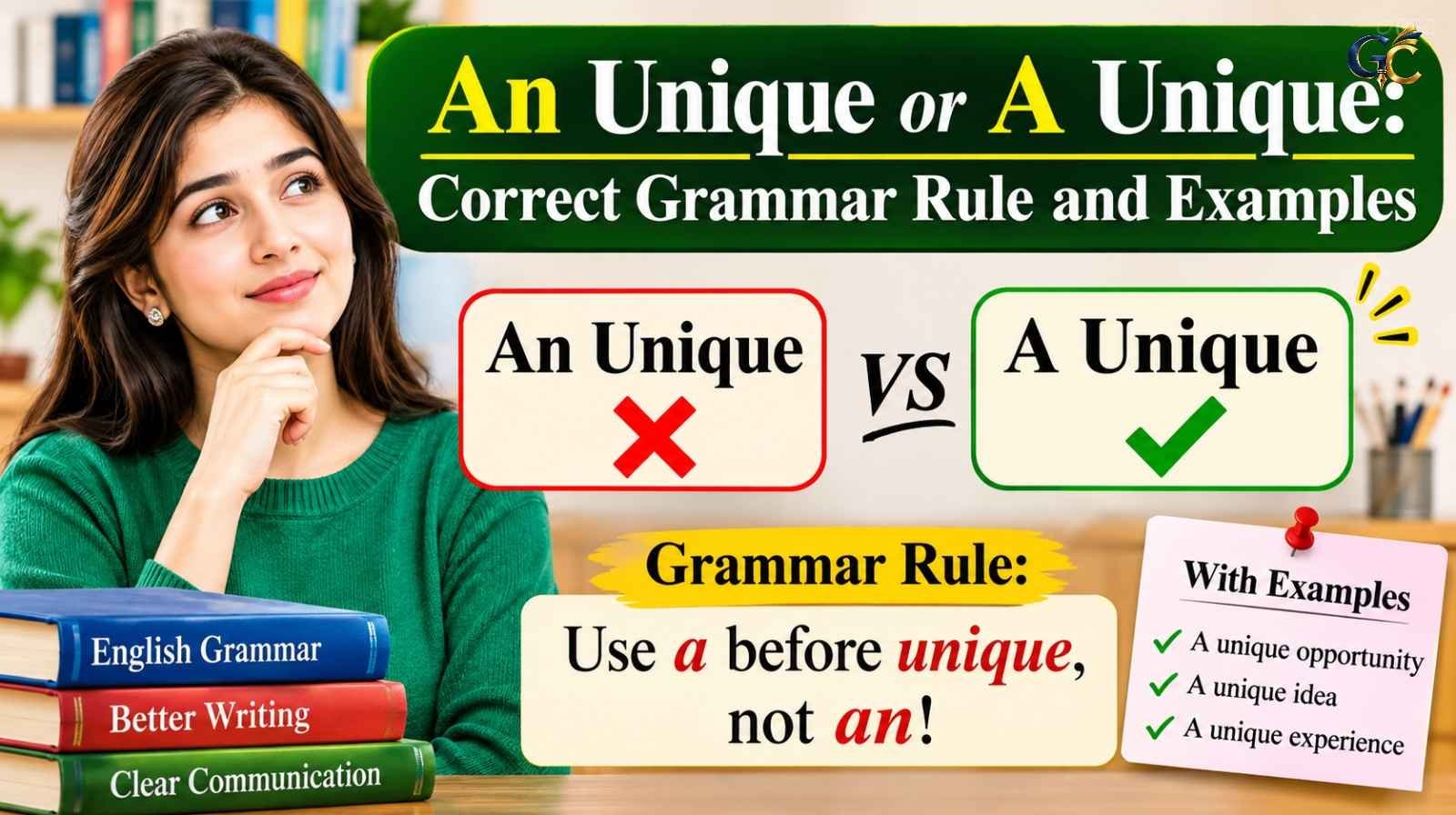
Have you ever wondered whether to write “an unique” or “a unique” in a sentence? It is a common English grammar question, especially among people learning English or trying to improve their writing. Although both expressions may look reasonable at first, only one is grammatically correct in standard English.
The correct phrase is “a unique,” not “an unique.” The reason is related to pronunciation rather than simply the first letter of a word. Even though unique begins with the vowel letter U, it starts with a consonant sound, which makes the article a the correct choice.
Understanding this small grammar rule can help you write more confidently in emails, professional documents, academic assignments, blog posts, and everyday conversations.
In this article, we will explain the difference between an unique and a unique, explore the grammar rule behind the correct choice, and provide simple examples and real-life scenarios to help you use the phrase naturally.
An Unique or A Unique: Which One Is Correct?
The correct expression is “a unique.” The phrase “an unique” is grammatically incorrect in standard English because the word unique begins with a consonant sound rather than a vowel sound.
English uses two indefinite articles: a and an. The choice between them depends on the initial sound of the following word, not necessarily its first written letter.
For example:
- A unique opportunity – Correct.
- An unique opportunity – Incorrect.
- A unique experience – Correct.
- An unique experience – Incorrect.
- A unique idea – Correct.
Although the letter U is a vowel, the word unique is pronounced with a “yoo” (/juː/) sound at the beginning. This sound functions as a consonant sound in English.
Therefore, you should always write “a unique” when using the word unique with an indefinite article.
Why Is “A Unique” Correct?
The main reason “a unique” is correct is that English articles are selected according to pronunciation.
The word unique begins with the sound /j/, which is similar to the initial sound in words such as yes, yellow, and young.
Because this is a consonant sound, the article a is required.
Consider these examples:
- A unique personality: She has a unique personality that makes her stand out.
- A unique design: The company introduced a unique design for its new product.
- A unique opportunity: This scholarship offers a unique opportunity for students.
- A unique solution: Our team developed a unique solution to the problem.
In each example, the article a appears before unique because of its initial pronunciation.
Remember that English grammar does not always follow spelling alone. Sometimes, you must listen to the sound of a word to select the correct article.
Why Is “An Unique” Incorrect?
The expression “an unique” is incorrect because the article an is generally used before words that begin with a vowel sound.
For example:
- An apple
- An elephant
- An umbrella
- An interesting story
- An honest person
Notice that the words following an begin with vowel sounds. The word unique, however, begins with a consonant sound.
Writing “an unique” ignores this pronunciation rule and creates a grammatical error.
For example:
Incorrect: Sarah received an unique gift from her parents.
Correct: Sarah received a unique gift from her parents.
Another example:
Incorrect: Our company provides an unique service to customers.
Correct: Our company provides a unique service to customers.
The corrected sentences sound natural and follow standard English grammar.
Understanding the Difference Between “A” and “An”
To understand why a unique is correct, it is helpful to learn when to use the indefinite articles a and an.
Both articles refer to a singular, nonspecific person, place, object, or idea. However, they are used in different pronunciation situations.
When to Use “A”
Use a before a word that begins with a consonant sound.
Examples include:
- A book
- A car
- A university
- A European country
- A unique opportunity
- A useful tool
- A beautiful painting
Notice that university, European, unique, and useful all begin with the letter U or E, but their initial sounds are consonant sounds.
For instance, university begins with a “yoo” sound, just like unique. Therefore, we say a university and a unique idea.
When to Use “An”
Use an before a word that begins with a vowel sound.
Examples include:
- An apple
- An orange
- An egg
- An umbrella
- An interesting book
- An hour
- An honest answer
Some words begin with consonant letters but have vowel sounds at the beginning. For example, the H in hour is silent, so the word begins with a vowel sound.
That is why an hour is correct rather than a hour.
The important thing to remember is that the choice depends on the sound, not the spelling.
Real-Life Examples of “A Unique” in Different Situations
The expression “a unique” is frequently used in everyday communication, business writing, academic work, and professional emails.
Here are some practical examples showing how to use it naturally in different situations.
Using “A Unique” in a Professional Email
Imagine that you are writing an email to your manager to suggest a new marketing strategy. You want to explain that your idea is different from the company’s previous approaches.
Example Email:
Subject: A Unique Marketing Strategy for Our New Campaign
Dear Mr. James,
I hope you are doing well. I would like to share a unique marketing strategy that could help our company attract more customers and improve brand awareness. I believe this approach offers a fresh perspective and could make our upcoming campaign more successful. I would appreciate the opportunity to discuss the idea with you and hear your feedback. Thank you for your time and consideration.
Best regards,
Daniel Smith
Why is it correct?
The phrase “a unique marketing strategy” is grammatically correct because unique begins with the consonant /j/ sound. Therefore, the article a is appropriate.
Using “A Unique” in a Business Presentation
Imagine that Emily is presenting a new product to potential investors. She wants to explain why the product is different from competing products.
Example:
“Our company has developed a unique product that combines modern technology with an easy-to-use design. We believe this product can offer customers something different from what is currently available in the market.”
Why is it correct?
The phrase “a unique product” is correct because the word unique begins with a consonant sound. The article a is therefore required.
Using “A Unique” in Academic Writing
Suppose a student named Olivia is writing an assignment about cultural traditions. She wants to describe a particular community’s customs.
Example:
“Every culture has a unique identity shaped by its history, traditions, language, and social values. Understanding these differences can help people develop greater respect for other communities.”
Why is it correct?
The expression “a unique identity” follows the correct indefinite article rule. The word unique begins with a “yoo” sound, so a is used.
Using “A Unique” in Everyday Conversation
Imagine that your friend asks you about your recent holiday experience.
Example Conversation:
Michael: How was your trip to the mountains?
David: It was amazing! I had a unique experience because I visited a beautiful village that was completely different from the places I had seen before.
Michael: That sounds wonderful. I would love to visit somewhere like that.
Why is it correct?
David correctly uses “a unique experience” because unique begins with a consonant sound.
Using “A Unique” in Blog Writing
Suppose a blogger is writing an article about creative home decoration ideas.
Example:
“Adding handmade decorations to your living room is a unique way to express your personality. You can combine different colours, textures, and materials to create a comfortable space that reflects your individual style.”
Why is it correct?
The phrase “a unique way” is correct because the first sound of unique is /j/, which is a consonant sound.
Common Words That Follow the Same Grammar Rule
The word unique is not the only English word that begins with a vowel letter but requires the article a.
Several other words follow the same pronunciation pattern.
| Word or Phrase | Correct Article | Example |
|---|---|---|
| Unique | A | A unique opportunity |
| University | A | A university student |
| Uniform | A | A school uniform |
| Useful | A | A useful suggestion |
| European | A | A European country |
| Unicorn | A | A unicorn story |
| Universal | A | A universal rule |
| User | A | A new user |
| Unusual | An | An unusual situation |
| Understanding | An | An understanding person |
The final two examples demonstrate why you must pay attention to pronunciation. Unusual begins with a vowel sound /ʌ/, and understanding begins with a vowel sound /ʌ/. Therefore, an is correct in these cases.
This comparison makes the rule easier to understand: the first letter alone does not determine whether you should use a or an.
Common Mistakes to Avoid When Using “A Unique”
Even people who speak English regularly sometimes make mistakes when choosing between a and an. Here are some common errors and their corrections.
Mistake 1: Using “An” Before Unique
Incorrect: I had an unique opportunity to work abroad.
Correct: I had a unique opportunity to work abroad.
The word unique begins with a consonant sound, so a is the correct article.
Mistake 2: Choosing Articles According to Spelling
Incorrect: She bought an university textbook.
Correct: She bought a university textbook.
Although university begins with the vowel letter U, it starts with a consonant “yoo” sound.
Mistake 3: Assuming Every Word Beginning With a Vowel Takes “An”
Incorrect: He designed an useful application.
Correct: He designed a useful application.
The word useful begins with the consonant sound /j/, so a is required.
Mistake 4: Ignoring Pronunciation in Professional Writing
Incorrect: We are offering an unique opportunity to our employees.
Correct: We are offering a unique opportunity to our employees.
Choosing the correct article helps make professional writing more accurate and polished.
Simple Tricks to Remember “A Unique” or “An Unique”
If you frequently confuse these expressions, a few simple tricks can help you remember the correct rule.
Listen to the first sound.
Do not focus only on the first letter. Pronounce the word unique aloud. You will notice that it begins with a “yoo” sound, which is a consonant sound.
Remember the word “Yes.”
The beginning of unique sounds similar to the beginning of yes. Since we say a yes in the appropriate grammatical context, we also say a unique opportunity.
Compare similar words.
Remember these examples:
- A unique idea
- A university
- A useful suggestion
- A European country
All these words begin with consonant sounds, even though their spelling may suggest otherwise.
Practise using complete sentences.
Instead of memorising the article rule alone, practise writing sentences such as:
- This is a unique experience.
- She has a unique talent.
- We discovered a unique solution.
- It was a unique opportunity.
Regular practice will make the correct choice feel natural.
Practice Exercise: Choose A Unique or An Unique
The best way to understand the difference between a unique and an unique is to practise using them in context. Complete the following sentences by choosing the correct article.
Exercise 1: Fill in the Blanks
- Sarah received _____ unique gift on her birthday.
- This company offers _____ unique service to its customers.
- We discovered _____ unique opportunity during our research.
- He shared _____ unique idea with his classmates.
- It was _____ unique experience for everyone involved.
- My teacher suggested _____ unique approach to learning English.
Show Answers and Explanations
- A unique — Unique begins with a consonant “yoo” sound, so use “a.”
- A unique — The word unique starts with a consonant sound, making “a” correct.
- A unique — Use “a” because unique begins with the consonant sound /j/.
- A unique — Although unique starts with the vowel letter U, its first sound is a consonant sound.
- A unique — The correct expression is “a unique experience” because unique begins with a consonant sound.
- A unique — Use “a” before unique because it begins with a “yoo” sound.
Explanation: All six sentences require a unique because the word unique begins with the consonant sound /j/. Using an in these sentences would be grammatically incorrect.
Frequently Asked Questions
1. Is An Unique or A Unique Correct?
A unique is correct in standard English. The word unique begins with a consonant “yoo” sound, so it takes the indefinite article a, not an.
2. Why Do We Say A Unique Instead of An Unique?
We say a unique because English articles depend on pronunciation rather than spelling. Although unique starts with the vowel letter U, its first sound is /j/, which is a consonant sound.
3. Is Unique a Vowel or Consonant Sound?
Unique begins with a consonant sound /j/, commonly described as a “yoo” sound. That is why we use a unique instead of an unique.
4. Can I Use An Before Words Starting With U?
Yes. You can use an before words beginning with U when the initial sound is a vowel sound. For example, an umbrella, an unusual situation, and an understanding person are correct.
5. Is A Unique Opportunity Grammatically Correct?
Yes. A unique opportunity is grammatically correct because unique begins with a consonant sound. It is a common expression in everyday, academic, and professional English.
6. Is A Unique Experience Correct?
Yes. A unique experience is the correct expression. For example, “Travelling to Japan was a unique experience for me.”
7. Does the Rule Depend on Spelling or Pronunciation?
The rule depends on pronunciation, not spelling. Use a before consonant sounds and an before vowel sounds, regardless of the first written letter.
8. Is “An Unique” Ever Correct in Standard English?
No. In standard modern English, an unique is considered grammatically incorrect. The correct expression is a unique.
Final Thoughts
Choosing between “an unique” and “a unique” becomes simple once you understand how English indefinite articles work. The correct expression is always “a unique” in standard English because the word unique begins with a consonant “yoo” sound, despite starting with the vowel letter U.
Remember that the articles a and an depend on the first sound of the following word rather than its spelling. This small rule also applies to words such as university, useful, European, and unicorn.
Whether you are writing a professional email, preparing an academic assignment, creating blog content, or having an everyday conversation, using a unique will help you communicate more clearly and confidently.
👉 Discover more simple and practical grammar guides on Grammar Clear

Zia Ahmad is the founder of GrammarClear, an educational platform dedicated to making English grammar simple and easy to understand. Through clear explanations and practical examples, he aims to help learners improve their grammar, writing, and communication skills with confidence.

