
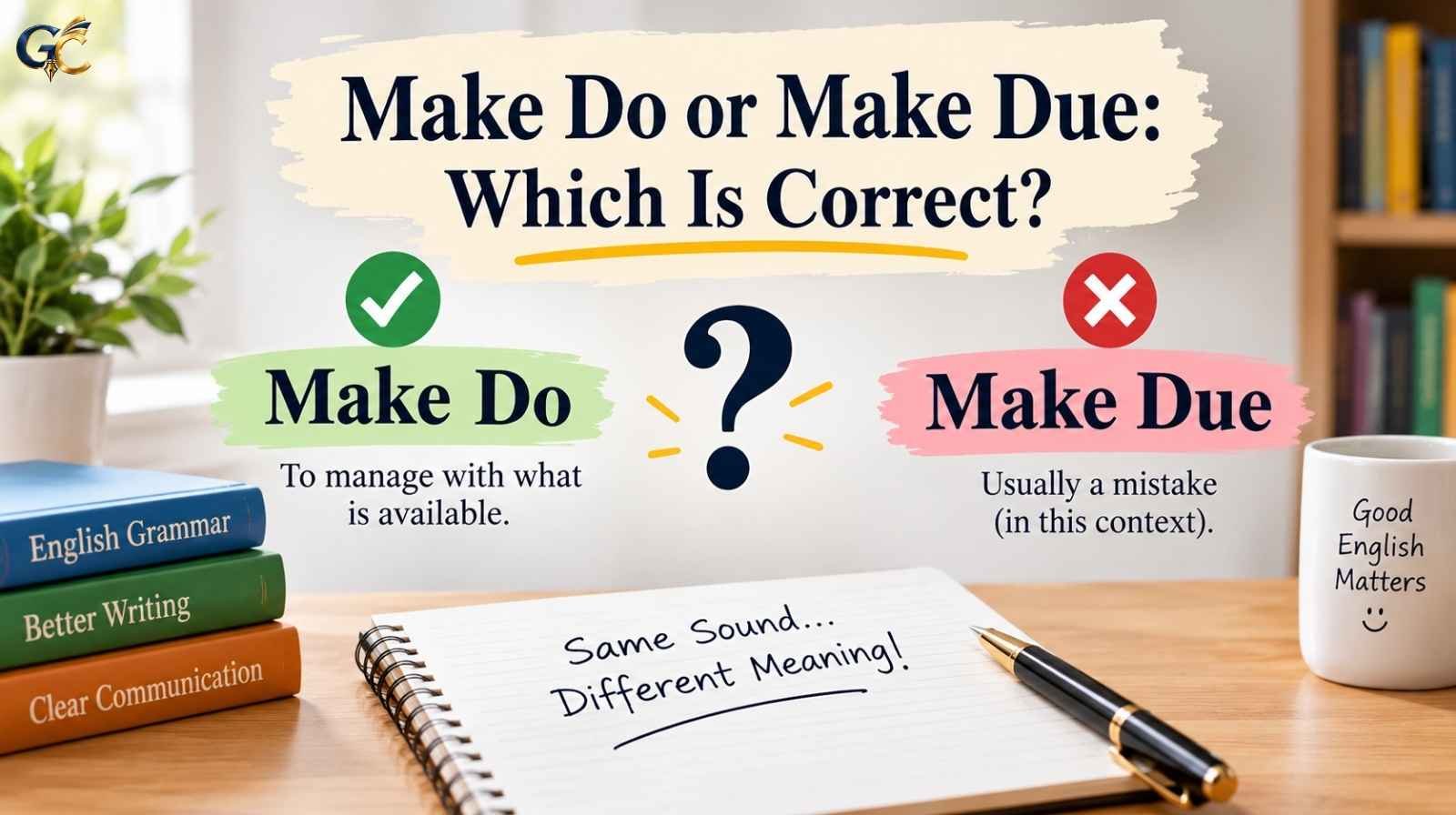
Have you ever wondered whether to write “make do” or “make due”? These phrases sound similar, so it is easy to confuse them when writing an email, article, or everyday message. However, only one is the standard expression for managing with what you have.
Make do is the correct phrase when you mean to manage with available resources, even when they are not ideal. Make due is generally incorrect when used with this meaning. The word due is correct in other contexts, such as when a payment or assignment is expected.
In this guide, you will learn the difference between make do and make due, understand their meanings, explore real-life examples, and discover a simple way to remember the correct spelling.
What Is the Difference Between Make Do and Make Due?
The main difference between make do and make due is their meaning and usage. Make do is an established English expression meaning to manage with what is available. Make due is not the standard spelling of this expression.
Make Do: Meaning and Usage
The phrase make do means to manage, cope, or get by with the resources you have, especially when something better is unavailable.
For example:
- We don’t have enough chairs, so we’ll make do with stools.
- I forgot my headphones, so I’ll make do with the laptop speakers.
- The company had a limited budget, so the team had to make do with existing equipment.
In each example, someone uses an available option instead of the one they would prefer.
The expression often appears with the word with or without.
- Make do with something: Use an available alternative.
- Make do without something: Manage despite not having it.
For example, “We can make do without a printer for one day” means the team can manage even though the printer is unavailable.
Make Due: Meaning and Usage
Make due is generally a spelling mistake when someone intends to express the meaning of make do.
The confusion often happens because do and due sound alike in many varieties of English. However, their meanings are different.
The word due commonly describes something that is owed, expected, scheduled, or required.
Examples:
- The electricity bill is due tomorrow.
- My assignment is due on Friday.
- The train is due to arrive at noon.
These sentences use due correctly. However, none of them uses the idiom make do.
Quick rule: If you mean “manage with what you have,” write make do. If you mean something is owed or expected, use due in the appropriate sentence.
Why Is Make Do Correct?
Make do is correct because the word do can mean that something is sufficient or good enough for a particular purpose.
Understanding this meaning makes the expression easier to remember.
The Meaning of Do in Make Do
Consider this sentence:
“This old laptop will do.”
Here, do means the laptop is good enough for the situation.
Now consider:
“We’ll make do with the old laptop.”
The meaning is similar. The laptop may not be ideal, but it is sufficient for the task.
This explains why the expression uses do rather than due.
For example:
- We don’t have a proper desk, so we’ll make do with the kitchen table.
- The restaurant ran out of our favorite dessert, so we made do with another option.
- The school had limited supplies, but the teachers made do with what they had.
Why People Write Make Due
The confusion usually comes from pronunciation and familiarity with the word due.
People regularly encounter expressions such as:
- Payment due
- Due date
- Due tomorrow
- Past due
Because due is a familiar word, writers may mistakenly use it in make due.
However, a word that sounds appropriate is not necessarily the correct word for an established expression.
For polished writing, remember that make do is the standard phrase for managing with limited resources.
Is Make Do Formal or Informal?
Make do is a natural expression used in everyday conversation and general writing. It can also appear in professional communication when the meaning is clear.
For example:
“The department will make do with its current equipment until the replacement arrives.”
If you want a more formal alternative, you can write:
“The department will operate with its existing equipment until the replacement arrives.”
Both sentences communicate the same general idea, but the second is more formal.
Make Do or Make Due: Examples in Real Life
Understanding the phrase becomes easier when you see how people use it in everyday situations.
At Home
Imagine your family is preparing dinner, but you discover that you do not have the correct cooking pan.
You might say:
“We don’t have the right pan, so we’ll make do with this one.”
The available pan is not perfect, but it can still serve the purpose.
Other examples:
- We ran out of clean plates, so we made do with bowls.
- The washing machine is broken, so we’ll make do until it is repaired.
- We don’t have a spare blanket, so we’ll make do with extra pillows.
At Work
The expression is also useful when discussing limited resources at work.
Examples:
- The office printer stopped working, so we made do with the backup printer.
- Our team has fewer employees this week, so we’ll make do with the available staff.
- The meeting room was unavailable, so we made do with a smaller room.
These examples show how make do can describe temporary solutions.
While Traveling
Travelers often need to manage without their preferred belongings.
Examples:
- I forgot my travel pillow, so I made do with my jacket.
- The hotel had no coffee machine, so we made do with instant coffee.
- Our luggage arrived late, so we made do with the clothes we had packed in our carry-on bags.
The phrase is useful whenever you need to adapt to an unexpected situation.
A Real-Life Example: Making Do During a Busy Workweek
Imagine that a small marketing team is preparing an important presentation for a client. The presentation is scheduled for Friday, but on Wednesday, the team’s main laptop stops working.
The team does not have enough time to purchase a replacement immediately. One employee has an older laptop that can still open the presentation files, although it runs more slowly than the usual computer.
Instead of postponing the entire project, the team decides to use the older laptop temporarily. They transfer the necessary files, check the presentation slides, and continue preparing for the meeting.
During a discussion, the team leader says, “We’ll make do with the older laptop until the new one arrives.”
This is a correct use of make do because the team is managing with an available resource that is not ideal.
Now imagine that one employee writes in the project update, “We will make due with the older laptop.”
The intended meaning is understandable, but the spelling is incorrect for this expression. The sentence should use make do.
This example also shows why the distinction matters in professional communication. A small spelling mistake can make otherwise clear writing look less polished. Choosing the correct phrase helps readers understand the message without distraction.
The lesson is simple: when you are using an alternative because your preferred option is unavailable, make do is the correct expression.
Make Do vs. Make Due: Comparison Table
The following table summarizes the difference between the two expressions.
Feature
Make Do
Make Due
Standard expression for managing with less
Yes
No
Meaning
Manage with what is available
Not the standard expression for this meaning
Common usage
Make do with, make do without
Commonly a spelling mistake
Example
We’ll make do with these chairs.
We’ll make due with these chairs.
Correct past tense
Made do
Made due is incorrect for this meaning
How to Choose the Correct Phrase
Use this simple checklist before writing:
- Are you talking about managing with limited resources? Use make do.
- Are you talking about using an alternative? Use make do.
- Are you talking about managing without something? Use make do without.
- Are you talking about a payment or deadline? Use due in the appropriate sentence.
For example:
Correct: “We had no internet, so we made do with mobile data.”
Correct: “The payment is due tomorrow.”
Incorrect for the intended meaning: “We had no internet, so we made due with mobile data.”
Make Do or Make Due: Grammar, Tense, and Common Mistakes
The phrase make do changes tense through the verb make. The word do remains unchanged in the expression.
Present, Past, and Continuous Forms
Tense
Correct Form
Example
Present
Make do
We make do with what we have.
Third-person present
Makes do
She makes do with a small desk.
Past
Made do
They made do without electricity.
Continuous
Making do
We are making do until Friday.
Future
Will make do
We will make do with the old equipment.
Notice that the correct past tense is made do, not made due.
Common Mistakes to Avoid
Here are several mistakes that writers should avoid.
Mistake 1: Using make due instead of make do
Incorrect: We had no chairs, so we made due with boxes.
Correct: We had no chairs, so we made do with boxes.
Mistake 2: Using made due in the past tense
Incorrect: She made due with her old phone.
Correct: She made do with her old phone.
Mistake 3: Confusing due dates with the idiom
Incorrect: I will make do my assignment tomorrow.
Correct: My assignment is due tomorrow.
Correct: I will make do with the notes I have.
These examples demonstrate that the correct choice depends on the meaning of the sentence.
A Simple Memory Trick
Remember this sentence:
“This will do.”
If something will do, it is good enough for the situation.
Therefore:
- Make do = Make something work.
- Due = Owed, expected, or scheduled.
This simple connection can help you remember the correct spelling whenever you are unsure.
Make Do or Make Due: 2025–2026 Usage and Data
Writers often want to know whether one spelling is becoming more common than the other. However, reliable usage statistics require a clearly defined source, time period, and method of counting.
What Does Current Usage Tell Us?
The standard expression remains make do when referring to managing with available resources. Grammar references continue to distinguish it from due, which is used for obligations, expectations, and schedules.
For example, Grammarist explains that make do is the established idiom and that make due is commonly substituted for it in error.
GRAMMARIST
A 2025–2026 comparison of search interest or spelling frequency would require a specific dataset, such as Google Trends or a dated text corpus. No verified numerical dataset is available here to establish an exact percentage or year-over-year change.
Therefore, it would be misleading to claim that a particular percentage of writers use make due or that the spelling has increased by a specific amount.
For practical writing, the important point is that make do remains the standard expression for managing with what is available.
How to Check Usage Trends Yourself
If you want to investigate spelling trends, you can compare the two phrases using:
- Google Trends compare search interest over a selected period and region.
- Google Books Ngram Viewer explore how phrases appear in books over time.
These tools measure different things. Search interest does not directly measure correct spelling, and book frequency does not represent every kind of everyday writing.
FAQs
Q1: Is it make do or make due?
A: Make do is the correct phrase when you mean to manage with what you have. Make due is generally incorrect when used with this meaning.
Example: “We don’t have enough supplies, so we’ll make do.”
Q2: What does make do mean?
A: Make do means to manage with available resources, especially when the ideal option is unavailable.
Example: “We had no chairs, so we made do with stools.”
Q3: Is make due ever correct?
A: Make due is not the standard expression for managing with limited resources. However, the words make and due can appear together in other grammatical constructions.
For example: “Make the payments due this month.”
Here, due describes the payments. It is not the idiom make do.
Q4: Is it made do or made due?
A: Made do is correct when you mean that someone managed with what was available.
Correct: “They made do with an old computer.”
Incorrect for this meaning: “They made due with an old computer.”
Q5: What does make do with mean?
A: Make do with means to use something that is available, even if it is not your preferred choice.
Example: “We’ll make do with the smaller room.”
Q6: What does make do without mean?
A: Make do without means to manage despite not having something.
Example: “We can make do without a television for a few days.”
Q7: Why do people confuse make do and make due?
A: People often confuse the phrases because do and due sound similar in many accents. Since due is a familiar English word, writers sometimes choose it by mistake.
However, the correct spelling depends on the meaning.
Q8: Is make do acceptable in professional writing?
A: Yes. Make do is acceptable in general professional writing when it communicates the intended meaning clearly.
For a more formal tone, you can use alternatives such as manage with, work with available resources, or use what is available.
Conclusion:
When choosing between make do or make due, remember that make do is the correct expression for managing with what is available. It describes situations where you need to use an alternative, cope with limited resources, or continue without something better.
Make due is generally a spelling mistake when used to express this meaning. The word due is correct in other contexts, especially when talking about payments, deadlines, and expected events.
The easiest way to remember the difference is to connect do with the expression “This will do,” meaning something is good enough for the situation.
Whether you are writing an email, preparing an assignment, or publishing an article, choosing the correct phrase helps make your writing clearer and more professional.
👉 Explore more useful grammar tips and guides on Grammar Clear

Zia Ahmad is the founder of GrammarClear, an educational platform dedicated to making English grammar simple and easy to understand. Through clear explanations and practical examples, he aims to help learners improve their grammar, writing, and communication skills with confidence.

