
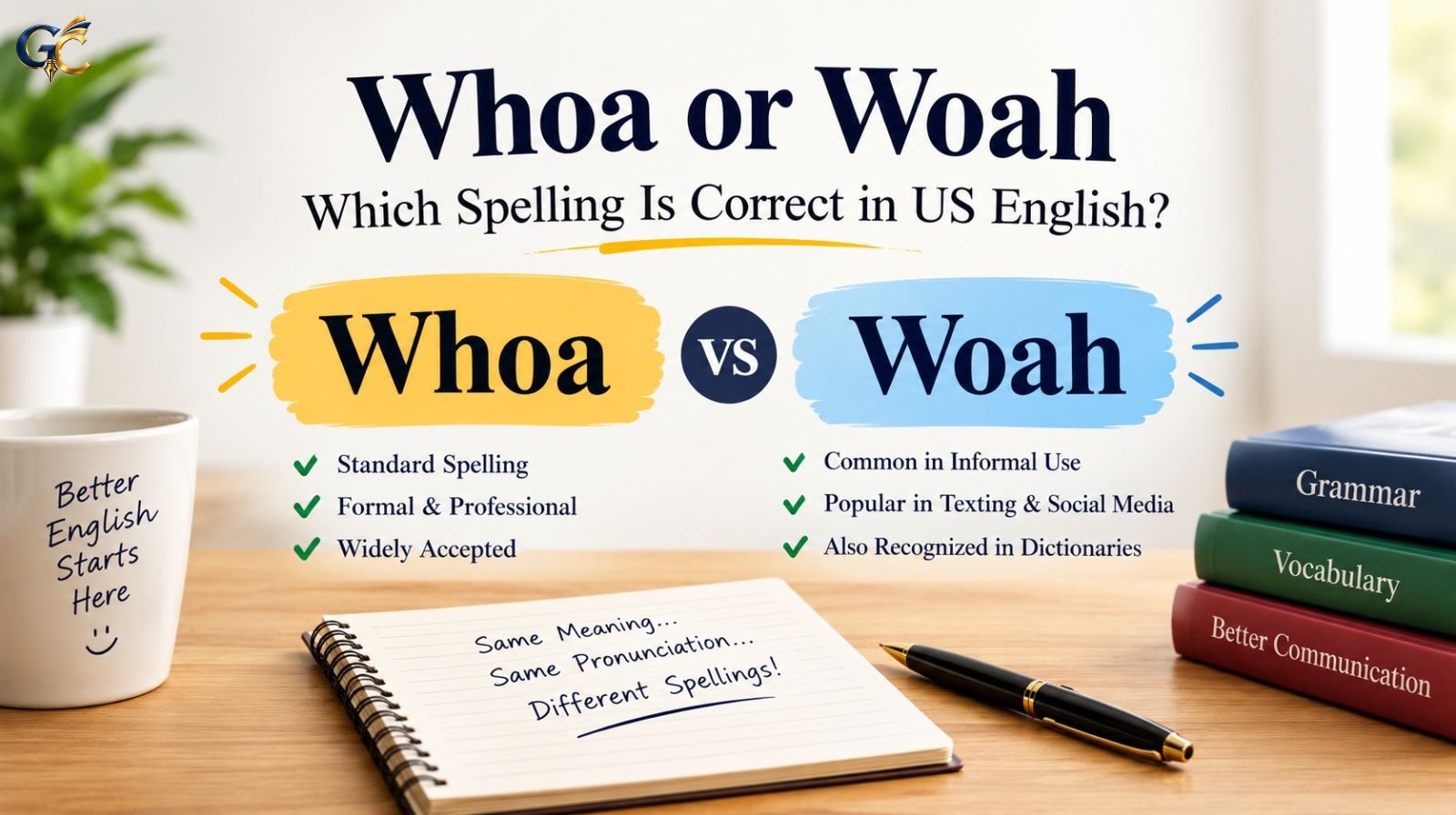
Have you ever typed “Whoa!” and wondered whether “Woah!” is actually the correct spelling? You are not alone. Both versions appear frequently in conversations, text messages, social media posts, and online content.
So, whoa or woah which spelling is correct in US English?
The safest answer is whoa. It is the traditional and standard spelling used for an interjection expressing surprise, excitement, or a command to stop or slow down. Woah is also widely used as an informal variant, and Cambridge currently lists it alongside whoa as an alternative spelling.
If you need one spelling for school, professional writing, edited content, or general American English, choose whoa.
Let’s look at the difference, examples, pronunciation, history, and when each spelling works.
Whoa or Woah: What Is the Correct Spelling?
Whoa is the best default spelling in US English.
Woah is a common alternative spelling that appears especially often in informal digital communication.
The two forms generally have the same meaning and pronunciation. The main difference is usage and spelling preference, rather than meaning.
| Feature | Whoa | Woah |
|---|---|---|
| Standard spelling | Yes | Alternative/variant |
| Meaning | Surprise, amazement, stop, slow down | Same |
| US English | Preferred | Informal variant |
| Formal or edited writing | Recommended | Usually avoid |
| Texting | Common | Common |
| Social media | Common | Common |
| Pronunciation | Usually /woʊ/ | Usually the same |
| Best choice when unsure | Yes | No |
Cambridge’s current dictionary entry lists whoa as an interjection and also gives woah, whoah, and woa as alternative forms. Its American English entry gives whoa as an expression used to tell someone or a horse to stop or slow down, or to express surprise.
Why “whoa” is the safer choice
When you’re writing for a broad American audience, whoa is the spelling most likely to look familiar and conventional.
For example:
- Whoa! That’s an amazing view.
- Whoa, slow down!
- Whoa! I didn’t expect that.
- Whoa, that’s a lot of work.
If you are unsure which spelling to use, simply remember: choose whoa.
What Does “Whoa” Mean?
Historically, whoa was associated with telling a horse to stop or slow down. That meaning still exists today.
For example:
“Whoa! Easy, boy.”
You can also use it figuratively when asking a person to slow down:
“Whoa, let’s not make a decision yet.”
Cambridge defines whoa as an expression used to tell a horse to stop and, informally, to tell a person to stop or slow down.
Whoa as an expression of surprise
Today, people commonly use whoa to show surprise, amazement, shock, or strong interest.
Examples:
- Whoa! That car is beautiful.
- Whoa, I didn’t know you could do that.
- Whoa! What just happened?
- Whoa, that’s much more expensive than I expected.
In this sense, whoa works similarly to expressions such as wow, although the two words are not completely interchangeable.
Whoa as a conversational reaction
Sometimes whoa signals that you need a moment to process something.
For example:
“Whoa, wait a minute. Are you saying we have to start over?”
Here, whoa doesn’t literally mean “stop.” Instead, it tells the listener that the speaker is surprised or wants to pause the conversation.
Is “Woah” a Correct Spelling?
This is where the answer becomes more interesting.
It would be too simplistic to say that woah never exists. Modern dictionaries recognize the form in some way. Cambridge lists woah as an alternative spelling of whoa, while Collins describes woah as a variant spelling of whoa.
Therefore, seeing woah does not necessarily mean that the writer doesn’t know English.
For example:
Woah! That was unexpected.
Most readers will understand exactly what the writer means.
Why “woah” feels natural
The spelling woah probably feels natural because it visually resembles the way many people hear the word.
When someone says the word quickly, it sounds approximately like /woʊ/ in American English. Cambridge gives the US pronunciation of whoa as /woʊ/.
As a result, some writers naturally arrange the letters as:
w + o + a + h → woah
instead of:
w + h + o + a → whoa
The pronunciation does not really help you decide between the spellings.
Whoa vs. Woah in US English: When Should You Use Each?
If you’re writing an article, school assignment, business communication, report, or other edited content, whoa is the safest option.
For example:
Recommended:
Whoa, that’s a significant difference.
If the sentence is part of formal academic writing, however, you may want to remove the interjection altogether:
The difference is significant.
This distinction is important. Whoa is correctly spelled, but it is still an informal interjection. Correct spelling does not automatically make a word appropriate for every writing situation.
“Woah” works in casual communication
Because woah is widely recognized as an informal variant, you may encounter it in:
- Text messages
- Social media
- Online comments
- Memes
- Gaming chats
- Informal dialogue
- Casual conversations written down
For example:
Woah, that was close!
The spelling contributes to a relaxed, conversational style.
Use the spelling that matches your purpose
A useful rule is:
When you want the conventional spelling, use “whoa.” When reproducing casual internet or conversational language, “woah” may appear naturally.
This is especially useful for writers who create dialogue. If a character’s voice is intentionally casual, woah can reflect that style.
Whoa or Woah: What Does Recent Usage Data Show?
There is an important limitation when discussing usage statistics for these spellings: book-corpus data does not measure texting, social media, or everyday speech.
Google’s Ngram Viewer currently provides English book data through 2022, rather than through 2025 or 2026. Its current system was updated with a new dataset in July 2024, and Google explains that Ngram charts track how words and phrases occur in its book corpus.
The current Ngram comparison for whoa and woah therefore gives us a useful historical usage window, but it should not be presented as a 2026 internet-usage statistic.
What changed in 2025–2026?
A useful 2025–2026 reference point is Microsoft’s updated guidance, which was revised on May 15, 2025. Microsoft notes that whoa and woah have the same pronunciation and meaning, while explaining that woah is a newer spelling that has become increasingly visible in informal communication.
So the available evidence supports three practical conclusions:
- Whoa is the established spelling.
- Woah is widely recognizable as an alternative spelling.
- Digital communication has helped informal variants become more visible.
That is why you may see both forms online even though whoa remains the safest choice for standard US English.
A Real-Life Example: Choosing “Whoa” for Clear American English
Imagine that Maya is writing a professional article about an unexpectedly large increase in online sales. While reviewing her draft, she writes:
“Woah! The company increased its sales by 40% in one year.”
Her editor understands the sentence immediately. There is no real problem with comprehension. However, the editor asks Maya to consider her audience and writing style.
Maya changes the sentence to:
“Whoa! The company increased its sales by 40% in one year.”
The spelling now uses the conventional form whoa. However, because the article is professional, Maya eventually decides that the emotional reaction is unnecessary and revises the sentence again:
“The company increased its sales by 40% in one year.”
This example shows an important point: there are actually two separate decisions involved.
First, if Maya wants the interjection, whoa is the safer spelling for edited American English. Second, she needs to decide whether an interjection belongs in the article at all.
Now imagine a different situation. Maya is writing dialogue for a character who sends a text message after seeing an unbelievable photograph:
“Woah! You actually did it!”
Here, the informal spelling can work because the goal is to reproduce a casual digital voice.
Therefore, neither spelling should be judged without considering context. Whoa is the better default, while woah can deliberately signal informality.
Whoa vs. Woah: Examples You Can Copy
Here are some natural examples:
- Whoa! That was a close call.
- Whoa, this place is huge.
- Whoa! I wasn’t expecting that.
- Whoa, slow down for a second.
- Whoa! Look at that view.
- Whoa, that’s a lot of money.
- Whoa! You finished already?
Examples with “woah”
In casual writing, you may also encounter:
- Woah! That was amazing.
- Woah, I didn’t see that coming.
- Woah! Check this out.
- Woah, that’s crazy.
- Woah, hold on a second.
The meaning remains essentially the same.
Which examples are better for standard US English?
If you’re creating polished content, use whoa:
Whoa! That’s incredible.
If you’re deliberately writing casual dialogue or reproducing someone’s informal online style, woah may be appropriate:
Woah! That’s incredible!
The difference is primarily about standardness and style, not meaning.
How to Remember the Correct Spelling
One easy way to remember whoa is to connect it with its traditional use as a command to a horse.
Think:
Horse → Whoa!
So when you’re unsure, remember the phrase:
“Whoa, horse!”
That can help you remember that the conventional spelling begins with wh:
W-H-O-A
not:
W-O-A-H
Remember the safest default
You don’t have to memorize every dictionary’s treatment of woah.
Just remember this practical rule:
If you’re unsure, use “whoa.”
That choice works well for standard American English and edited writing.
Whoa or Woah: Common Mistakes to Avoid
Mistake 1: Assuming both spellings have different meanings
They generally do not.
Whoa and woah are normally used for the same kinds of reactions.
Mistake 2: Calling “woah” completely meaningless
That is also too strong.
Modern dictionary sources recognize woah as an alternative or variant form. Cambridge explicitly lists it alongside whoa.
Mistake 3: Assuming “woah” is the American spelling
It isn’t best understood as a US-versus-UK spelling difference.
The distinction is mainly about standard versus informal usage.
Mistake 4: Using “whoa” simply because it is correct, even in formal writing
Remember that whoa is an interjection. Even when correctly spelled, it can make a sentence sound conversational.
For formal writing, consider whether the interjection adds useful meaning.
FAQs
Q1: Is “whoa” or “woah” correct?
A: Whoa is the safest and most conventional spelling, especially in standard US English and edited writing. Woah is a widely used alternative spelling.
Q2: Is “woah” a real word?
A: Yes. Some modern dictionaries recognize woah as a variant spelling of whoa. Cambridge lists woah among the alternative forms of whoa.
Q3: Is “whoa” the American spelling?
A: Yes. Whoa is the conventional spelling used in American English. Cambridge’s American Dictionary lists whoa and gives its US pronunciation as /hwoʊ, woʊ/.
Q4: Do “whoa” and “woah” mean the same thing?
A: Generally, yes. Both are used to express surprise, amazement, or to tell someone or something to stop or slow down.
Q5: How do you pronounce “whoa”?
A: In US English, whoa is commonly pronounced /woʊ/, with a sound similar to the vowel sound in go. Cambridge lists /woʊ/ as the US pronunciation.
Q6: Can I use “woah” in a text message?
A: Yes. Woah is common in informal digital communication. However, if you want the safest conventional spelling, use whoa.
Q7: Should I use “whoa” in an essay?
A: If you need the interjection, whoa is the better spelling. However, because it is conversational, consider whether the interjection fits the tone of the essay.
Q8: Is “woah” wrong?
A: It depends on what you mean by “wrong.” Woah is widely used and recognized as a variant in modern dictionary sources, but whoa remains the safer standard form, particularly for edited or professional writing.
Final Verdict:
So, whoa or woah which spelling should you use in US English?
The best answer is whoa.
Whoa is the established and safest spelling for standard American English. It can express surprise, amazement, or a command to stop or slow down. Woah is a common informal variant that readers easily understand and that modern dictionaries may recognize, but it is not the best default when you’re aiming for conventional, polished writing.
The easiest rule is:
When in doubt, choose “whoa.”
Use whoa for school assignments, professional writing, edited articles, and other situations where conventional spelling matters. Use woah only when the informal style is intentional, such as in casual dialogue, texting, or social media.
So the next time you stop to ask yourself “Whoa or woah?”, you already have your answer: Whoa is the safer choice.
👉 Explore more useful grammar tips and guides on Grammar Clear

Zia Ahmad is the founder of GrammarClear, an educational platform dedicated to making English grammar simple and easy to understand. Through clear explanations and practical examples, he aims to help learners improve their grammar, writing, and communication skills with confidence.

