
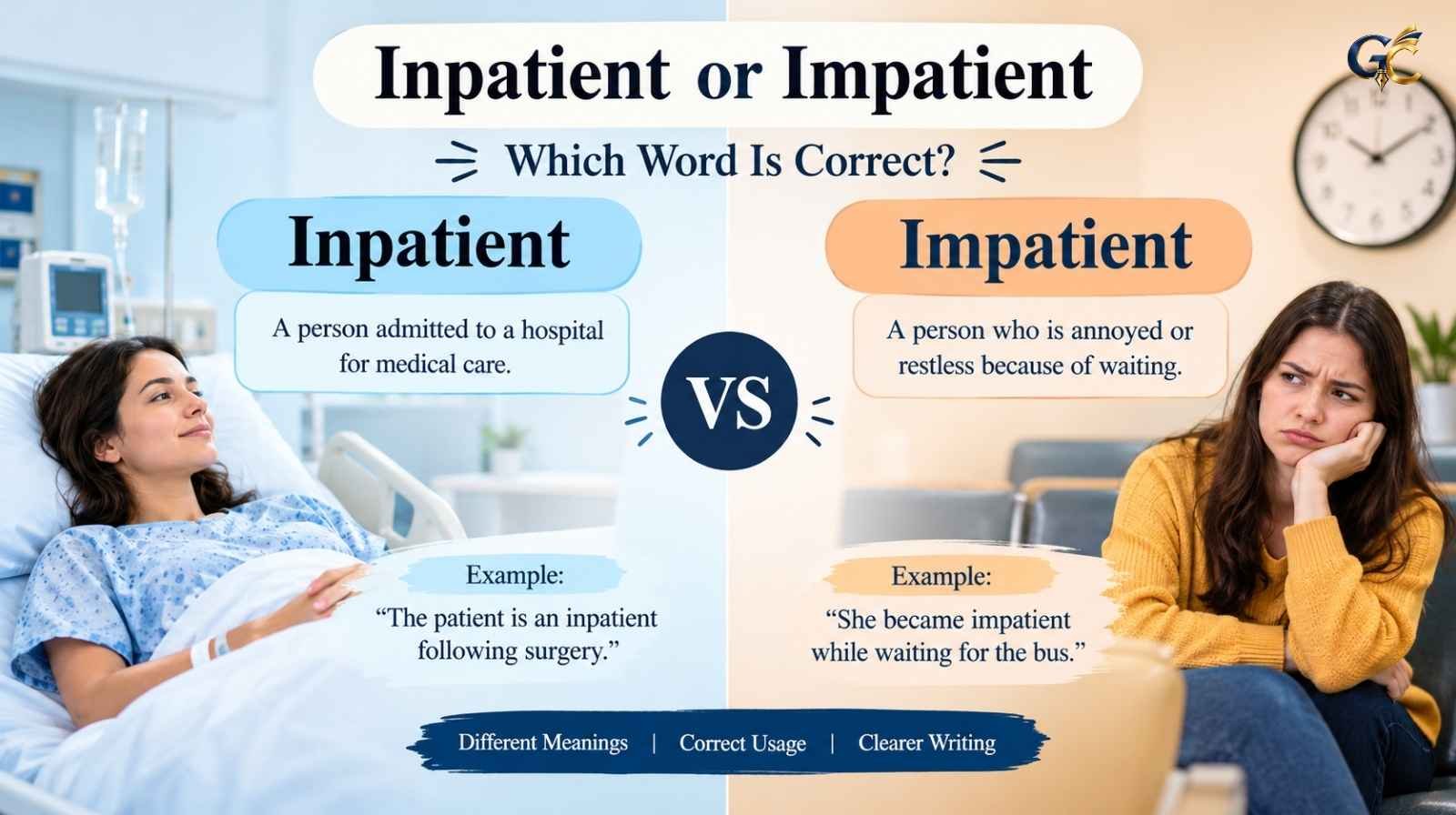
Have you ever confused inpatient or impatient while writing a sentence? These two words look almost identical, but they have completely different meanings. Choosing the wrong one can change the entire message, especially when discussing medical care or describing someone’s feelings.
The good news is that understanding the difference between inpatient and impatient is simple once you know what each word means.
Inpatient refers to someone who stays in a hospital or another medical facility to receive care. Impatient describes someone who is annoyed or restless because they have to wait or cannot do something immediately.
In this guide, you will learn the meanings, spelling differences, pronunciation, practical examples, common mistakes, and easy ways to remember which word to use.
What Is the Difference Between Inpatient and Impatient?

The main difference between inpatient and impatient is their meaning. One is associated with medical care, while the other describes a person’s attitude toward waiting.
Inpatient Meaning
An inpatient is a person who is formally admitted to a hospital or another healthcare facility and stays there to receive medical treatment or observation.
For example:
- My grandfather became an inpatient after his surgery.
- The hospital provides specialized care for inpatient children.
- The doctor explained the inpatient treatment plan to the family.
In everyday English, the word is especially common in healthcare settings.
Impatient Meaning
Impatient is an adjective that describes someone who becomes annoyed, restless, or frustrated when they must wait or when something takes longer than expected.
For example:
- She became impatient while waiting for the bus.
- The impatient customer asked when the order would arrive.
- He was impatient to hear the final results.
Unlike inpatient, this word describes an emotional state or attitude rather than a person’s medical status.
Quick Comparison Table
| Feature | Inpatient | Impatient |
|---|---|---|
| Meaning | A person admitted for medical care | Someone who struggles to wait calmly |
| Part of speech | Noun or adjective | Adjective |
| Main context | Hospitals and healthcare | Feelings and behavior |
| Example | The inpatient needs rest. | The impatient child kept asking questions. |
| Memory clue | In for inside a medical facility | Im for impatience |
Quick answer: Use inpatient when referring to hospital admission and impatient when describing frustration or difficulty waiting.
When Should You Use Inpatient?
Use inpatient when discussing someone who has been admitted to a hospital or another healthcare facility for treatment, monitoring, or medical observation.
Inpatient as a Noun
As a noun, inpatient refers directly to a person receiving care as a formally admitted patient.
Examples:
- The inpatient received medication after the examination.
- Each inpatient has an individual treatment plan.
- The nurse checked on the inpatient throughout the night.
These sentences focus on people receiving medical care.
Inpatient as an Adjective
Inpatient can also describe medical services, facilities, treatment, or care involving admitted patients.
Examples:
- The hospital recently expanded its inpatient services.
- She needs inpatient rehabilitation after the injury.
- The doctor recommended inpatient treatment for closer monitoring.
In these examples, inpatient describes the type of healthcare being provided.
Inpatient vs. Outpatient
Understanding the opposite term can make the meaning even clearer.
An inpatient is admitted to a healthcare facility and stays for treatment or observation. An outpatient receives medical services without being admitted for an overnight or extended hospital stay.
For example:
- The patient required inpatient care after major surgery.
- The patient attended an outpatient appointment for a routine checkup.
The exact admission arrangements depend on the healthcare facility and the type of treatment.
When Should You Use Impatient?
Use impatient when describing someone who feels frustrated, restless, or eager because of waiting, delays, or a lack of immediate progress.
Impatient When Waiting
This is one of the most common uses of impatient.
Examples:
- I became impatient after waiting for an hour.
- The children grew impatient while standing in line.
- Customers were impatient because the restaurant was taking too long.
In each example, impatient describes frustration caused by waiting.
Impatient to Do Something
You can also use impatient to describe eagerness to do or experience something.
Examples:
- She was impatient to open her birthday presents.
- The students were impatient to learn their examination results.
- He was impatient to begin his new job.
In these sentences, impatient expresses strong eagerness. The feeling may be positive, although it can suggest that the person does not want to wait.
Impatient With Someone or Something
The word can also describe frustration directed toward a person, situation, or process.
Examples:
- The manager became impatient with repeated mistakes.
- I am impatient with unnecessary delays.
- She was impatient with herself for making the same error again.
These examples show how impatience can affect communication and everyday relationships.

Inpatient or Impatient: Common Mistakes and Easy Ways to Remember
Although these words differ by only a few letters, their meanings are not interchangeable. Understanding their spelling patterns and sentence contexts can help you avoid mistakes.
A Simple Memory Trick
Use these two reminders:
- Inpatient = In a hospital. Think of someone who has been admitted for medical care.
- Impatient = Not willing to wait patiently. Think of someone who is restless or frustrated.
For example:
- Correct: The inpatient waited for the doctor.
- Correct: The impatient visitor kept checking the clock.
Notice that both words can appear in a hospital-related situation. The first identifies a patient’s medical status, while the second describes a person’s behavior.
Step-by-Step Guide to Choosing the Correct Word
Follow these steps whenever you are unsure which word to use.
- Check the meaning. Are you describing medical admission or a feeling?
- Look at the context. Is the sentence about treatment, hospital care, waiting, or frustration?
- Replace the word. Try substituting “hospital patient” or “unable to wait calmly.”
- Read the sentence again. Choose the word that preserves the intended meaning.
Consider this example:
“She was inpatient while waiting for her appointment.”
If the intended meaning is that she felt frustrated while waiting, the correct sentence is:
“She was impatient while waiting for her appointment.”
However, if the sentence refers to someone admitted to a hospital, inpatient may be appropriate.
Real-Life Example: Choosing the Right Word in a Hospital
Imagine a family visiting a hospital because their father needs medical treatment after an unexpected illness. The doctor decides that he should remain in the hospital for observation and additional care. In this situation, the father is an inpatient because he has been formally admitted to receive medical attention.
His daughter, however, has been sitting in the waiting room for several hours. She is worried about her father and wants to know when the doctor will provide an update. As time passes, she starts checking her phone repeatedly, asking the receptionist for information, and expressing frustration about the delay. She becomes impatient.
Later, a nurse explains that the medical team is carefully monitoring her father’s condition. The daughter calms down after receiving an update.
This example demonstrates why the distinction matters. The father is an inpatient because of his medical status, while the daughter is impatient because of her emotional response to waiting.
Both words can describe people in the same hospital, but they communicate entirely different information. Using the wrong word could confuse the reader or make the sentence sound incorrect.
Inpatient or Impatient: Statistics and Language Usage in 2025–2026

There is no verified, widely established 2025–2026 statistic available here that measures how often English writers confuse inpatient with impatient. Therefore, assigning a percentage to this specific spelling mistake would be misleading.
However, the distinction remains useful in modern writing, particularly in healthcare communication, education, workplace correspondence, and everyday digital messages.
What Current Writing Practices Tell Us
Rather than relying on an unsupported statistic, consider these practical language facts:
- Context matters: A sentence about hospital admission requires a different word from a sentence about frustration.
- Spelling affects meaning: Replacing one letter can change what the reader understands.
- Clear writing reduces ambiguity: Choosing the correct term helps readers understand whether someone is receiving medical care or expressing impatience.
- Proofreading remains valuable: Reading a sentence in context can reveal errors that spell-checking alone may not catch.
These are general observations about English usage, not measured findings from a 2025–2026 survey.
For Grammarclear readers, the most reliable approach is to learn the definitions, study examples, and apply the correct word according to the sentence’s meaning.
FAQs
Q1: Is inpatient or impatient the correct spelling?
A: Both are correct spellings, but they have different meanings. Inpatient refers to someone admitted for medical care, while impatient describes someone who is restless or unwilling to wait calmly.
Q2: What does inpatient mean in simple words?
A: An inpatient is someone who has been admitted to a hospital or healthcare facility to receive treatment or medical observation.
Example: “The inpatient stayed in the hospital after surgery.”
Q3: What does impatient mean in simple words?
A: Impatient means feeling annoyed, restless, or eager because you have to wait or cannot do something immediately.
Example: “He became impatient while waiting for the train.”
Q4: Can a person be both an inpatient and impatient?
A: Yes. Someone admitted to a hospital can also feel impatient while waiting for test results, treatment, or a doctor’s visit. The two words describe different things about the same person.
Q5: What is the difference between inpatient and outpatient?
A: An inpatient is formally admitted to a healthcare facility for treatment or observation. An outpatient receives medical services without being admitted as an inpatient.
Q6: Is impatient a noun or an adjective?
A: Impatient is an adjective. It describes a person’s feelings or behavior.
Example: “The impatient passenger complained about the delay.”
The related noun is impatience.
Q7: How can I remember the difference between inpatient and impatient?
A: Remember inpatient = in a hospital and impatient = unable or unwilling to wait calmly. Thinking about the meaning of the sentence will help you choose the correct spelling.
Q8: Which word should I use when someone is tired of waiting?
A: Use impatient.
Example: “She became impatient after waiting for her appointment for two hours.”
Use inpatient only when referring to a person admitted for medical care or to healthcare services associated with such admission.
Conclusion:
The difference between inpatient or impatient becomes easy once you understand what each word communicates.
- Inpatient refers to a person admitted to a hospital or healthcare facility for treatment or observation.
- Impatient describes someone who feels restless, frustrated, or eager because they have to wait.
For example, a patient recovering in a hospital may be an inpatient, while a visitor who is tired of waiting for news may become impatient.
The key is to focus on the meaning of your sentence rather than how similar the words look. With a little practice, you can use both words confidently in your writing.
👉 Discover more simple and practical grammar guides on Grammar Clear

Zia Ahmad is the founder of GrammarClear, an educational platform dedicated to making English grammar simple and easy to understand. Through clear explanations and practical examples, he aims to help learners improve their grammar, writing, and communication skills with confidence.

