
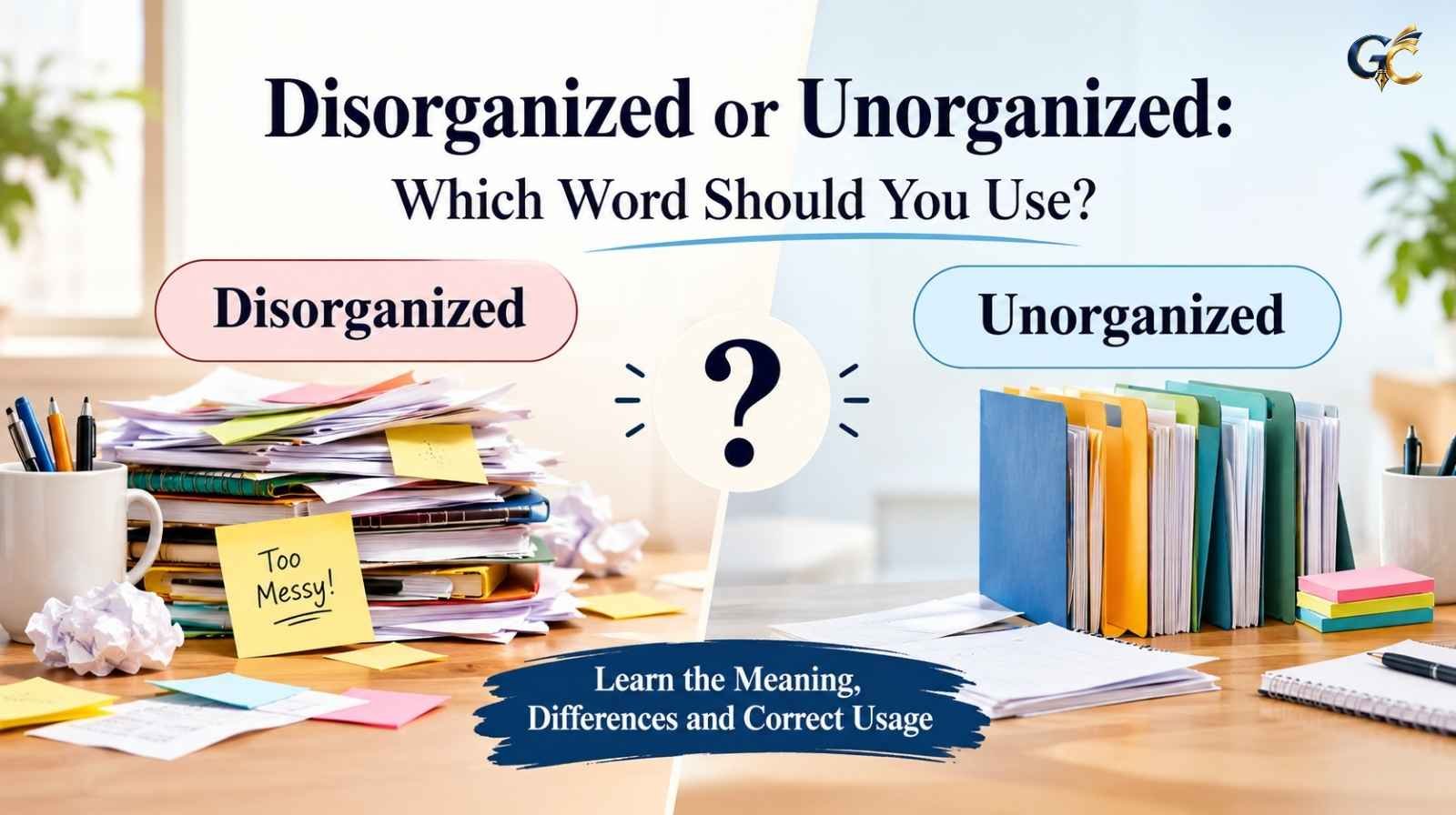
Have you ever wondered whether to write disorganized or unorganized? Both words are used in English, and they may seem interchangeable. However, there is a subtle difference in how people typically use them.
Disorganized usually describes something messy, poorly arranged, or lacking order. Unorganized generally means something has not been arranged into an organized system or structure.
For example, you might describe a messy desk as disorganized, while a group that has not yet established a formal structure could be called unorganized.
Understanding the difference between disorganized and unorganized can help you choose the right word in emails, essays, workplace communication, and everyday conversations. Let’s explore their meanings, differences, and practical examples so you can use both words confidently.
What Is the Difference Between Disorganized and Unorganized?
Although both words relate to a lack of organization, they often emphasize different things.
Meaning of Disorganized
Disorganized is an adjective that describes something messy, chaotic, inefficient, or poorly arranged. It often suggests that an existing arrangement is not working properly.
Examples:
- My desk is disorganized because papers are scattered everywhere.
- The meeting became disorganized when everyone started talking at once.
- She felt disorganized after changing her daily routine.
- The company has a disorganized filing system that makes documents difficult to find.
In these examples, something lacks order or is not functioning in an organized way.
Meaning of Unorganized
Unorganized is an adjective that generally describes something that has not been organized, structured, or arranged systematically.
Examples:
- The documents remained unorganized until Friday.
- We collected unorganized notes before preparing the report.
- The volunteers were an unorganized group without a designated leader.
- His digital photographs were unorganized, so he created folders for them.
Here, the emphasis is often on the absence of an established arrangement or organizational structure.
Are Disorganized and Unorganized Interchangeable?
Sometimes, yes. Both words can describe messy files, cluttered spaces, or poorly arranged materials.
For example:
- My notes are disorganized.
- My notes are unorganized.
Both sentences are understandable. However, disorganized may suggest that the notes are messy or difficult to follow, while unorganized can emphasize that they have not been sorted or arranged.
Quick rule: Use disorganized when emphasizing disorder or poor organization. Use unorganized when emphasizing the absence of an organized arrangement or structure.
When Should You Use Disorganized?
Use disorganized when you want to describe something that is messy, confusing, poorly planned, or lacking an effective system. It is particularly useful when discussing personal habits, workplaces, schedules, and events.
Disorganized in Everyday Life
In everyday English, this word often describes a person or place where things are not in order.
Examples:
- My bedroom is disorganized because I haven’t put my clothes away.
- He is disorganized and frequently forgets his appointments.
- Her daily routine became disorganized after she changed jobs.
These examples show a lack of order or effective planning.
Disorganized in Professional Writing
The word also works well in business and academic writing when describing inefficient processes or poor coordination.
Examples:
- The disorganized project management process caused unnecessary delays.
- The company’s records were disorganized and difficult to review.
- The presentation felt disorganized because the speaker jumped between unrelated topics.
The Cambridge Dictionary defines disorganized in terms of poor planning and a lack of order, supporting these common uses.
When Disorganized Is the Better Choice
Choose disorganized when the problem is disorder, confusion, or ineffective planning.
For instance, if a team has assigned responsibilities but nobody follows the plan, describing the team’s work as disorganized is appropriate.
When Should You Use Unorganized?
Use unorganized when you want to emphasize that something has not been arranged, sorted, or structured systematically. Depending on the context, it can describe a neutral situation rather than a chaotic one.
Unorganized Information and Materials
This word is useful when discussing information, documents, photographs, research notes, and other materials that have not been sorted into a clear system.
Examples:
- The research data is still unorganized.
- I received a collection of unorganized documents.
- Her photographs remained unorganized until she created separate folders.
In these examples, the materials need organization, but they are not necessarily chaotic.
Unorganized Groups and Activities
Unorganized can also describe a group that has not established formal leadership, procedures, or coordination.
Examples:
- The volunteers started as an unorganized group.
- The neighborhood residents were unorganized before they formed a committee.
- The participants were unorganized, with no clear plan for the event.
The word highlights the absence of an established structure.
When Unorganized Is the Better Choice
Choose unorganized when your main point is that a system or arrangement has not yet been established.
For example, a folder containing hundreds of files that have never been categorized can be described as unorganized. This wording focuses on the missing organizational system rather than suggesting that an existing system has broken down.
Disorganized vs. Unorganized: Comparison Table
The following table summarizes the key differences to help you choose the correct word.
| Feature | Disorganized | Unorganized |
|---|---|---|
| Part of speech | Adjective | Adjective |
| Main meaning | Messy or lacking effective order | Not organized or arranged systematically |
| Typical emphasis | Disorder or poor planning | Absence of a clear arrangement |
| Common example | A disorganized office | Unorganized research notes |
| Workplace use | A poorly coordinated team | A group without a formal structure |
| Tone | Often negative | Can be neutral or negative |
| Are they interchangeable? | Sometimes | Sometimes |
A Simple Way to Remember the Difference
Use this simple guide:
- Disorganized = disorder or poor organization.
- Unorganized = lacking an organized arrangement.
Remember that this is a practical guideline, not an absolute grammatical rule. Both words overlap in meaning, so context matters.
Real-Life Example: Choosing Between Disorganized and Unorganized
Imagine that Sarah works as an office assistant at a small marketing company. At the beginning of the year, she receives hundreds of documents, client emails, invoices, and project notes. The company has not yet created a central filing system, so the documents are scattered across several folders and individual computers.
Initially, Sarah describes the documents as unorganized. This is a reasonable choice because the company has never established a consistent method for storing and categorizing its files.
Sarah then creates a filing system with separate folders for invoices, client records, and marketing projects. She also establishes naming conventions so employees can find documents quickly.
After several months, however, employees stop following the new system. Some save invoices in project folders, others create duplicate files, and several important documents are stored under incorrect names. At this point, Sarah describes the filing system as disorganized.
Why does the word change?
The first situation emphasizes the absence of an established system. The second describes a system that exists but is no longer being followed effectively.
Sarah’s experience demonstrates how context influences word choice. The distinction is not that unorganized can only describe something that has never been organized or that disorganized always means an established system has fallen apart. Rather, these are useful tendencies that help writers communicate more precisely.
The same reasoning applies to classrooms, personal schedules, business operations, research projects, and digital storage. Choosing the word that best describes the situation makes your writing clearer and more natural.
Usage Trends and English Language Guidance for 2025–2026
When choosing between similar English words, it is useful to distinguish established dictionary definitions from claims about current popularity.
What Do Modern Dictionaries Say?
The Cambridge Dictionary continues to define disorganized as something badly planned or lacking order. Its examples include conferences, workplaces, and people who struggle with planning.
These definitions provide a reliable basis for understanding the word’s meaning in contemporary English.
Are There Reliable Statistics Showing Which Word Is More Popular?
As of 2026, this article does not have a verified, comparable 2025–2026 dataset establishing the exact frequency difference between disorganized and unorganized. Therefore, it would be misleading to invent percentages or claim that one word has gained a particular amount of popularity.
For a numerical comparison, researchers could examine a consistent English-language corpus or a historical search-interest dataset. These sources measure different things: corpus frequency reflects occurrences in collected texts, while search-interest data reflects relative search activity rather than the total number of times a word is used.
What Should Writers Do in 2026?
For practical writing, focus on accuracy rather than an unsupported popularity claim.
- Use disorganized to describe messy arrangements, poor planning, or ineffective coordination.
- Use unorganized when emphasizing a lack of systematic arrangement or structure.
- Check the surrounding sentence to make sure your intended meaning is clear.
- Consult a reputable dictionary when the distinction matters in formal writing.
These principles help writers make defensible language choices without relying on misleading statistics.
Common Mistakes to Avoid
Although both words are correct, choosing one without considering the context can make a sentence less precise.
Assuming Unorganized Is Always Incorrect
Incorrect assumption: “Unorganized is not a real English word.”
Correction: Both unorganized and disorganized are valid English adjectives. Their meanings overlap, but they can emphasize different situations.
Example:
- Correct: The documents were unorganized and needed to be sorted.
- Correct: The disorganized office made it difficult to find documents.
Using Disorganized When You Mean Unsorted
Consider this sentence:
“The raw survey responses were disorganized.”
This sentence is grammatically correct. However, if you simply mean that the responses have not been categorized, unorganized or unsorted may communicate your meaning more precisely.
Using Unorganized for Every Type of Disorder
If a meeting has a schedule but repeatedly goes off track, disorganized is usually the more natural choice.
For example:
“The meeting became disorganized when the speakers ignored the agenda.”
The sentence emphasizes poor coordination, not merely the absence of a plan.
FAQs
Q1: Is disorganized or unorganized correct?
A: Both are correct English words. Disorganized generally describes disorder or poor planning, while unorganized emphasizes a lack of systematic arrangement or structure.
Q2: Is unorganized a real word?
A: Yes. Unorganized is a standard English adjective. You can use it to describe information, materials, activities, or groups that lack an organized structure.
Q3: Is disorganized more common than unorganized?
A: Disorganized is a familiar choice for describing messy situations, poor planning, and inefficient systems. However, a precise 2025–2026 frequency comparison requires reliable corpus or search-interest data. The words should be chosen according to meaning, not assumed popularity.
Q4: What is the difference between disorganized and unorganized behavior?
A: Disorganized behavior often suggests inconsistent actions, confusion, or difficulty following a plan. Unorganized behavior may suggest a lack of structure or a systematic approach. In everyday English, the expressions can overlap.
Q5: Should I use disorganized or unorganized in a formal email?
A: Use the word that best describes the situation. For example, write “The project has become disorganized” if coordination is poor. Write “The project materials are unorganized” if they have not been sorted into a clear system.
Q6: Is disorganised the same as disorganized?
A: Yes. Disorganized is the standard American English spelling, while disorganised is the standard British English spelling. The meaning is the same.
Q7: What is the opposite of disorganized?
A: Common opposites include organized, orderly, well-arranged, and systematic. The best choice depends on the sentence.
For example, “a disorganized desk” can become “an organized desk,” while “a disorganized process” can become “a well-organized process.”
Q8: Can I use disorganized and unorganized interchangeably?
A: Sometimes. Both words can describe things that lack order. However, disorganized often emphasizes disorder or poor coordination, whereas unorganized can emphasize the absence of an established arrangement. Consider your intended meaning before choosing one.
Conclusion:
The choice between disorganized or unorganized depends on what you want to communicate. Both words are correct, but they have slightly different emphases.
Use disorganized when describing something messy, confusing, poorly planned, or inefficient. Use unorganized when emphasizing that something lacks a systematic arrangement or established structure.
For example, a meeting that repeatedly goes off schedule is likely to be disorganized, while research notes that have not yet been sorted into categories may be described as unorganized.
The key is to consider the situation rather than treating the words as perfect synonyms. With practice, choosing between them becomes much easier.
👉 Discover more simple and practical grammar guides on Grammar Clear

Zia Ahmad is the founder of GrammarClear, an educational platform dedicated to making English grammar simple and easy to understand. Through clear explanations and practical examples, he aims to help learners improve their grammar, writing, and communication skills with confidence.

