
Have you ever stopped while writing an email or message because you were unsure whether to use steer or stear? You are not alone. English contains many words that sound similar but have different spellings, and sometimes a small spelling mistake can change the quality of an otherwise perfectly written sentence.
The confusion between steer and stear is a good example. Although both may look like possible English words, only one is the correct standard spelling when you want to describe guiding, directing, or controlling something.
Whether you are writing a professional email, preparing a school assignment, sending a text message, or communicating with colleagues, knowing which spelling to use can help you express yourself more clearly.
In this article, we will explore steer or stear, identify the correct spelling, explain its meaning, examine common mistakes, and provide practical examples from everyday situations.
Steer or Stear: Which Spelling Is Correct?
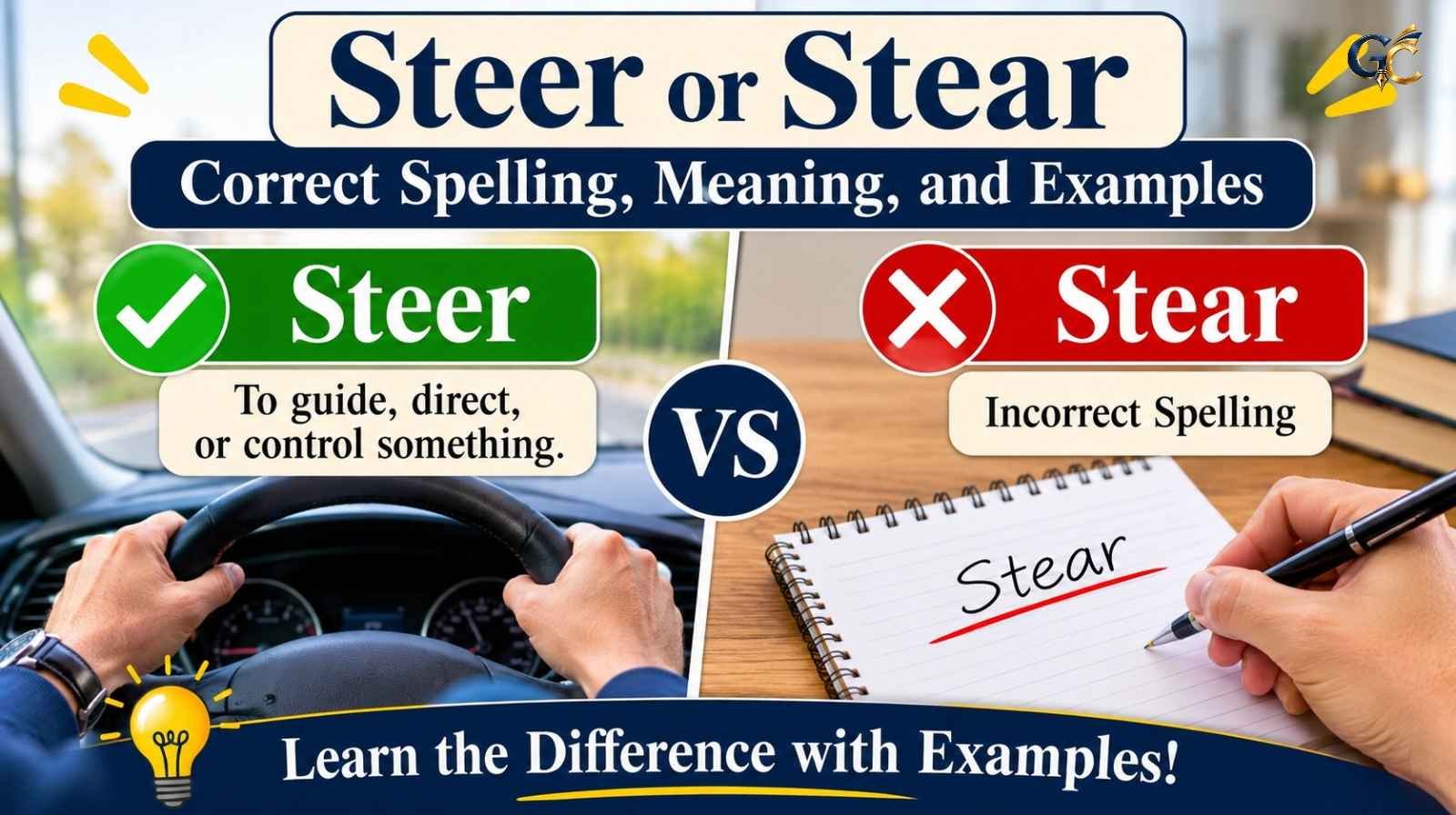
The correct spelling is steer.
Steer is a standard English word used as both a verb and a noun. As a verb, it means to guide, direct, or control the movement or direction of something. It can refer to driving a vehicle, guiding a boat, influencing a conversation, or helping someone make a decision.
On the other hand, stear is not the correct spelling of the word in these contexts. It is generally a spelling mistake that occurs because people confuse the pronunciation of the two forms.
For example:
- Correct: Please steer the car carefully around the corner.
- Incorrect: Please stear the car carefully around the corner.
Another example:
- Correct: Maria helped steer the discussion towards a solution.
- Incorrect: Maria helped stear the discussion towards a solution.
The easiest way to remember the difference is that steer contains two letter E’s.
Whenever you are talking about guiding, directing, or controlling something, remember to write steer, not stear.
What Does Steer Mean?
The word steer has several meanings depending on the situation in which it is used. Its central meaning is connected to guidance, direction, and control.
Let’s explore its most common meanings.
Steer Means to Guide or Direct Something
The most common meaning of steer is to guide something in a particular direction.
This meaning is often used when discussing vehicles, boats, bicycles, and other forms of transportation.
For example:
- James learned how to steer a car during his first driving lesson.
- The captain carefully steered the boat through the narrow passage.
- Please steer the bicycle away from the pedestrians.
Scenario example: Driving lesson
Imagine that a driving instructor named David is teaching a student named Emily how to drive.
David notices that Emily is approaching a sharp bend too quickly. He says:
“Emily, slow down and steer gently to the left. Make sure you maintain control of the vehicle.”
In this situation, steer means controlling the direction of the car using the steering wheel.
Steer Means to Influence or Guide a Conversation
Steer can also describe the act of directing a conversation towards a particular topic.
This meaning is especially common in workplaces, meetings, interviews, and discussions.
For example:
- The manager tried to steer the meeting towards the company’s main objectives.
- Sarah steered the conversation away from personal disagreements.
- John managed to steer the discussion towards a more practical solution.
Scenario example: Workplace meeting
Imagine that a team is having a meeting about an upcoming project. However, the discussion keeps moving towards unrelated topics.
The team leader, Michael, decides to bring everyone back to the main issue.
He says:
“Thank you for sharing your thoughts. However, let’s steer the conversation back towards our marketing strategy so that we can finish the discussion on time.”
Here, steer means guiding the conversation towards the intended subject.
Steer Means to Guide Someone’s Decisions or Actions
Another common use of steer is to describe influencing someone to make a particular decision or take a particular action.
It does not necessarily mean forcing someone. Instead, it often involves offering advice, encouragement, or direction.
For example:
- My parents helped steer me towards a successful career.
- The teacher tried to steer her students away from negative influences.
- Good leadership can steer a company towards long-term success.
Scenario example: Career advice
Imagine that a young graduate named Daniel is unsure whether to pursue a career in business or technology.
His older sister, Rebecca, discusses his interests and abilities with him.
She says:
“You have always enjoyed solving technical problems. I think you should consider technology because it may steer you towards a career that matches your strengths.”
In this example, steer describes influencing or guiding someone’s decisions.
Steer Can Refer to Controlling the Direction of an Organisation
In business and professional environments, steer is frequently used when discussing leadership, management, and organisational development.
A person who steers an organisation helps determine its direction, priorities, and future plans.
For example:
- The new director will steer the organisation through its restructuring process.
- Effective leadership is necessary to steer a business towards growth.
- The board appointed a new chairman to steer the company through difficult times.
Scenario example: Business management
Suppose a company called Bright Solutions is experiencing financial difficulties. The board appoints a new managing director named Thomas.
During his first meeting with employees, Thomas says:
“My responsibility is to steer this company towards stability, improve our services, and create better opportunities for everyone.”
Here, steer means leading and directing the company’s overall progress.
What Does Stear Mean?
Unlike steer, the spelling stear is not recognised as the standard English spelling for guiding, directing, or controlling something.
People sometimes write it because they are unsure which vowels belong in the word.
For example, someone might write:
“Can you stear the conversation towards the main topic?”
However, the correct sentence is:
“Can you steer the conversation towards the main topic?”
The mistake is understandable because English spelling does not always follow pronunciation consistently.
Nevertheless, when writing standard English, you should always use steer for the meanings discussed in this article.
It is worth remembering that unusual letter combinations can appear in names, specialist terms, or other contexts. However, that does not make stear an acceptable alternative spelling of the verb steer.
Steer vs Stear: Understanding the Difference
The main difference between the two spellings is that steer is correct, while stear is an incorrect spelling when used to mean guide or direct.
Here is a simple comparison:
| Word | Meaning | Correct usage |
|---|---|---|
| Steer | To guide or direct | Correct |
| Stear | Incorrect spelling of steer | Incorrect in this context |
Consider these additional examples:
- Correct: I need to steer the discussion in a different direction.
- Incorrect: I need to stear the discussion in a different direction.
- Correct: The driver managed to steer away from the obstacle.
- Incorrect: The driver managed to stear away from the obstacle.
- Correct: Her advice helped steer me towards a better opportunity.
- Incorrect: Her advice helped stear me towards a better opportunity.
The important thing is to remember that steer is the spelling you should use in standard English.
How to Use Steer in Everyday Sentences
Understanding the meaning of a word is important, but knowing how to use it naturally in everyday communication is equally valuable.
Below are several practical examples showing how steer can be used in different situations.
Using Steer in a Professional Email
When communicating with colleagues, managers, or clients, steer can help you explain how you want a discussion or project to progress.
Scenario: Redirecting a project discussion
Imagine that you are working with a colleague named Daniel on a business project. Your recent discussions have focused too much on minor details, and you want to concentrate on the main objectives.
You could write:
Subject: Refocusing Our Project Discussion
Hi Daniel,
I appreciate the ideas you have shared so far. However, I think we should steer our discussion towards the main project objectives so that we can make better progress. Let’s focus on the key deliverables and identify the actions required to complete everything on schedule.
Best regards,
Michael
In this email, steer our discussion means directing the conversation towards the most important matters.
Using Steer in a Text Message
Steer can also be used naturally in informal conversations with friends and family.
Scenario: Giving a friend advice
Your friend Sarah is considering accepting a job offer that may not suit her long-term goals.
You could send her this message:
“Take your time before making a decision. I think you should steer your career towards something you genuinely enjoy rather than choosing a job simply because it pays well.”
Here, steer means guiding your career in a particular direction.
Using Steer in an Academic Essay
Students can use steer when writing about education, leadership, society, and personal development.
Scenario: Writing about education
Consider this sentence:
“Teachers play an important role in helping students steer their lives towards positive opportunities by providing guidance, knowledge, and encouragement.”
In this example, steer describes helping students make decisions that can positively influence their futures.
Using Steer in a Business Report
In business writing, steer is useful when discussing organisational direction, management decisions, and strategic planning.
Scenario: Company performance report
Imagine that you are preparing a report for a company director named James.
You might write:
“The management team must steer the organisation towards sustainable growth by improving customer satisfaction, strengthening internal operations, and investing in employee development.”
Here, steer the organisation means guiding the company’s overall direction.
Using Steer in a Driving Situation
Steer is particularly common when discussing driving and vehicle control.
Scenario: Giving driving instructions
Imagine that you are teaching your younger brother, Alex, how to drive.
You might say:
“Keep your eyes on the road, maintain a safe speed, and steer gently around the bend.”
In this sentence, steer refers to controlling the direction of the vehicle.
Using Steer in a Leadership Situation
Leaders often need to guide people through difficult situations and help them achieve shared objectives.
Scenario: Motivating a team
Imagine that a project manager named Olivia is addressing her team after an unsuccessful project launch.
She says:
“We have faced some challenges, but we should learn from them and steer the team towards a better outcome. Let’s identify what went wrong and work together on a stronger plan.”
Here, steer means guiding the team’s efforts towards improvement.

Common Expressions and Phrases That Use Steer
The word steer appears in several common English expressions. Learning these expressions can help you use the word more confidently.
Steer Clear Of
Steer clear of means to avoid someone or something, usually because it may cause problems or difficulties.
Examples:
- You should steer clear of unnecessary arguments at work.
- I prefer to steer clear of people who constantly create drama.
- Drivers should steer clear of flooded roads.
Scenario example:
Your colleague, Peter, advises you not to get involved in an office disagreement.
He says:
“My advice is to steer clear of the argument between those two departments. It has nothing to do with your responsibilities.”
Steer Someone in the Right Direction
This expression means helping someone make better decisions or guiding them towards a suitable opportunity.
Examples:
- My mentor helped steer me in the right direction.
- The teacher steered the student in the right direction.
- Her advice steered me in the right direction when I was choosing a career.
Scenario example:
A student named Emma is struggling to choose a university course.
Her teacher recommends several subjects that match her interests and abilities.
Emma later says:
“My teacher really helped steer me in the right direction.”
Steer Away From Something
This expression means guiding someone or something away from a particular subject, activity, or situation.
Examples:
- The manager tried to steer the meeting away from personal disagreements.
- Parents should help their children steer away from harmful habits.
- We need to steer away from unnecessary expenses.
Scenario example:
During a business meeting, two employees begin arguing about an issue that is unrelated to the project.
The manager interrupts politely:
“Let’s steer away from that subject and focus on what we need to achieve today.”
Steer Towards Something
This expression means guiding or directing someone or something towards a particular goal or outcome.
Examples:
- The company wants to steer towards more sustainable business practices.
- His experience helped steer him towards a management position.
- The government introduced policies to steer the economy towards growth.
Scenario example:
A business owner named Richard wants to improve his company’s environmental performance.
He tells his employees:
“We need to steer towards more sustainable operations by reducing waste and using resources responsibly.”

Why Do People Confuse Steer and Stear?
There are several reasons why people make this spelling mistake.
Similar Pronunciation
One of the main reasons is that people may not immediately recognise the correct vowel combination when hearing the word.
The word steer is pronounced /stɪər/ in many British English accents, although pronunciation varies across English-speaking regions.
Because spelling and pronunciation do not always match perfectly in English, some people may incorrectly write stear.
Typing Mistakes
Sometimes, the confusion happens simply because someone types too quickly without checking their work.
For example, a person writing an email might accidentally type:
“Please stear the conversation towards the main issue.”
A quick proofreading check would help identify the mistake and replace it with steer.
Uncertainty About English Spelling
English contains many words with similar sounds but different spellings.
For example:
- Hear and here.
- Their and there.
- Brake and break.
- Steer and the incorrect spelling stear.
These examples show why it is important to learn the correct spelling of words rather than relying entirely on how they sound.
Other Words Related to Steer
Learning related words can make it easier to understand and use steer correctly.
Here are some useful alternatives and related expressions:
| Word or phrase | Meaning | Example |
|---|---|---|
| Guide | To show the way | She guided the team through the process. |
| Direct | To control or give instructions | He directed the employees towards the task. |
| Lead | To take responsibility for guiding others | Maria led the discussion. |
| Navigate | To find or follow a route | The captain navigated the ship through the water. |
| Control | To manage or regulate something | The driver controlled the vehicle carefully. |
| Influence | To affect someone’s decisions | His advice influenced my decision. |
| Steer clear of | To avoid something | We should steer clear of unnecessary problems. |
Although these words have related meanings, they are not always interchangeable.
For example, navigate is often used when finding a route, while influence focuses more on affecting someone’s thoughts or decisions.
Understanding these differences will help you choose the most appropriate word for each situation.
Is Steer a Noun or a Verb?
An interesting feature of steer is that it can function as both a verb and a noun.
Steer as a Verb
As a verb, steer means to guide, direct, or control something.
Examples:
- I will steer the car through the narrow street.
- She helped steer the company towards success.
- We need to steer the discussion back to the main subject.
Steer as a Noun
As a noun, steer refers to a male bovine animal, particularly one that has been castrated and is commonly raised for beef.
Examples:
- The farmer purchased a young steer.
- The steer was kept in a separate enclosure.
- The farmer prepared the steer for market.
This is another reason why context matters when understanding English vocabulary.
The spelling remains steer, but its meaning changes depending on how it is used in a sentence.
Common Mistakes to Avoid When Using Steer

Even though steer is a relatively simple word, there are a few mistakes worth avoiding.
Writing stear instead of steer.
Incorrect: We need to stear the project towards success.
Correct: We need to steer the project towards success.
Using steer when guide would be more appropriate.
Although steer and guide have similar meanings, steer often suggests actively directing something towards a particular destination or outcome.
For example:
“She helped steer the company through a difficult period.”
This sounds natural because it describes leadership and direction.
Forgetting the expression steer clear of.
Incorrect: You should steer clear from unnecessary arguments.
More natural: You should steer clear of unnecessary arguments.
Confusing steer with steering.
Steering is the continuous or gerund form of the verb steer.
Examples:
- He is steering the vehicle carefully.
- She is steering the discussion towards a solution.
- The captain is steering the boat.
Remember that the correct forms include steer, steers, steered, and steering.
Simple Tips to Remember the Correct Spelling
If you frequently confuse steer and stear, the following tips can help you remember the correct spelling.
- Remember the double E: Steer is spelled with two E’s.
- Connect it with a steering wheel: A steering wheel helps you steer a vehicle.
- Practise writing sentences: Use steer in everyday messages, emails, and conversations.
- Proofread your work: Check your spelling before sending professional emails or submitting assignments.
- Learn common expressions: Remember phrases such as steer clear of and steer in the right direction.
The more frequently you encounter and use the correct spelling, the easier it becomes to remember.
Frequently Asked Questions
1. Is it steer or stear?
The correct spelling is steer. It means to guide, direct, or control something. Stear is an incorrect spelling when used with this meaning.
2. What does steer mean in simple English?
Steer means to guide or control the direction of something. For example, when you steer a car, you control which direction it moves.
3. Is stear a real English word?
Stear is not the standard English spelling of the word meaning to guide or direct. In ordinary writing, you should use steer.
4. How do you use steer in a sentence?
You can use steer in several ways. Here are some examples:
- Please steer the car carefully.
- We need to steer the conversation towards the main issue.
- My parents helped steer me towards a successful career.
5. What is the past tense of steer?
The past tense of steer is steered.
- The driver steered the car around the obstacle.
- Sarah steered the conversation towards a more positive subject.
- The manager steered the company through a difficult period.
6. What is the difference between steer and steering?
Steer is the base form of the verb, while steering is its -ing form.
- I will steer the vehicle.
- I am steering the vehicle.
Both are correct, but they are used in different grammatical situations.
7. What does steer clear of mean?
Steer clear of means to avoid something or someone.
Example: “I usually steer clear of unnecessary arguments at work.”
This means that you try to avoid getting involved in arguments.
8. Can steer be used in professional emails?
Yes. Steer is perfectly acceptable in professional communication.
Example: “Let’s steer our discussion towards the key objectives so that we can reach a decision before the end of the meeting.”
It is particularly useful when discussing leadership, project direction, business strategy, and decision-making.
Conclusion
When deciding between steer or stear, the correct spelling is steer.
The word can mean guiding a vehicle, directing a conversation, influencing someone’s decisions, or leading an organisation towards a particular goal. It is a versatile English word that appears in everyday conversations, professional emails, academic writing, and business communication.
Remember that stear is not the correct standard spelling when referring to these meanings.
Whether you are writing to a colleague, advising a friend, preparing a report, or completing an academic assignment, using the correct spelling will make your communication clearer and more professional.
The simplest way to remember it is this: You use a steering wheel to steer a car, not stear it.
👉 Discover more simple and practical grammar guides on Grammar Clear

Zia Ahmad is the founder of GrammarClear, an educational platform dedicated to making English grammar simple and easy to understand. Through clear explanations and practical examples, he aims to help learners improve their grammar, writing, and communication skills with confidence.

