
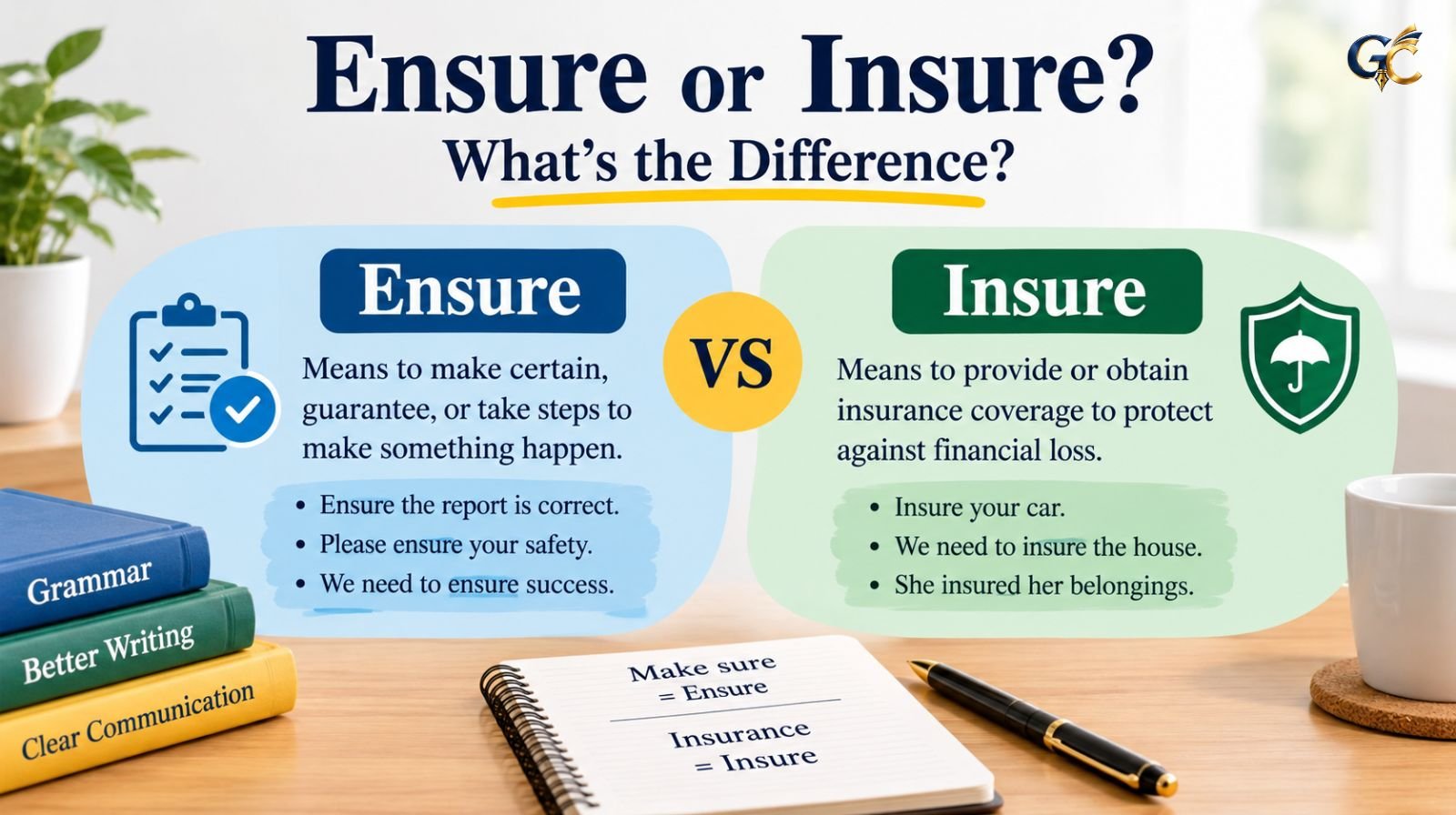
The main difference between ensure or insure is simple: ensure means to make certain that something happens, while insure usually means to protect someone or something financially through an insurance policy. Although American English sometimes uses insure to mean ensure, the distinction remains useful in everyday writing.
Have you ever wondered whether to write ensure or insure? These two English words look and sound similar, so it is easy to confuse them. However, they usually have different meanings, and choosing the right one can make your writing clearer and more professional.
In this guide, you will learn the meanings of both words, discover practical examples, understand their differences, and find an easy way to remember which one to use.
What Is the Difference Between Ensure and Insure?
The easiest way to distinguish these words is to consider what you want to communicate. Are you trying to make something happen, or are you arranging financial protection against a possible loss?
What Does Ensure Mean?
Ensure is a verb meaning to make certain, guarantee, or take steps to make a particular result more likely or certain.
Use ensure when discussing accuracy, safety, success, completion, or a desired outcome.
Examples:
- Please ensure that all the doors are locked before leaving.
- The teacher checked the answers to ensure accuracy.
- We arrived early to ensure that we got good seats.
- The manager created a checklist to ensure every task was completed.
In each example, ensure means making sure something is done or happens.
What Does Insure Mean?
Insure is a verb that usually means to provide or obtain insurance coverage to protect against financial loss, damage, or other specified risks.
Use insure when discussing insurance policies, vehicles, homes, businesses, travel, or other property and risks.
Examples:
- I need to insure my new car against theft.
- They decided to insure their house against fire damage.
- The business insured its equipment against accidental damage.
- She wants to insure her belongings before moving abroad.
In these sentences, insure refers to financial protection through insurance rather than simply making something happen.
Quick Comparison: Ensure vs. Insure
| Feature | Ensure | Insure |
|---|---|---|
| Main meaning | Make certain | Provide or obtain insurance |
| Common context | Safety, accuracy, results | Financial protection and risk |
| Example | Ensure the report is correct. | Insure the company vehicle. |
| Memory clue | Make sure | Insurance |
Quick answer: Use ensure when you mean “make sure” and insure when you mean “provide or obtain insurance.”
When Should You Use Ensure?
The word ensure is useful whenever you want to communicate that someone is taking steps to make a condition, action, or result certain.
Ensure in Everyday Conversations
In everyday English, ensure often appears when people discuss plans, responsibilities, and precautions.
Examples:
- Please ensure that you bring your identification.
- I set an alarm to ensure that I wake up on time.
- We checked the weather forecast to ensure a safe journey.
- She saved a copy of the file to ensure that her work was not lost.
Notice that none of these examples involves an insurance policy. Instead, each sentence describes an action intended to make something certain.
Ensure in Business and Professional Writing
In professional communication, ensure can help explain procedures, expectations, and quality standards.
Examples:
- The company introduced new procedures to ensure product quality.
- Employees must ensure that customer information is accurate.
- The supervisor reviews each document to ensure compliance with company policies.
- The team tested the software to ensure that it worked correctly.
These examples show how ensure communicates responsibility and attention to detail.
Ensure in Academic Writing
Students, teachers, and researchers can also use ensure when describing methods intended to improve accuracy or consistency.
Examples:
- Researchers checked the data to ensure accuracy.
- Students should read the instructions carefully to ensure that their assignments meet the requirements.
- The researcher repeated the experiment to ensure consistent results.
Writing tip: If you can replace ensure with make sure without changing the intended meaning, ensure is probably the right choice.
When Should You Use Insure?
Use insure when the sentence concerns an insurance arrangement or protection against financial loss. It is particularly common in discussions about personal finances, property, transportation, and business risks.
Insure in Everyday Life
Insurance is a common part of modern life, making insure useful in many ordinary situations.
Examples:
- We decided to insure our car before taking a long trip.
- He insured his home against certain types of damage.
- You should check whether your travel policy covers medical emergencies.
- The family insured their valuable belongings.
In each case, the word refers to arranging insurance coverage.
Insure in Business and Finance
Businesses may insure buildings, equipment, vehicles, and other assets to help manage financial risks.
Examples:
- The restaurant insured its kitchen equipment.
- The company insured its delivery vans.
- The shop owner decided to insure the building against fire.
- The contractor insured the business against specified liabilities.
The exact protection available depends on the terms, exclusions, and conditions of the relevant policy.
Can Insure Mean Make Certain?
Yes. In American English, insure can also be used in the broader sense of ensure, meaning to make something certain. This overlap is recognized by dictionaries, so it would be inaccurate to say that every non-insurance use of insure is automatically incorrect.
For example:
– The new process will insure greater accuracy.
This sentence uses insure in the sense of making accuracy more certain. Nevertheless, ensure greater accuracy is generally the clearer choice for readers who expect the conventional distinction.
For professional writing, educational content, and international audiences, the simplest approach is to reserve insure for insurance and use ensure for making something certain.
Ensure or Insure: Common Mistakes and Easy Ways to Remember
Understanding the difference becomes easier when you compare similar sentences and focus on their intended meanings.
Common Mistakes to Avoid
Here are some examples of commonly confused usage.
| Less clear or incorrect for the intended meaning | Better choice | Why |
|---|---|---|
| Please insure that the report is accurate. | Please ensure that the report is accurate. | The goal is accuracy, not insurance. |
| We need to ensure the car against theft. | We need to insure the car against theft. | The sentence refers to insurance coverage. |
| The teacher insured that everyone understood. | The teacher ensured that everyone understood. | The intended meaning is to make certain. |
| The company ensured its building against fire. | The company insured its building against fire. | The sentence refers to financial protection. |
These corrections follow the standard distinction between the two words. Remember that American English permits some overlap in meaning, but the conventional choices above are clearer.
A Simple Memory Trick
Use this two-part memory aid:
- Ensure = make sure.
- Insure = insurance.
For example:
- Double-check the address to ensure accurate delivery.
- Insure the delivery vehicle against covered risks.
You can also test your sentence by asking whether an insurance policy is involved. If it is, insure is usually the right choice. If you simply want to make something certain, ensure is normally the better option.
What About Assure?
Another related word is assure. Although it sounds similar to ensure and insure, it generally means to tell someone something confidently or to remove their doubts.
Examples:
- I assure you that everything is ready.
- The manager assured the customer that the issue would be addressed.
- She assured her parents that she had arrived safely.
Compare all three words:
| Word | Meaning | Example |
|---|---|---|
| Assure | Give someone confidence | I assure you that the package arrived. |
| Ensure | Make something certain | Please ensure that the package arrives on time. |
| Insure | Obtain insurance coverage | We insure the vehicle used to deliver packages. |
This distinction is especially helpful when writing emails, business documents, and educational articles.
Real-Life Example: Choosing Ensure or Insure at Work
Consider a small delivery company that wants to improve its service and protect its business assets.
The company manager notices that some deliveries are late and that employees occasionally forget to verify customer addresses. At the same time, the company has purchased a new delivery van that needs appropriate insurance coverage.
First, the manager introduces a checklist for every delivery. Employees must confirm the customer’s address, verify the package details, and check the delivery schedule. The manager explains that these steps will ensure that orders are handled more consistently and reduce avoidable mistakes.
Next, the company arranges suitable insurance coverage for its new van. The manager reviews the policy details, checks the coverage limits, and confirms which risks are covered. In this situation, the company needs to insure the van because it wants financial protection against specified losses.
Later, an employee writes a report stating, “We insured that every package was delivered correctly.” The manager suggests changing the sentence to “We ensured that every package was delivered correctly.”
Why? The report describes a process intended to make successful delivery more certain, not an insurance contract.
This example demonstrates that the correct word depends on the meaning of the sentence rather than the subject alone. A delivery company may need to ensure that orders are handled properly and insure its vehicles against covered risks.
The two words can appear in the same paragraph, but they perform different jobs. Understanding that distinction helps employees write clearer reports, communicate more effectively, and avoid confusing operational responsibilities with financial protection.
Ensure or Insure: Usage Trends and Reliable Language Guidance
There is an important distinction between published language guidance and statistical evidence about how often people use a word.
What Current Language References Tell Us
As of October 2026, the following references provide useful guidance for choosing between ensure and insure.
- Microsoft Style Guide: Recommends ensure for making something certain, insure for providing insurance, and assure for expressing confidence. Microsoft Learn
- LanguageTool: Its guide, originally published in 2025 and revised in February 2026, explains the meanings and practical differences among ensure, insure, and assure. Difference & Examples
- OECD Style Guide, Fourth Edition: Its 2025 guidance distinguishes ensure as making something certain and insure as protecting against risk or loss. OECD
Are There Statistics Showing Which Word Is More Popular?
There is no verified 2025–2026 usage statistic cited here that establishes a reliable percentage of writers who confuse these words or proves which spelling is universally more popular.
That distinction matters because a grammar explanation should not present invented percentages, search volumes, or survey results as facts.
Instead, the current references above support a practical editorial recommendation: use ensure for certainty and insure for insurance. This convention is easy to understand, works well for international readers, and reduces ambiguity.
For writers who want to investigate word frequency further, the Google Books Ngram Viewer can help compare occurrences of words in its digitized book collection. However, book frequency is not the same as everyday usage, and the tool alone cannot establish how often people make spelling or word-choice mistakes.
FAQs
Q1: Is ensure or insure correct?
A: Both are correct English words, but they usually have different meanings. Use ensure to mean make certain and insure to refer to obtaining or providing insurance coverage.
Q2: What is the easiest way to remember ensure vs. insure?
A: Remember ensure = make sure and insure = insurance. This simple rule works well for most everyday and professional writing.
Q3: Can insure mean ensure?
A: Yes. Some American English dictionaries recognize insure as meaning make certain. However, ensure is usually the clearer choice when you are not talking about insurance.
Q4: Should I use ensure or insure in a business email?
A: Use ensure when discussing tasks, accuracy, deadlines, or results. Use insure when discussing insurance coverage for vehicles, buildings, equipment, or other risks.
Q5: Is it ensure or insure your car?
A: Use insure your car when you mean obtaining insurance coverage. For example, “You should insure your car before driving it.”
Q6: Is it ensure or insure safety?
A: Generally, use ensure safety when describing steps taken to make a situation safer or to help prevent harm.
For example: “The staff followed the safety procedures to ensure everyone’s safety.”
Q7: What is the difference between assure, ensure, and insure?
A: Assure means to give someone confidence, ensure means to make something certain, and insure usually means to provide or obtain insurance coverage.
For example: “I assure you that we will ensure the vehicle is ready and insure it before the trip.”
Q8: Is insure wrong in American English when it means make certain?
A: Not necessarily. American English recognizes this broader meaning. However, using ensure for making something certain and insure for insurance is a useful convention that helps avoid confusion.
Conclusion:
The difference between ensure or insure becomes straightforward once you focus on the meaning of your sentence.
Use ensure when you want to make certain that something happens, such as ensuring accuracy, safety, or successful completion of a task. Use insure when arranging insurance coverage to protect against specified financial risks. Although the meanings overlap in some American English usage, this distinction remains the clearest choice for most writing.
Remember this simple rule: ensure means make sure, while insure means insurance.
Now that you understand the difference, you can use both words with greater confidence in emails, essays, business documents, and everyday conversations.
👉 Discover more simple and practical grammar guides on Grammar Clear

Zia Ahmad is the founder of GrammarClear, an educational platform dedicated to making English grammar simple and easy to understand. Through clear explanations and practical examples, he aims to help learners improve their grammar, writing, and communication skills with confidence.

