
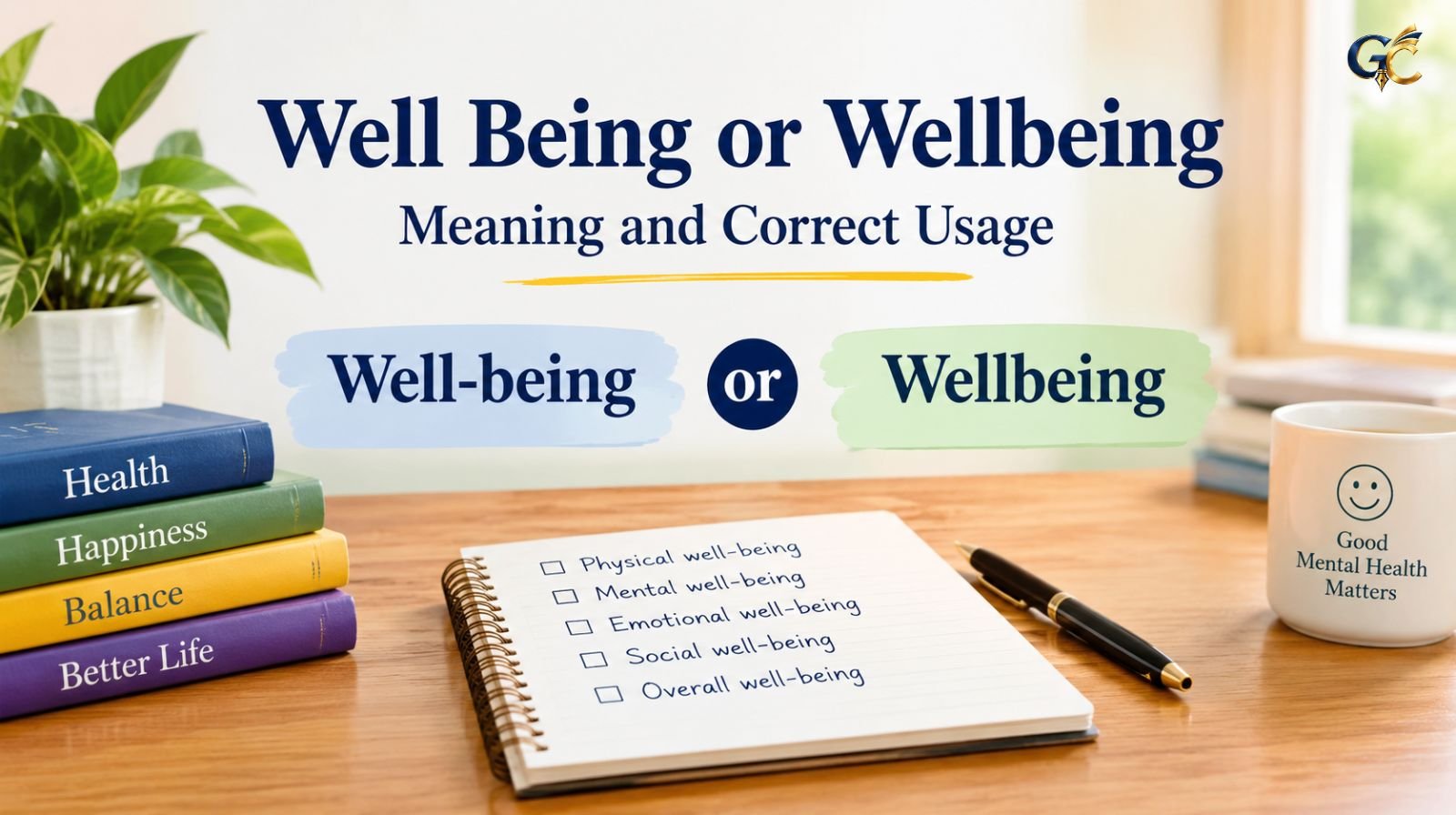
Have you ever stopped while writing to wonder whether well being or wellbeing is the correct spelling? You are not alone. These forms appear in articles, emails, school assignments, workplace documents, and discussions about health and happiness. However, another spelling, well-being, is also widely used.
The good news is that the difference is easy to understand once you know the standard spelling conventions. Well-being is the most widely accepted form in formal English, while wellbeing is also an established one-word variant. The two-word form well being is generally less preferred when you mean overall health, happiness, and welfare.
In this guide, you will learn what well-being means, which spelling to choose, how to use it in real sentences, and how to avoid common mistakes.
What Does Well-Being Mean?
Well-being refers to a person’s overall state of health, happiness, comfort, and satisfaction with life. It includes physical health, mental health, emotional balance, social relationships, and the ability to manage everyday challenges.
In simple terms, well-being describes how well someone is doing in life, not just whether they are free from illness.
Understanding the Meaning of Well-Being
Well-being is a broad concept that covers several areas of life.
For example:
- Physical well-being: Having energy, getting enough sleep, and maintaining good physical health.
- Mental well-being: Being able to manage stress and cope with everyday problems.
- Emotional well-being: Understanding and managing your emotions.
- Social well-being: Building healthy relationships and feeling connected to others.
- Financial well-being: Managing money in a way that supports stability and reduces financial stress.
These areas can influence one another. For instance, poor sleep may affect your mood, while supportive friendships can improve your emotional health.
Examples of Well-Being in Sentences
Here are some natural examples:
- Regular exercise can improve your physical well-being.
- The company introduced new policies to support employee well-being.
- Spending time with family contributes to emotional well-being.
- Schools should consider the mental well-being of their students.
- Getting enough rest is important for your overall well-being.
Notice that well-being works as a noun in each sentence.
Why Is Well-Being Important?
Well-being matters because it affects how people feel, think, work, learn, and interact with others. Someone may have no obvious physical illness but still experience stress, loneliness, or dissatisfaction.
For example, a student who sleeps well, has supportive friends, and manages schoolwork effectively may experience better overall well-being than a student who constantly feels overwhelmed.
Well-being is therefore about more than physical health. It includes the overall quality of a person’s life.
Well Being or Wellbeing: Which Spelling Is Correct?
Both well-being and wellbeing are accepted spellings of the noun referring to health, happiness, and general welfare. The main difference is spelling preference rather than meaning.
Well-Being: The Hyphenated Form
Well-being is a standard spelling used in formal and general English. It is a reliable choice for essays, professional documents, educational content, and everyday writing.
Examples:
- Exercise can improve your well-being.
- The school prioritizes students’ well-being.
- Good communication supports emotional well-being.
If you are unsure which spelling to use, the hyphenated form is a safe choice.
Wellbeing: The One-Word Form
Wellbeing is also a recognized spelling. Many organizations, educational institutions, and publications use this form in their writing.
Examples:
- The organization promotes employee wellbeing.
- Daily exercise supports mental wellbeing.
- The new program focuses on community wellbeing.
This spelling is common in some workplace, healthcare, educational, and organizational contexts.
Well Being: The Two-Word Form
When you mean the general condition of being healthy and happy, well being is usually not the preferred spelling. Choose well-being or wellbeing instead.
Compare these examples:
| Form | Example | Recommendation |
|---|---|---|
| Well-being | Sleep supports your well-being. | Standard choice |
| Wellbeing | Sleep supports your wellbeing. | Accepted alternative |
| Well being | Sleep supports your well being. | Usually avoid for this meaning |
The key is to choose a recognized form and use it consistently throughout your writing.
Well-Being vs. Wellbeing: Key Differences

Although these spellings have the same basic meaning, understanding their usage can help you write more confidently.
Meaning and Grammar
Both forms function as nouns. They describe a person’s general health, happiness, comfort, or welfare.
For example:
- Correct: Her well-being improved after she changed her routine.
- Also correct: Her wellbeing improved after she changed her routine.
Neither sentence changes meaning because of the spelling.
Regional and Editorial Preferences
Spelling preferences can vary between publications, organizations, and regions. Some style guides prefer the hyphenated form, while some institutions use the one-word spelling.
For example, a university may refer to its student wellbeing program, while a health publication may use mental well-being throughout its articles.
Neither preference automatically makes the other established form wrong.
Which Form Should You Choose?
Use this simple guide when deciding between the two spellings.
| Writing Situation | Recommended Form |
|---|---|
| General English writing | Well-being |
| Academic essay | Well-being, unless a style guide says otherwise |
| Workplace document | Follow the organization’s style |
| Blog post | Choose one accepted form and remain consistent |
| Official program name | Preserve its official spelling |
| Meaning health and happiness | Avoid the unhyphenated two-word form |
For your own writing, well-being is a safe default when no specific style guide applies.
How to Use Well-Being Correctly in Sentences
Understanding the definition is only the first step. You also need to know how the word fits naturally into everyday English.
Use Well-Being as a Noun
Well-being commonly appears after verbs such as improve, protect, support, and promote.
Examples:
- Walking every morning can improve your well-being.
- Parents should protect their children’s well-being.
- A supportive environment promotes employee well-being.
- Spending time outdoors may support mental well-being.
These examples show how the term describes a condition that can be supported or improved.
Use Common Expressions With Well-Being
Some word combinations are especially natural in English.
- Overall well-being: Your general condition across different areas of life.
- Mental well-being: Your psychological and emotional state.
- Physical well-being: The condition of your body and physical health.
- Emotional well-being: Your ability to understand and manage emotions.
- Employee well-being: The health and welfare of people in a workplace.
For example, you might write, “The school introduced a program to improve students’ overall well-being.”
This is clearer and more natural than saying, “The school introduced a program for students’ being well.”
Avoid Common Usage Mistakes
Watch out for these errors:
- Writing well being when you mean the established noun.
- Switching between well-being and wellbeing repeatedly in the same article without a reason.
- Assuming that well-being means only physical health.
- Confusing well-being with wellness, even though the terms overlap.
A useful rule is to treat well-being as a broad concept that includes physical, mental, emotional, and social health.
Why Well-Being Matters: 2025–2026 Statistics and Research
Well-being is more than a popular word in conversations about health. It is an important concept in public health, education, employment, and social research.
What Recent Research Tells Us
Research and workplace surveys highlight the importance of mental health, social connections, and employee experiences.
Here are two relevant statistics from recent reporting:
- 34% of employees worldwide were thriving in their lives in 2025. This figure was reported in Gallup’s 2026 workplace research, compared with 33% in 2024.
- 39% of adults worldwide reported experiencing worry for much of the previous day in 2024. This figure appeared in Gallup’s 2025 emotional health reporting.
These statistics measure different aspects of emotional and overall well-being. They show why mental health, workplace support, and healthy daily routines remain important topics.
What Do These Statistics Mean?
These findings show why well-being deserves attention in everyday life and the workplace. However, thriving in life is not the same as experiencing worry, and neither measure determines an individual’s complete health.
For writers, this research also provides context for why the term appears frequently in discussions about employee support, emotional health, and quality of life.
A Real-Life Example: Understanding Well-Being in Everyday Life

Consider this illustrative example of a person balancing work, family responsibilities, and personal health.
A Practical Example of Improving Well-Being
Sarah works full-time and spends most of her day sitting at a desk. Recently, she has started feeling tired, struggling to concentrate, and becoming frustrated by small problems. Although she has no obvious physical illness, she feels that her overall quality of life has declined.
At first, Sarah believes that she simply needs to work harder and finish her tasks faster. However, she gradually recognizes that several aspects of her routine may be affecting her well-being.
She begins taking short walking breaks, following a more regular sleep schedule, and setting boundaries around work after office hours. She also makes time to speak with friends and family instead of spending every evening checking emails.
After several weeks, Sarah notices that she feels more organized and has more opportunities to relax. These changes do not eliminate every challenge, but they help her develop a healthier routine.
Sarah’s experience illustrates how physical activity, rest, social connection, and reasonable boundaries can support different aspects of well-being.
What Can We Learn From This Example?
The main lesson is that well-being involves several connected areas of life. It is not limited to physical fitness or the absence of illness.
This example also demonstrates the correct use of the word:
- Sarah is improving her overall well-being.
- Her new routine supports her mental well-being.
- Spending time with loved ones contributes to her emotional well-being.
These sentences use the term naturally and correctly.
Note: Sarah’s story is illustrative, not a documented research case study.
FAQs
Q1: Is well-being one word or two?
A: Well-being is conventionally written with a hyphen. Wellbeing is also an accepted one-word spelling. When using the noun to mean health, happiness, or welfare, the unhyphenated two-word form is generally less preferred.
Q2: Is wellbeing or well-being correct in American English?
A: Both forms are used and understood. Well-being is a reliable default for American English, particularly in formal writing. Follow your publication’s preferred style if one exists.
Q3: Why is well-being hyphenated?
A: The hyphen reflects the conventional spelling of this compound noun. It helps distinguish the established term from the ordinary phrase well being, which is generally not used for the same noun meaning.
Q4: What is the difference between well-being and wellness?
A: Well-being describes a broad state of health, happiness, and welfare. Wellness often refers to practices or efforts intended to maintain or improve health. The meanings overlap, but they are not always interchangeable.
Q5: How do you use well-being in a sentence?
A: You can write, “Regular exercise and adequate sleep can support your overall well-being.” Other natural expressions include mental well-being, physical well-being, emotional well-being, and employee well-being.
Q6: Is wellbeing grammatically incorrect?
A: No. Wellbeing is an established spelling used by reputable dictionaries and many organizations. The choice between wellbeing and well-being is primarily a spelling and editorial-style matter.
Q7: Should I use well-being or wellbeing in a blog post?
A: Choose one form and use it consistently. If your website has no established style guide, well-being is a safe choice. Focus on clear explanations and natural language rather than repeating the keyword unnecessarily.
Q8: What is the plural of well-being?
A: Well-being is normally an uncountable noun, so it generally does not have a regular plural in this meaning. Use phrases such as “different aspects of well-being” instead of “well-beings.”
Conclusion:
When deciding between well being or wellbeing, remember that well-being is a reliable, widely accepted spelling, while wellbeing is also correct in established usage. Both generally refer to a person’s overall health, happiness, and welfare.
The two-word form well being is usually best avoided when you intend to use this established noun.
For everyday writing, academic assignments, and blog articles, choose the spelling that fits your style guide and remain consistent. Understanding the meaning and usage matters more than treating every spelling variation as an error.
👉 Discover more simple and practical grammar guides on Grammar Clear

Zia Ahmad is the founder of GrammarClear, an educational platform dedicated to making English grammar simple and easy to understand. Through clear explanations and practical examples, he aims to help learners improve their grammar, writing, and communication skills with confidence.

