
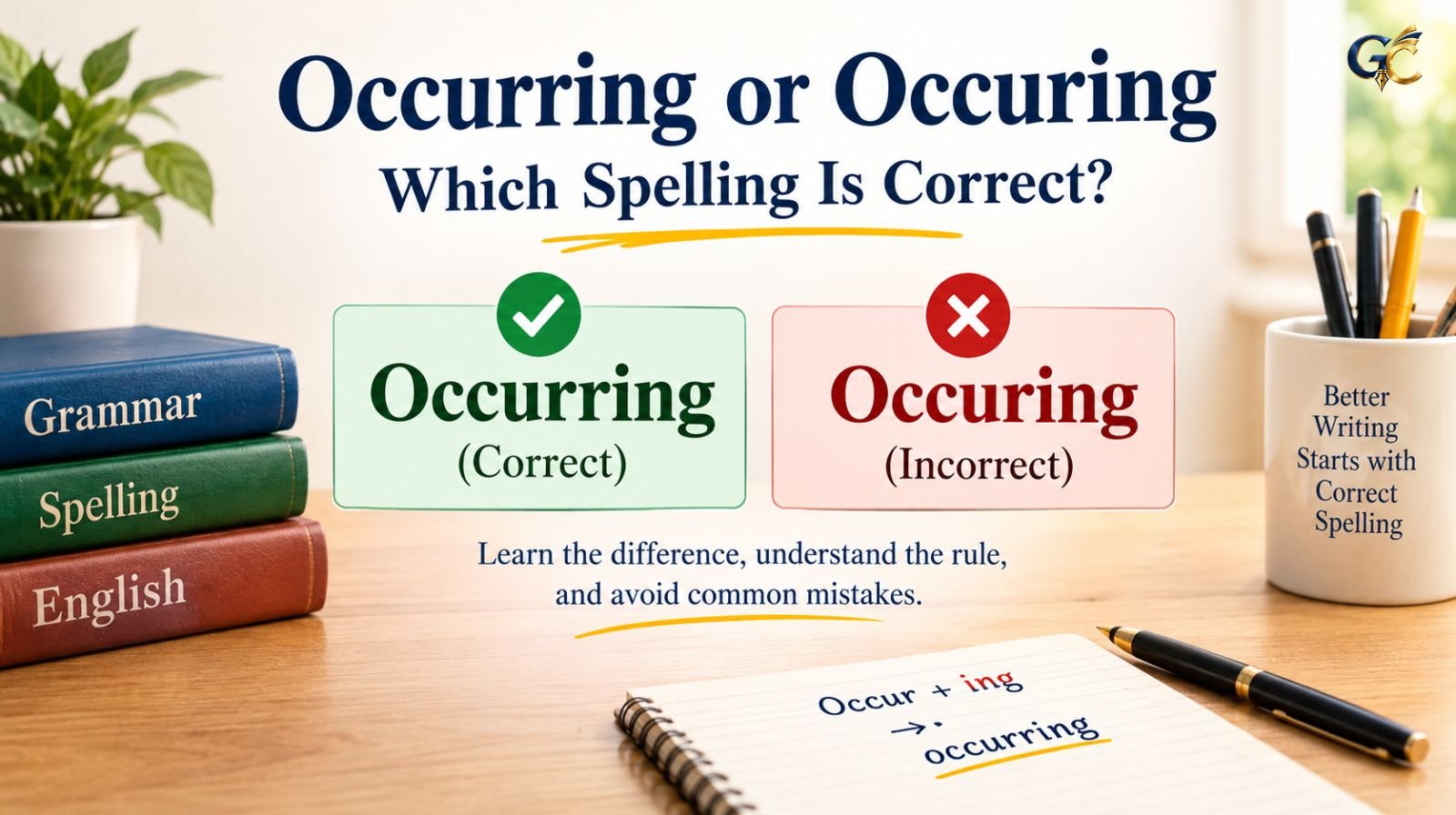
Have you ever paused while writing and wondered whether occurring or occuring is the correct spelling? You are not alone. This word can be confusing because the two spellings look almost identical, and the difference is just one letter.
The correct spelling is occurring, with two r’s before -ing. The spelling occuring, with only one r in that position, is incorrect in standard English. Occurring is the present participle of occur, which means to happen, take place, or exist.
In this guide, you will learn why occurring is correct, how to use it in sentences, and how to remember its spelling. You will also discover related words and practical tips to avoid this common spelling mistake.
Occurring or Occuring: What Is the Correct Spelling?
The correct spelling is occurring. Although occuring may look reasonable, it is a misspelling and should be avoided in formal and informal standard English.
Quick Answer
Here is the simplest way to remember the difference:
| Spelling | Correct or Incorrect? | Example |
|---|---|---|
| Occurring | Correct | The problem is occurring again. |
| Occuring | Incorrect | The problem is occuring again. |
For example:
- Correct: Several changes are occurring in the workplace.
- Incorrect: Several changes are occuring in the workplace.
The difference is the second r in occurring. When you add -ing to occur, you must double the final r.
What Does Occurring Mean?
Occurring means happening, taking place, or existing at a particular time or in a particular situation. It is commonly used when describing events, problems, changes, and repeated activities.
Consider these examples:
- A technical issue is occurring during the update.
- Unusual weather conditions are occurring this month.
- Several changes are occurring in the education system.
In each sentence, occurring describes something that is happening or taking place.
Is Occuring Ever Correct?
No. Occuring is not a standard alternative spelling of occurring in American or British English.
If you see this spelling in an email, article, school assignment, or business report, it should normally be corrected to occurring.
Why Is Occurring Spelled With Two R’s?
The reason is straightforward: the base verb is occur, and its standard -ing form is occurring. The final r doubles when the suffix is added.
Understanding the Spelling Rule
Start with the base word:
Occur + ing = occurring
The verb occur has two c’s and one final r. When you form the present participle, the final r doubles, giving you two consecutive r’s before -ing.
The complete spelling is:
O-C-C-U-R-R-I-N-G
This is a useful pattern to memorize because the additional r is easy to overlook when typing quickly.
Examples of Similar Words
English uses consonant doubling in several other verbs when certain spelling and stress conditions are met.
| Base Verb | Correct Form | Example |
|---|---|---|
| Begin | Beginning | The meeting is beginning now. |
| Prefer | Preferring | She is preferring the simpler option. |
| Refer | Referring | I am referring to the latest report. |
| Occur | Occurring | A problem is occurring again. |
These examples demonstrate how consonant doubling works in common English word forms. However, the rule depends on the word’s spelling and stress pattern, so it does not apply to every verb.
An Easy Memory Trick
Use this simple pattern:
Occur → Occurring → Occurred
Remember that both occurring and occurred contain two r’s.
You can also think of it this way: when something continues to happen, it is occurring. Keep the extra r in the word.
For example:
- The error keeps occurring.
- The error occurred yesterday.
Remembering these related forms together makes it easier to avoid both occuring and occured.
How to Use Occurring Correctly in Sentences
Understanding the spelling is important, but knowing how to use the word correctly makes your writing clearer.
Everyday Examples of Occurring
Here are some natural examples from everyday situations:
- Work: Several technical problems are occurring during the installation.
- Education: Significant changes are occurring in the education system.
- Weather: Heavy rainfall is occurring across the region.
- Technology: An unexpected error is occurring on my computer.
- Daily life: These misunderstandings are occurring more frequently.
Each example uses occurring to describe an event, process, or situation that is happening.
Occurring in Different Sentence Structures
Occurring often appears with forms of be, such as is, are, and was, or after verbs such as keep and continue.
Examples include:
- The problem is occurring right now.
- Several incidents are occurring simultaneously.
- The same issue was occurring last week.
- Errors keep occurring when I open the application.
- The changes are continuing to occur throughout the year.
Notice that the correct spelling remains occurring regardless of the surrounding words.
Common Mistakes to Avoid
Writers sometimes make related spelling errors because the word family contains several forms that look similar.
| Incorrect | Correct |
|---|---|
| Occuring | Occurring |
| Occured | Occurred |
| Occurence | Occurrence |
For example:
- Incorrect: The error is occuring again.
- Correct: The error is occurring again.
- Incorrect: The problem occured yesterday.
- Correct: The problem occurred yesterday.
- Incorrect: It was an unusual occurence.
- Correct: It was an unusual occurrence.
Learning the complete word family helps you recognize these errors more quickly.
Occurring vs. Occurred vs. Occurrence
Although these words share the same base, they have different grammatical functions. Understanding those differences will help you choose the right form for each sentence.
What Is the Difference?
- Occur: The base verb, meaning to happen or take place.
- Occurring: The -ing form, used for something happening or taking place.
- Occurred: The past tense and past participle of occur.
- Occurrence: A noun referring to an event or the fact that something happens.
For example:
- Mistakes sometimes occur during testing.
- Mistakes are occurring during testing.
- A mistake occurred during testing yesterday.
- The mistake was an unusual occurrence.
These words are related, but they cannot always replace one another. Choose the form that fits the meaning and grammar of your sentence.
A Step-by-Step Spelling Checklist
Use this checklist whenever you are unsure about occurring or a related word.
- Identify the base verb: occur.
- Decide which form you need: occurring, occurred, or occurrence.
- Remember that the longer forms contain a double r.
- Check your spelling before submitting or publishing your writing.
- Use a trusted dictionary if you remain uncertain.
This simple process is particularly helpful when writing school assignments, professional emails, reports, and online articles.
A Real-Life Example: Correcting a Workplace Report
Imagine that a marketing assistant is preparing a weekly report about a website problem. The assistant writes, “The same loading error has been occuring throughout the week.”
At first glance, the sentence looks understandable. The reader can easily work out the intended meaning. However, the spelling error makes the report appear less polished and may distract from the technical issue being discussed.
The assistant checks the verb occur and realizes that the correct present participle is occurring. The sentence is revised to read, “The same loading error has been occurring throughout the week.”
The assistant then reviews the rest of the report and notices two related mistakes: occured in a description of an earlier incident and occurence in a sentence about the frequency of the problem. Both are corrected to occurred and occurrence.
Finally, the assistant runs a spelling check and reads the report again before sending it to the manager.
This example illustrates a practical lesson: a spelling mistake does not necessarily prevent readers from understanding a sentence, but correcting it improves clarity and professionalism. Recognizing the relationship between occur, occurring, occurred, and occurrence also helps prevent similar errors in future documents.
Occurring or Occuring: What Do Dictionaries and Recent Data Tell Us?
Reliable spelling guidance is more useful than guessing from pronunciation or relying on a word’s appearance. Dictionaries provide established spellings, while current research can help explain the broader importance of accurate writing.
What Authoritative References Say
The standard spelling is occurring. The Government of Canada’s Language Portal explicitly identifies occurring, occurred, and occurrence as forms spelled with a double r. Merriam-Webster and Cambridge Dictionary are also useful references for checking word forms and meanings.
These references support the standard spelling and help distinguish the verb from its related forms.
What About 2025–2026 Spelling Statistics?
As of October 2026, I could not verify a reliable, authoritative 2025–2026 statistic measuring how often English writers misspell occurring specifically as occuring. Therefore, it would be misleading to invent a percentage or claim that a particular number of people make this mistake.
There is an important distinction between general writing research and data about an individual spelling error. Statistics about overall literacy, spelling performance, or digital writing do not automatically establish how frequently this particular mistake occurs.
For practical purposes, the established spelling rule and authoritative dictionary entries provide a reliable basis for choosing the correct form.
How to Improve Your Spelling Accuracy
You do not need complicated techniques to avoid this error. A few consistent habits can make your writing more accurate.
- Learn related word forms together.
- Read your work aloud and check the written form separately.
- Use a spell-checking tool before publishing.
- Keep a personal list of words you often misspell.
- Consult a dictionary when a spelling seems uncertain.
These habits are useful for students, professionals, bloggers, and anyone who wants to communicate clearly in English.
FAQs
Q1: Is it occurring or occuring?
A: Occurring is correct. Occuring is a misspelling. The correct form contains two r’s before -ing.
Q2: Why does occurring have two r’s?
A: The word comes from the verb occur. When the -ing suffix is added, the final r doubles, producing occurring.
Q3: What does occurring mean?
A: Occurring means happening, taking place, or existing in a particular situation. For example, “Several problems are occurring during the test.”
Q4: Is occurring correct in American and British English?
A: Yes. Occurring is the standard spelling in both American and British English. Occuring is not a standard regional alternative.
Q5: What is the difference between occurring and occurred?
A: Occurring is the -ing form, while occurred is the past tense and past participle.
Examples:
- The problem is occurring now.
- The problem occurred yesterday.
Q6: Is occurrence spelled with two r’s?
A: Yes. The correct spelling is occurrence, which contains two c’s and two r’s. The spelling occurence is incorrect.
Q7: How can I remember the spelling of occurring?
A: Remember the pattern occur → occurring → occurred. Both occurring and occurred contain two r’s. Repeating the word family can help you remember the correct spelling.
Q8: Can I use occurring in formal writing?
A: Yes. Occurring is appropriate in academic writing, professional reports, emails, and articles whenever its meaning and grammatical form fit the sentence.
Conclusion:
When deciding between occurring or occuring, always choose occurring. It is the correct spelling in standard English, while occuring is a misspelling.
The easiest way to remember the difference is to start with the base verb occur. When you add -ing, the final r doubles, giving you occurring. The same pattern helps you remember occurred, while the related noun is spelled occurrence.
For example, write “The problem is occurring again,” not “The problem is occuring again.”
👉 Discover more simple and practical grammar guides on Grammar Clear

Zia Ahmad is the founder of GrammarClear, an educational platform dedicated to making English grammar simple and easy to understand. Through clear explanations and practical examples, he aims to help learners improve their grammar, writing, and communication skills with confidence.

