
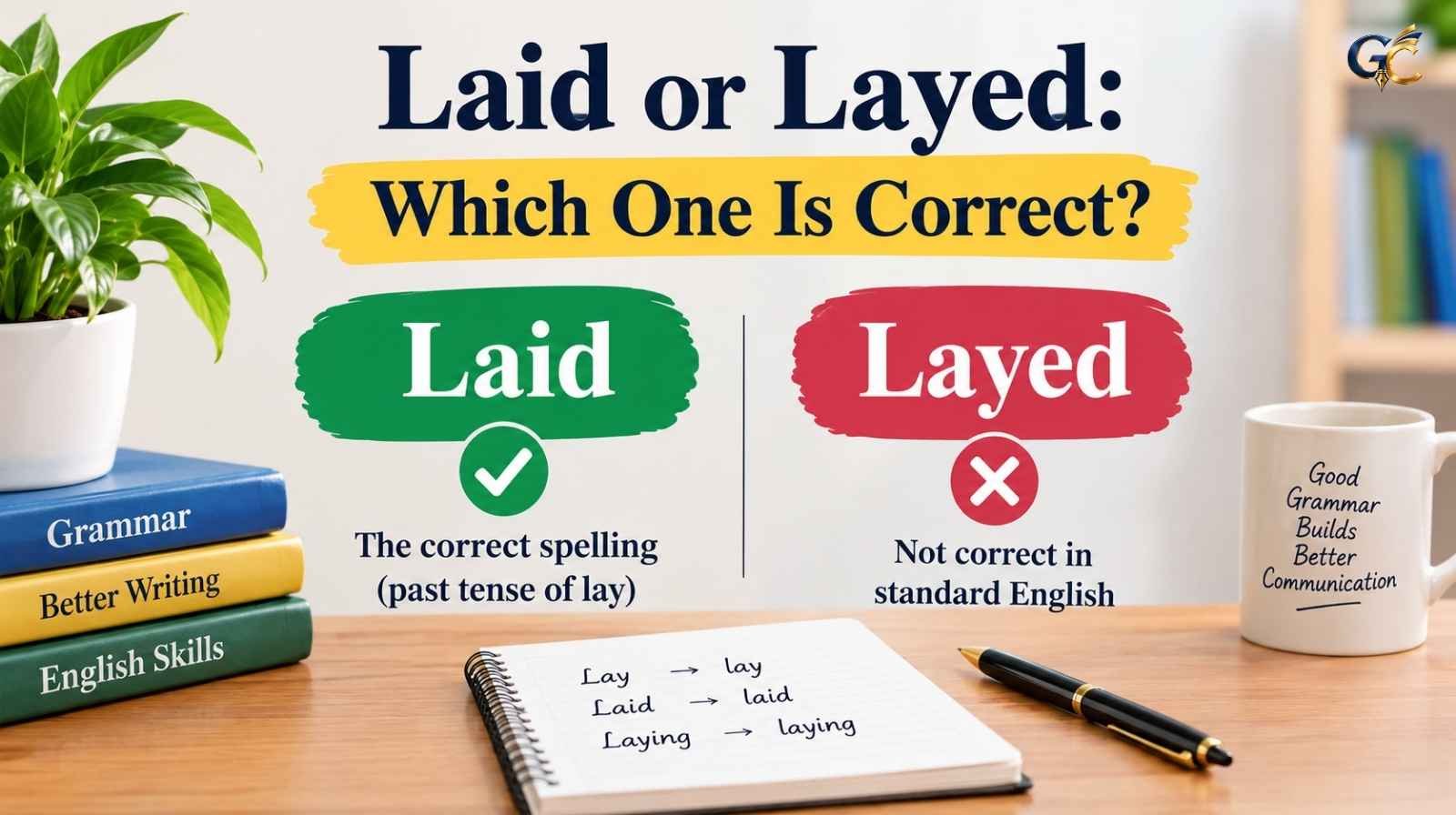
Have you ever wondered whether to write laid or layed in a sentence? These two spellings look similar and sound almost identical, so it is easy to confuse them. However, only one is the standard spelling of the past tense of the verb lay.
Laid is correct, while layed is a nonstandard spelling. If you want to write grammatically correct English, use laid when describing something that someone placed down, arranged, or set in position.
For example:
- Correct: She laid the book on the table.
- Incorrect: She layed the book on the table.
In this guide, you will learn why laid is correct, how to use it in everyday writing, how it differs from lay, and how to avoid common mistakes. You will also discover a simple way to remember the correct spelling.
What Is the Difference Between Laid and Layed?

The main difference between laid and layed is that laid is the standard past tense and past participle of lay, whereas layed is generally considered incorrect in standard English.
What Does Laid Mean?
Laid is the past tense and past participle of lay, which means to put or place something somewhere.
You use laid when someone has placed an object, arranged something, or established something.
Examples:
- He laid his jacket on the chair.
- Maria laid the documents on my desk.
- The workers laid new tiles in the kitchen.
- The committee laid out its plans for the project.
- The hen has laid three eggs.
In each sentence, laid describes an action involving placing, arranging, or producing something.
Is Layed a Correct Word?
Layed is a common spelling mistake that people sometimes make when they assume the past tense of lay follows the regular pattern of adding -ed.
For example, regular verbs often form their past tense by adding -ed:
- Walk → walked
- Clean → cleaned
- Open → opened
However, lay has an irregular past-tense form. Its correct form is laid, not layed.
Therefore, use laid in formal writing, school assignments, emails, articles, and professional documents.
Quick Comparison: Laid vs. Layed
| Word | Correct in standard English? | Example |
|---|---|---|
| Laid | Yes | She laid the blanket on the bed. |
| Layed | No, as the standard past tense of lay | She layed the blanket on the bed. |
Easy rule: When you mean that someone placed something down, choose laid, not layed.
Why Is Laid the Correct Spelling?
English contains many irregular verbs whose past-tense forms do not follow the usual spelling pattern. Lay is one of them. Instead of becoming layed, it becomes laid.
Understanding the Verb Lay
The verb lay means to put something down or place it in a particular position. It normally takes an object.
Examples:
- I lay the keys on the counter every evening.
- She lays the baby in the crib carefully.
- They laid the foundation for the new building.
- He has laid the papers in alphabetical order.
Notice that the object being placed is clear in each example: the keys, the baby, the foundation, or the papers.
The Verb Forms of Lay
Learning the different forms of lay makes it easier to remember the correct spelling.
| Verb form | Correct word | Example |
|---|---|---|
| Base form | Lay | Please lay the towel here. |
| Third-person singular | Lays | He lays the tools on the shelf. |
| Present participle | Laying | She is laying the table. |
| Simple past | Laid | I laid the book down. |
| Past participle | Laid | They have laid the carpet. |
As the table shows, laid is used for both the simple past tense and the past participle.
Why Do People Write Layed?
People often write layed because they apply a familiar spelling rule to an irregular verb. They may know that adding -ed forms the past tense of many English verbs and assume the same rule applies here.
Another reason is pronunciation. Laid and layed are usually pronounced the same way, making the difference difficult to hear.
For example, someone might write, “He layed his phone on the desk,” because the spelling seems logical. Nevertheless, the standard written form is “He laid his phone on the desk.”
Remember that English spelling does not always follow one consistent pattern. Learning common irregular verbs is one of the best ways to improve your writing.
When Should You Use Laid in a Sentence?

You should use laid whenever you need the past tense or past participle of lay. It can describe placing an object, preparing something, establishing a foundation, or producing eggs.
Everyday Examples of Laid
Here are some examples that show how laid works in everyday English:
- At home: She laid the baby gently in the crib.
- At school: The student laid her notebook on the teacher’s desk.
- At work: The manager laid out the new rules for the team.
- In construction: The workers laid the bricks carefully.
- In nature: The turtle laid its eggs in the sand.
- In planning: The agreement laid the groundwork for future cooperation.
These examples demonstrate that laid has several meanings, but the spelling remains the same.
Laid vs. Lay: Do Not Confuse Them
One reason people struggle with laid or layed is that they sometimes confuse lay with lie. Although these verbs are related in meaning, their forms are different.
- Lay: To put something down.
- Laid: The past tense of lay.
- Lie: To recline or rest in a horizontal position.
- Lay: The past tense of lie when it means to recline.
For example:
- Present: I lay the book on the table.
- Past: I laid the book on the table.
- Present: I lie on the sofa.
- Past: I lay on the sofa.
The last example is particularly important. When you describe resting or reclining in the past, lay is correct, not laid.
Common Mistakes and Their Corrections
| Incorrect sentence | Correct sentence |
|---|---|
| She layed the baby down. | She laid the baby down. |
| He has layed the papers on the desk. | He has laid the papers on the desk. |
| They layed the carpet yesterday. | They laid the carpet yesterday. |
| The hen layed an egg. | The hen laid an egg. |
| I layed my phone beside the bed. | I laid my phone beside the bed. |
The easiest way to avoid these mistakes is to identify the verb’s meaning before choosing its form.
A Real-Life Example: How a Small Spelling Mistake Can Affect Your Writing
Imagine a student named Daniel who is preparing an English assignment about his weekend activities. He writes the following sentence:
“On Saturday, I layed my clothes on the bed and organized my room.”
Daniel understands the meaning of the sentence perfectly. He knows that he placed his clothes on the bed before organizing everything. However, he has used the wrong spelling.
His teacher points out that layed should be laid. Daniel initially wonders why, because he knows that words such as played and stayed use the -ed ending. He assumes that lay should follow the same pattern.
To correct the mistake, Daniel learns the verb forms:
- Present: I lay my clothes on the bed.
- Past: I laid my clothes on the bed.
- Present perfect: I have laid my clothes on the bed.
He then reviews his assignment and finds two more sentences containing the same error. After correcting them, he checks other irregular verbs in his work.
The experience teaches Daniel an important lesson: English verbs do not all follow the same spelling rules. He begins keeping a short list of irregular verbs, including lay/laid, write/wrote, and take/took.
When Daniel writes his next assignment, he remembers that laid is the correct past-tense form. His writing becomes more accurate because he understands the underlying rule rather than simply memorizing a single correction.
The lesson: A small spelling mistake can be easy to overlook, but understanding irregular verb forms helps you write more confidently in school, at work, and online.
Laid or Layed: What Do the 2025–2026 References Say?

When checking a grammar question, it is important to distinguish established spelling rules from statistics about how frequently people make a mistake.
What Current Dictionary Guidance Confirms
The Cambridge Dictionary’s grammar guidance identifies laid as the past simple and past participle of lay. It explicitly gives layed as an incorrect spelling in this context.
This supports the standard usage rule in 2026: write laid when you mean the past tense or past participle of lay.
Are There Statistics About Laid vs. Layed?
There is no verified, authoritative 2025–2026 statistic available in the sources consulted here that establishes the percentage of writers who use layed instead of laid. It would be misleading to invent a figure or present search interest as proof of spelling accuracy.
However, reliable reference sources provide clear grammatical evidence:
For writers, the practical conclusion is straightforward: use the established dictionary form, laid, and consult reputable grammar references whenever a verb’s form is uncertain.
How to Remember the Correct Spelling of Laid

If you regularly confuse laid and layed, a simple memory technique can help you avoid the mistake.
Use the Laid, Not Layed Rule
Remember this sentence:
“Yesterday, I laid it down.”
The word laid is the correct past tense of lay. Repeating this short sentence can help you associate the correct spelling with a past action.
You can also memorize these three forms:
- Today: I lay the book on the desk.
- Yesterday: I laid the book on the desk.
- Before now: I have laid the book on the desk.
Follow This Three-Step Checklist
Whenever you are unsure whether to write laid or layed, follow these steps:
- Identify the meaning. Are you describing placing something down?
- Check the tense. Are you talking about the past or using a past participle?
- Choose the spelling. Use laid rather than layed.
For example, if you want to describe placing your bag on a chair yesterday, write, “I laid my bag on the chair yesterday.”
This checklist works well for essays, emails, blog posts, and everyday messages.
Learn Related Irregular Verbs
Practicing other irregular verbs can improve your overall spelling and grammar.
| Present tense | Past tense | Past participle |
|---|---|---|
| Lay | Laid | Laid |
| Write | Wrote | Written |
| Take | Took | Taken |
| Break | Broke | Broken |
| Speak | Spoke | Spoken |
Learning these patterns will help you recognize why adding -ed does not always produce the correct past tense.
FAQs
Q1: Is It Laid or Layed?
A: Laid is correct. It is the standard past tense and past participle of lay. Layed is a nonstandard spelling when used with this meaning.
Correct: She laid the keys on the table.
Incorrect: She layed the keys on the table.
Q2: Is Layed Ever Correct?
A: Layed is not the standard spelling of the past tense of lay. In ordinary modern English writing, use laid instead. If you encounter layed in an older text, a quotation, or a specialized context, consider that context rather than assuming it is standard usage.
Q3: Is It Laid Down or Layed Down?
A: Laid down is the correct form when you mean that someone placed something down.
For example:
- Correct: He laid down his tools.
- Incorrect: He layed down his tools.
However, if you mean that someone reclined, the usual expression is lay down: “He lay down to rest.”
Q4: Is It Laid or Layed an Egg?
A: The correct expression is laid an egg.
For example: “The hen laid an egg this morning.”
The verb lay can mean to produce an egg, and its past tense is laid, not layed.
Q5: Is Laid the Past Tense of Lay?
A: Yes. Laid is both the simple past tense and the past participle of lay.
Examples:
- Simple past: She laid the blanket on the bed.
- Past participle: She has laid the blanket on the bed.
Q6: What Is the Difference Between Lay and Laid?
A: Lay is the base form of a verb meaning to put or place something down. Laid is its past tense and past participle.
For example:
- Present: I lay the book on the desk.
- Past: I laid the book on the desk.
Remember that lay can also be the past tense of lie when lie means to recline.
Q7: Why Do People Spell Laid as Layed?
A: People often assume that lay follows the regular rule of adding -ed to form the past tense. However, lay is irregular, so its correct past-tense form is laid. Pronunciation also contributes to the confusion because the two spellings sound alike.
Q8: How Can I Use Laid Correctly in a Sentence?
A: Use laid when describing a past action involving placing something, or when using the past participle of lay.
Examples:
- She laid her phone beside the computer.
- They laid the foundation last year.
- He has laid the documents on the desk.
If you remember that the correct verb forms are lay, laid, and laid, you can avoid the most common spelling error.
Conclusion:
When choosing between laid or layed, the correct spelling is laid. It is the standard past tense and past participle of the verb lay, which means to put or place something somewhere.
Use laid in sentences such as “She laid the book on the table” and “They have laid the new flooring.” Avoid layed in standard English writing because it is not the accepted form of this verb.
Also, remember the difference between lay and lie. The past tense of lay is laid, while the past tense of lie (meaning to recline) is lay.
👉 Discover more simple and practical grammar guides on Grammar Clear

Zia Ahmad is the founder of GrammarClear, an educational platform dedicated to making English grammar simple and easy to understand. Through clear explanations and practical examples, he aims to help learners improve their grammar, writing, and communication skills with confidence.

