
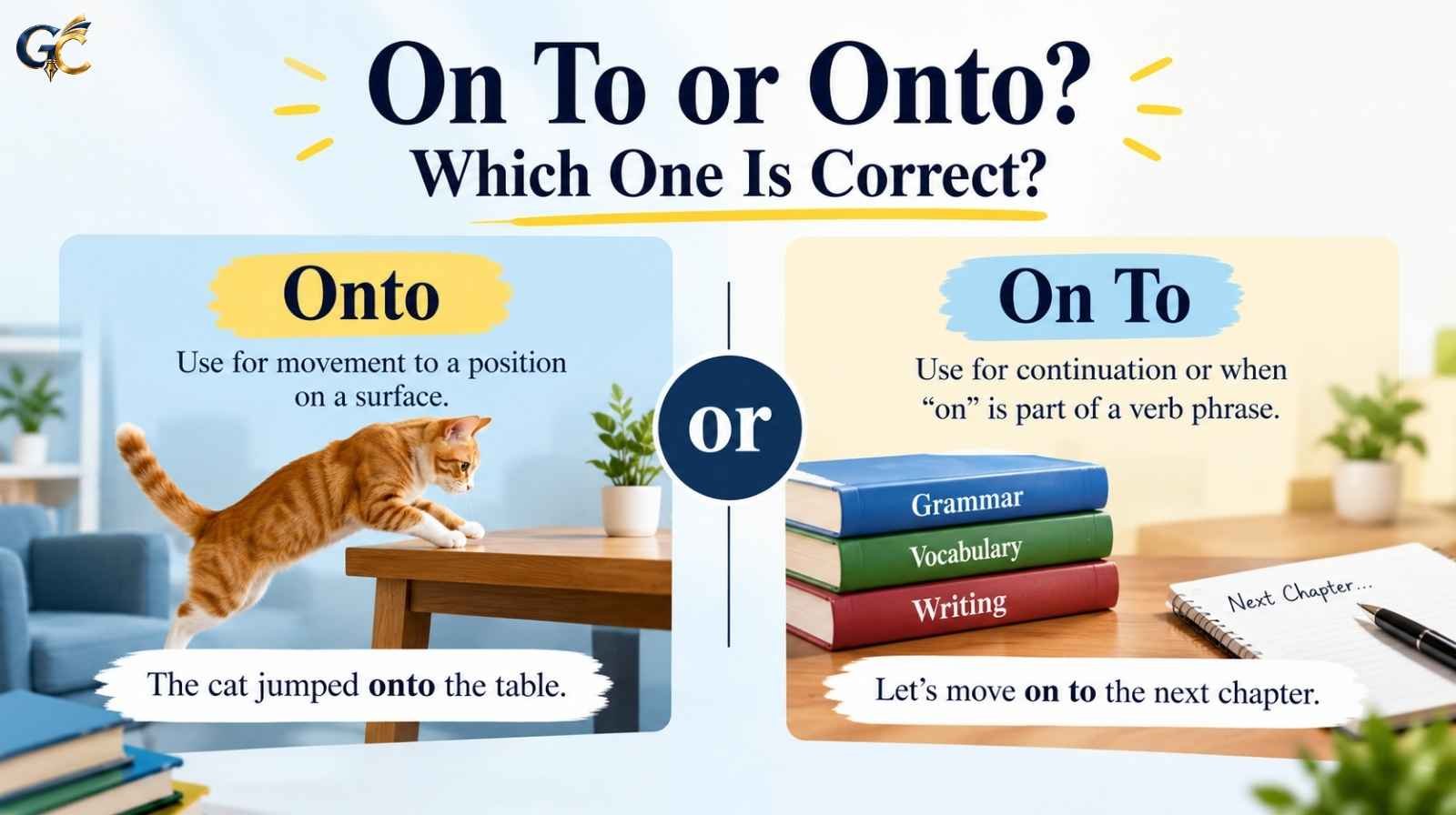
Have you ever wondered whether you should write “on to” or “onto”? You’re not alone. These two forms look almost identical, and in some sentences, either form may appear possible. However, on to and onto are not always interchangeable.
The basic rule is simple: onto is usually used when something moves to a position on a surface, while on to is often used when on belongs to a verb or phrase and to introduces what comes next. Cambridge Dictionary describes onto as a preposition commonly used for movement to a position on a surface.
For example:
- The cat jumped onto the table.
- We moved on to the next topic.
In this guide, you’ll learn exactly when to use onto, when to use on to, why the difference matters, and how to remember the rule easily.
What Is the Difference Between On To and Onto?
The main difference comes from how the words function in a sentence.
When to use onto
Use onto as a single word when it means movement to a position on a surface or on top of something.
Examples:
- The child climbed onto the bed.
- The bird flew onto the roof.
- She placed the bag onto the chair.
- Water spilled onto the floor.
Cambridge explains that onto is used to show movement into or onto a particular place.
When to use on to
Use on to as two words when on and to have separate grammatical jobs.
For example:
We moved on to the next chapter.
Here, move on means to continue or progress. The word to introduces the next destination or subject.
Other examples include:
- Let’s move on to the next question.
- She went on to become a successful writer.
- He passed the message on to his manager.
- I will go on to explain the second point.
A quick test
Ask yourself:
Does “onto” mean “to a position on a surface”?
If yes, onto is usually appropriate.
The dog jumped onto the sofa.
If on is part of a verb or expression, keep on to separate.
We moved on to another subject.
When Should You Use Onto?
Onto is commonly used with verbs that express movement toward a surface or position.
Onto for physical movement
Consider these examples:
The boy jumped onto the bus.
The cat climbed onto the roof.
She stepped onto the stage.
The ball rolled onto the road.
In each example, something moves toward or arrives at a position on a surface.
Cambridge gives the same basic distinction: onto describes direction or movement to a position on a surface.
Onto for placing something
You can also use onto when an object is moved or transferred to a surface.
For example:
- He poured the water onto the ground.
- She transferred the files onto the new computer.
- The worker loaded the boxes onto the truck.
- I dropped my keys onto the table.
Purdue OWL similarly explains on + to as forming onto when it expresses movement toward a surface.
Onto can have other meanings
Onto isn’t limited to physical movement.
It can also mean that someone has discovered or become aware of something:
The detective was onto the suspect’s plan.
It can also occur when someone begins discussing a different subject:
How did we get onto this topic?
Cambridge lists onto with several established meanings beyond simple physical movement.
When Should You Use On To?
The two-word form on to is especially important when on is part of a phrasal verb.
On to after phrasal verbs
A phrasal verb can contain on, while to has a separate function.
For example:
We moved on to the next lesson.
The phrase move on means “continue.” The word to then introduces the next lesson.
Other examples include:
- She went on to study medicine.
- Let’s move on to the next question.
- He handed the responsibility on to his assistant.
- The teacher went on to explain the answer.
Dictionary.com gives the same type of distinction, explaining that on to can occur when on is part of a phrasal verb and to performs its own grammatical role.
On to after “hold on”
One particularly common expression is hold on to.
Please hold on to the railing.
Here, hold on is the expression, and to introduces the thing being held.
Therefore, writing hold onto is also common in modern English in some contexts, but when you want to make the separate grammatical roles especially clear, hold on to is straightforward.
Compare:
- Hold on to your passport.
- Hold onto the railing.
Both forms can be encountered, but the first clearly preserves hold on + to.
On to does not mean “wrong”
It’s important not to think of onto as the “correct” version and on to as the “incorrect” version.
Both are correct.
The correct choice depends on meaning and sentence structure.
On To vs. Onto: Comparison Table
| Feature | Onto | On to |
|---|---|---|
| Number of words | One | Two |
| Common function | Preposition | Separate words with separate functions |
| Main idea | Movement to a position on a surface | Continuation, progression, or phrasal-verb structure |
| Example | The cat jumped onto the table. | We moved on to the next topic. |
| Common pattern | climb onto, jump onto, step onto | move on to, go on to, hold on to |
| Can indicate awareness? | Yes: “I’m onto your plan.” | Usually not in this meaning |
The distinction is supported by Cambridge, Purdue OWL, and other established grammar references.
A Simple Trick to Remember On To or Onto
This is one of the easiest ways to remember the difference.
The cat jumped onto the table.
The cat moved to a position on the table.
She stepped onto the platform.
She moved to a position on the platform.
Therefore, onto works naturally.
Keep “on to” separate when “on” belongs to the verb
Now consider:
Let’s move on to the next subject.
You cannot replace this naturally with “on top of.”
The expression is move on, followed by to the next subject.
So:
move on + to the next subject → move on to the next subject
This same principle works with many other expressions:
- go on to
- move on to
- pass on to
- hold on to
- carry on to
Grammar references commonly recommend looking at the grammatical role of on and to, rather than simply memorizing isolated sentences.
Real-Life Example: Choosing the Correct Form
Imagine you’re writing an email about a presentation.
You want to say that your colleague finished discussing one subject and began discussing another. You write:
“After discussing the budget, Sarah moved onto the marketing plan.”
Is onto necessarily wrong?
Not always. Modern English does use onto for transitions between subjects, and Cambridge’s dictionary includes a subject-changing use.
However, if your intended structure is clearly the phrasal verb move on, then:
“After discussing the budget, Sarah moved on to the marketing plan.”
makes the grammatical structure especially clear.
Now imagine a different situation. Sarah physically walks onto a stage:
“Sarah stepped onto the stage.”
Here, there is physical movement toward a surface, so onto is the natural choice.
This example shows why simply memorizing “one word versus two words” is not enough. Meaning and grammatical structure both matter.
For writers, editors, and students, the safest approach is to examine the verb first. Ask whether on forms part of the verb or whether the sentence describes movement to a surface. That small check can prevent many common errors.
2025–2026 Data and Usage Snapshot
There is an important limitation when discussing statistics about on to vs. onto: there is no authoritative 2025–2026 statistic showing what percentage of English writers use one form incorrectly.
It would therefore be misleading to invent a search-volume percentage or claim that one spelling is universally more common.
However, current reference data provides useful evidence about how the forms are treated today.
What current sources show
- Cambridge Dictionary currently lists “onto” as a preposition and identifies movement to a position on or in a particular place as a core use.
- Cambridge also records “on to” as an alternative form in its dictionary entry.
- Oxford Learner’s Dictionaries likewise lists onto as a preposition used with verbs to express movement to a particular place or position.
- Google’s 2025 search data reported that searches beginning with “How do I…” increased by 25% year over year, showing continued growth in question-style searches; this is broader search behavior, not a statistic specifically about onto or on to.
- Google also explains that Google Trends can compare exact search terms and different ways of phrasing or spelling a query, but search interest should not be confused with grammatical correctness.
The practical 2025–2026 takeaway: both onto and on to remain established forms, and the correct choice depends primarily on the grammatical role and intended meaning not on which form appears more frequently online.
Common Mistakes With On To and Onto
Mistake 1: Using onto after every verb
Incorrect thinking:
“If there is movement, I should always use onto.”
Not necessarily.
For example:
We moved on to the next lesson.
This is about progression, not movement onto a physical surface.
Mistake 2: Assuming on to is always two separate ideas
Sometimes onto is clearly the appropriate preposition:
The child climbed onto the roof.
Separating it as:
The child climbed on to the roof.
is possible in some varieties and contexts, but onto is the straightforward choice when the meaning is movement to a surface.
Mistake 3: Confusing “hold on to” with physical movement
Consider:
Hold on to the rope.
Here, hold on is the expression.
You are not describing someone moving onto the rope. Therefore, on to clearly makes sense.
Mistake 4: Thinking there is one universal rule
English usage contains some gray areas. Cambridge explicitly notes that on and onto can sometimes have very little difference in meaning, particularly with attachment or movement.
So context matters.
FAQs
Q1: Is “onto” one word or two?
A: Onto is normally written as one word when it functions as a preposition meaning movement to a position on a surface.
Example:
The dog jumped onto the bed.
However, on to is correctly written as two words when on and to have separate grammatical functions.
Q2: Is “on to” grammatically correct?
A: Yes. On to is grammatically correct when on and to are functioning separately.
Example:
Let’s move on to the next chapter.
Q3: Is “onto” always correct for movement?
A: No. Although onto commonly expresses movement to a surface, not every sentence involving movement requires it.
For example:
She went on to become a doctor.
This describes progression in an activity or life path, not movement onto a physical surface.
Q4: Which is correct: “move onto” or “move on to”?
A: Both can be correct depending on meaning and style.
Move onto the platform.
means move to a position on the platform.
Move on to the next question.
means continue to the next question.
Q5: Is “hold onto” correct?
A: Yes. Hold onto is widely used, and hold on to is also standard.
For example:
Hold onto the railing.
or
Hold on to the railing.
When the sentence clearly contains the phrasal verb hold on, the two-word form makes that structure visible.
Q6: Is “go onto” correct?
A: It can be correct when onto expresses movement to a surface or position.
The athlete went onto the field.
But if go on is the phrasal verb followed by another destination or activity, use on to:
She went on to study law.
Q7: Is “onto” formal English?
A: Yes. Onto is a standard English preposition and is listed in major dictionaries, including Cambridge and Oxford.
Q8: How can I quickly remember the difference?
A: Think:
ONTO = movement to/on a surface
Jump onto the table.
ON TO = on + to
Move on to the next topic.
Then check the meaning of the entire sentence before deciding.
Final Verdict:
So, which one is correct: on to or onto?
Both are correct. The right choice depends on what you mean and how the sentence is constructed.
Use onto when you mean movement to a position on a surface, such as:
The cat jumped onto the sofa.
Use on to when on belongs to a verb or expression and to introduces what follows:
We moved on to the next topic.
The easiest rule to remember is:
Onto = to a position on something.
On to = on + to, when the two words have separate jobs.
Once you start looking at the verb and the meaning of the sentence, choosing between on to and onto becomes much easier.
👉 Explore more useful grammar tips and guides on Grammar Clear

Zia Ahmad is the founder of GrammarClear, an educational platform dedicated to making English grammar simple and easy to understand. Through clear explanations and practical examples, he aims to help learners improve their grammar, writing, and communication skills with confidence.

