
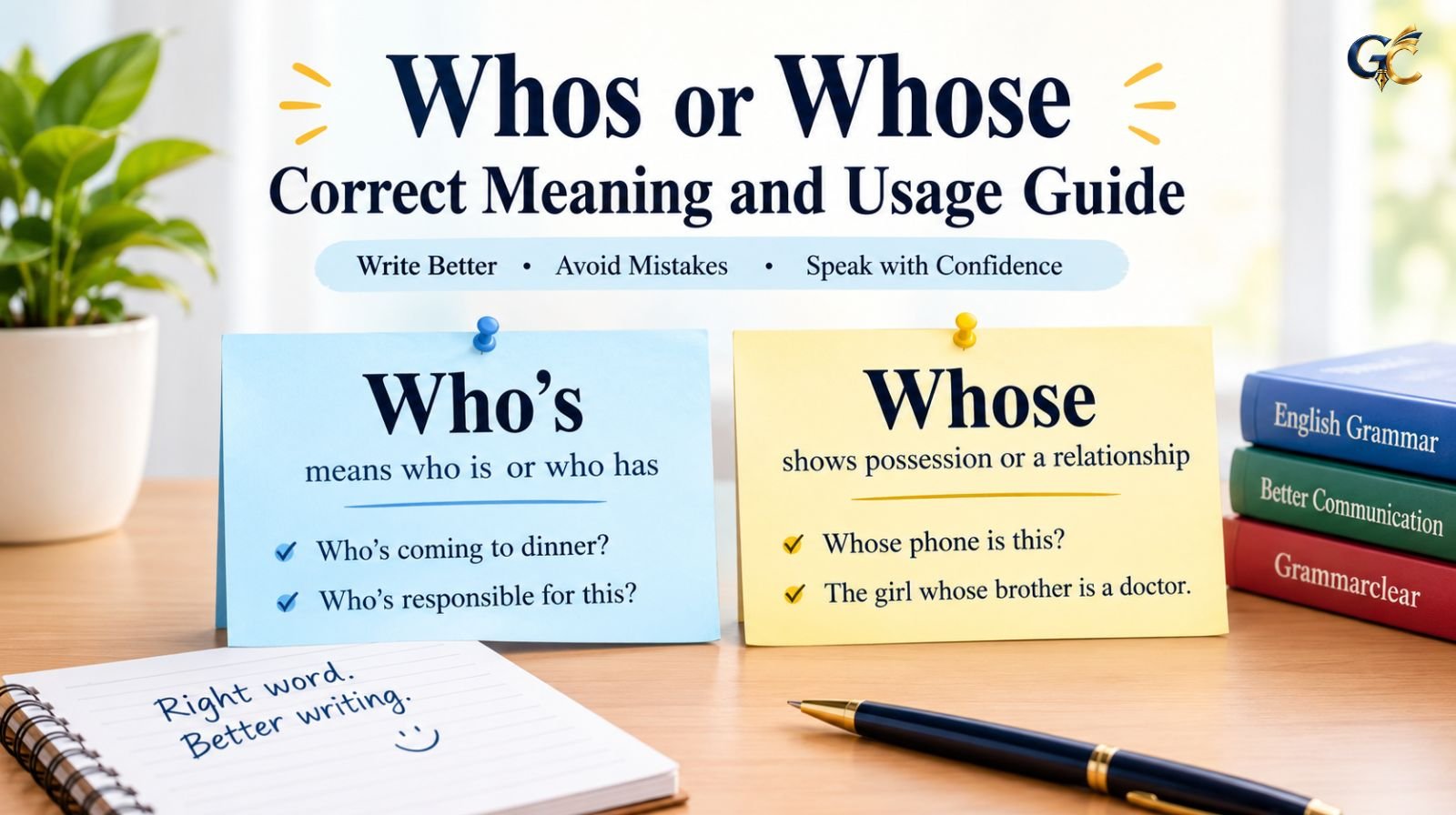
Have you ever stopped while writing a sentence because you were unsure whether to use whos or whose? You are not alone. Many English learners and native speakers confuse these words because they sound alike when spoken. However, their meanings and grammatical functions are different.
The correct choice is usually whose when asking who owns something or describing a relationship. The form who’s, with an apostrophe, means who is or who has. Although people sometimes type whos without an apostrophe, it is generally an incorrect spelling when they intend either of these standard forms.
In this guide, you will learn the difference between whos and whose, understand when to use each word, explore practical examples, and discover a simple trick that will help you choose the correct form every time.
What Is the Difference Between Whos and Whose?

The main difference between these words is their grammatical purpose. Whose shows possession or a relationship, while who’s is a contraction of who is or who has.
What Does Whose Mean?
Whose is a possessive word used to ask who something belongs to or to describe a connection between a person, animal, or thing and something associated with it.
Examples:
- Whose phone is ringing?
- Whose shoes are these?
- I met a student whose father is a teacher.
- This is the house whose roof was damaged in the storm.
In the first two examples, whose asks about ownership. In the last two, it connects a person or thing with a related detail.
What Does Who’s Mean?
Who’s is a contraction that replaces who is or who has. The apostrophe indicates that letters have been omitted.
Examples:
- Who’s coming to dinner? (Who is coming to dinner?)
- Who’s responsible for this project? (Who is responsible for this project?)
- Who’s taken my notebook? (Who has taken my notebook?)
- She’s the writer who’s published three books. (She’s the writer who has published three books.)
The surrounding words help you determine whether who’s means who is or who has.
Is Whos a Correct English Word?
In standard English, whos without an apostrophe is generally incorrect when you mean who’s or whose. Use who’s for a contraction and whose for possession.
For example:
- Incorrect: Whos calling me?
- Correct: Who’s calling me?
- Incorrect: Whos bag is this?
- Correct: Whose bag is this?
The key is to understand the meaning of your sentence instead of relying only on how the word sounds.
When Should You Use Whose in a Sentence?
Use whose when you need to ask about ownership or identify a person or thing through a relationship. It can appear in direct questions, indirect questions, and descriptive clauses.
Use Whose to Ask About Ownership
This is the most familiar use of whose. It helps you find out who owns something.
Examples:
- Whose jacket is hanging by the door?
- Whose keys did you find?
- Whose turn is it to speak?
- Do you know whose laptop this is?
Notice that whose does not need to appear at the beginning of a sentence. In the final example, it appears inside an indirect question.
Use Whose to Describe Relationships
You can also use whose to provide additional information about a person, animal, or thing.
Examples:
- The woman whose car was stolen called the police.
- We adopted a dog whose ears are unusually long.
- I read a novel whose ending surprised everyone.
- She works for a company whose headquarters are in New York.
These sentences show that whose can express more than legal ownership. It can also describe a connection, characteristic, or association.
Can Whose Refer to Things?
Yes. Although whose often refers to people, it can also refer to animals and things. Using it with an object is acceptable when you want to express a relationship or identify something.
For example:
- The building whose windows were broken is being repaired.
- We visited a museum whose collection includes ancient coins.
- She bought a phone whose battery lasts all day.
These examples demonstrate why whose is useful in both everyday communication and formal writing.
How to Remember Whos or Whose Correctly
The easiest way to distinguish who’s from whose is to check whether you can replace the word with who is or who has. If the replacement works, use who’s. If the sentence expresses possession or a relationship, use whose.
Use the Who Is or Who Has Test
Try this simple method before submitting an email, essay, article, or social media post.
Example 1: Who’s at the door?
Replace who’s with who is:
Who is at the door?
The sentence still makes sense, so who’s is correct.
Example 2: Whose book is on the table?
Try replacing whose with who is:
Who is book is on the table?
The sentence is incorrect. Because the question asks who owns the book, use whose.
Example 3: Who’s finished the assignment?
Replace who’s with who has:
Who has finished the assignment?
The sentence works, so who’s is correct.
Compare Whose and Who’s Side by Side
| Feature | Who’s | Whose |
|---|---|---|
| Meaning | Who is or who has | Belonging to whom |
| Grammatical role | Contraction | Possessive determiner or pronoun |
| Apostrophe | Required | Not used |
| Example | Who’s calling? | Whose phone is this? |
| Quick test | Expand to who is or who has | Check for possession or association |
Follow This Quick Checklist
Before choosing a spelling, ask yourself:
- Am I asking who owns something? Use whose.
- Am I describing a relationship, such as a person whose brother is a doctor? Use whose.
- Can I replace the word with who is? Use who’s.
- Can I replace it with who has? Use who’s.
- Have I written whos without an apostrophe? Check the sentence and correct it if you intended who’s or whose.
This checklist works for school assignments, professional emails, blog posts, and everyday messages.
Common Mistakes When Using Whos or Whose
Many writers confuse these forms because they sound the same. However, understanding the sentence’s meaning makes it easier to avoid spelling and grammar mistakes.
Mistake 1: Using Who’s to Show Possession
Incorrect: Who’s bag is lying on the floor?
Correct: Whose bag is lying on the floor?
Why? The sentence asks who owns the bag. Therefore, whose is the correct choice.
Mistake 2: Using Whose Instead of Who’s
Incorrect: Whose coming to the party tonight?
Correct: Who’s coming to the party tonight?
Why? The intended meaning is who is coming. Since who’s can replace who is, it is the correct form.
Mistake 3: Forgetting the Apostrophe
Incorrect: Whos going to help us?
Correct: Who’s going to help us?
Why? The sentence means who is going to help us. The apostrophe is necessary to form the contraction who’s.
Mistake 4: Assuming Every Apostrophe Shows Ownership
Incorrect: Who’s turn is it?
Correct: Whose turn is it?
Why? An apostrophe does not always indicate possession. In who’s, it marks a contraction. The possessive form is whose, without an apostrophe.
Real-Life Example: How to Choose Between Who’s and Whose
Imagine that Sara is preparing an email for her school’s English teacher. She wants to ask about a missing notebook, confirm who will attend a class meeting, and describe a student who recently won an award.
At first, Sara writes the following sentences:
- Who’s notebook was left in the classroom?
- Whose attending the meeting tomorrow?
- Ali is the student who’s sister won the award.
Although these sentences may look reasonable at first glance, each one contains a word-choice mistake.
Step 1: Correct the Question About the Notebook
Sara wants to find out who owns the notebook. She is not asking who is notebook or who has notebook. She is asking about ownership.
The corrected sentence is:
Whose notebook was left in the classroom?
The word whose identifies the person to whom the notebook belongs.
Step 2: Correct the Question About the Meeting
Next, Sara wants to know who will attend the meeting. The intended meaning is who is attending the meeting tomorrow.
The corrected sentence is:
Who’s attending the meeting tomorrow?
Replacing who’s with who is produces a grammatically correct sentence, confirming the choice.
Step 3: Correct the Sentence About the Award
Finally, Sara wants to explain that Ali’s sister won an award. The sentence describes a relationship between Ali and his sister.
The corrected sentence is:
Ali is the student whose sister won the award.
Here, whose links Ali to his sister. It does not mean who is or who has.
What Can We Learn From This Example?
Sara’s experience shows that choosing between who’s and whose is not simply a spelling decision. It requires understanding the intended meaning of a sentence.
By checking for possession and applying the replacement test, she can correct all three mistakes without memorizing complicated grammar rules. The same approach works when writing homework, workplace emails, website content, reports, and social media captions.
The important lesson is to identify what the sentence means first and choose the spelling second.
Whos or Whose: Grammar Facts and Usage in 2025–2026
Understanding these words remains useful in 2025–2026 because clear written communication matters across education, professional communication, and online publishing.
What Grammar References Tell Us
Established English grammar references consistently distinguish who’s as a contraction of who is or who has and whose as the possessive form used in questions and relative clauses.
These rules apply in both American and British English. Neither form is inherently more correct than the other; the appropriate choice depends on its grammatical function.
Is There Reliable Data on These Mistakes?
As of October 2026, there is no verified, representative statistic presented here that establishes the exact percentage of English writers who confuse who’s and whose during 2025–2026. It would be misleading to invent a number or claim that this particular error has increased by a specific percentage.
However, the distinction is well documented in established grammar guidance, and the two forms remain a useful example of a common writing challenge: words that sound alike but have different grammatical functions.
Why Does This Matter for Online Writing?
For bloggers, students, editors, and business writers, using the correct form supports readability and professional presentation.
For example:
- A grammar article should ask, “Whose responsibility is it?”
- A newsletter might ask, “Who’s joining us this weekend?”
- A professional report could describe “an employee whose performance improved.”
These examples show that accuracy comes from understanding context rather than relying solely on spell-checking tools. Both who’s and whose are valid English forms, so automated tools may not identify every incorrect use.
FAQs
Q1: Is it whos or whose?
A: Whose is correct when asking who something belongs to or describing a relationship. Who’s is correct when you mean who is or who has. The spelling whos, without an apostrophe, is generally incorrect in standard English.
Q2: What is the difference between who’s and whose?
A: Who’s is a contraction of who is or who has. Whose expresses possession or association.
Examples:
- Who’s coming to dinner?
- Whose coat is this?
Q3: Is whose possessive?
A: Yes. Whose is the possessive form of who. It can ask about ownership or introduce a clause that describes a relationship.
Example: “The author whose book I read is visiting our school.”
Q4: When should I use who’s in a sentence?
A: Use who’s when you can replace it with who is or who has without changing the intended meaning.
Examples:
- Who’s ready to leave? (Who is ready to leave?)
- Who’s completed the task? (Who has completed the task?)
Q5: Can whose be used for objects and animals?
A: Yes. Whose can refer to people, animals, and things.
Examples:
- The dog whose owner moved away needs a new home.
- The house whose windows were damaged is being repaired.
Q6: Why doesn’t whose have an apostrophe?
A: Whose is already the possessive form of who. The apostrophe in who’s indicates a contraction, not possession. This is why whose bag is correct, while who’s bag is not.
Q7: Are who’s and whose pronounced the same?
A: In standard English, they are generally pronounced the same way. Because pronunciation usually cannot distinguish them, readers and writers must rely on meaning and grammar to choose the correct form.
Q8: How can I remember the difference between who’s and whose?
A: Use the replacement test. If who is or who has fits the sentence, write who’s. If the sentence asks who owns something or describes a relationship, write whose.
For example, “Who’s calling?” means “Who is calling?” but “Whose phone is ringing?” asks who owns the phone.
Conclusion:
When deciding between whos or whose, remember that the correct spelling depends on what you want to express. Whose shows possession or a relationship, while who’s means who is or who has. The spelling whos, without an apostrophe, is generally not correct for either meaning in standard English.
The easiest way to avoid mistakes is to check the sentence rather than rely on pronunciation. If you can replace who’s with who is or who has, use the apostrophe. If you are asking who owns something or describing a connection, use whose.
With this simple rule and the examples in this guide, you can write more confidently in school assignments, professional emails, and online articles.
👉 Discover more simple and practical grammar guides on Grammar Clear

Zia Ahmad is the founder of GrammarClear, an educational platform dedicated to making English grammar simple and easy to understand. Through clear explanations and practical examples, he aims to help learners improve their grammar, writing, and communication skills with confidence.

