
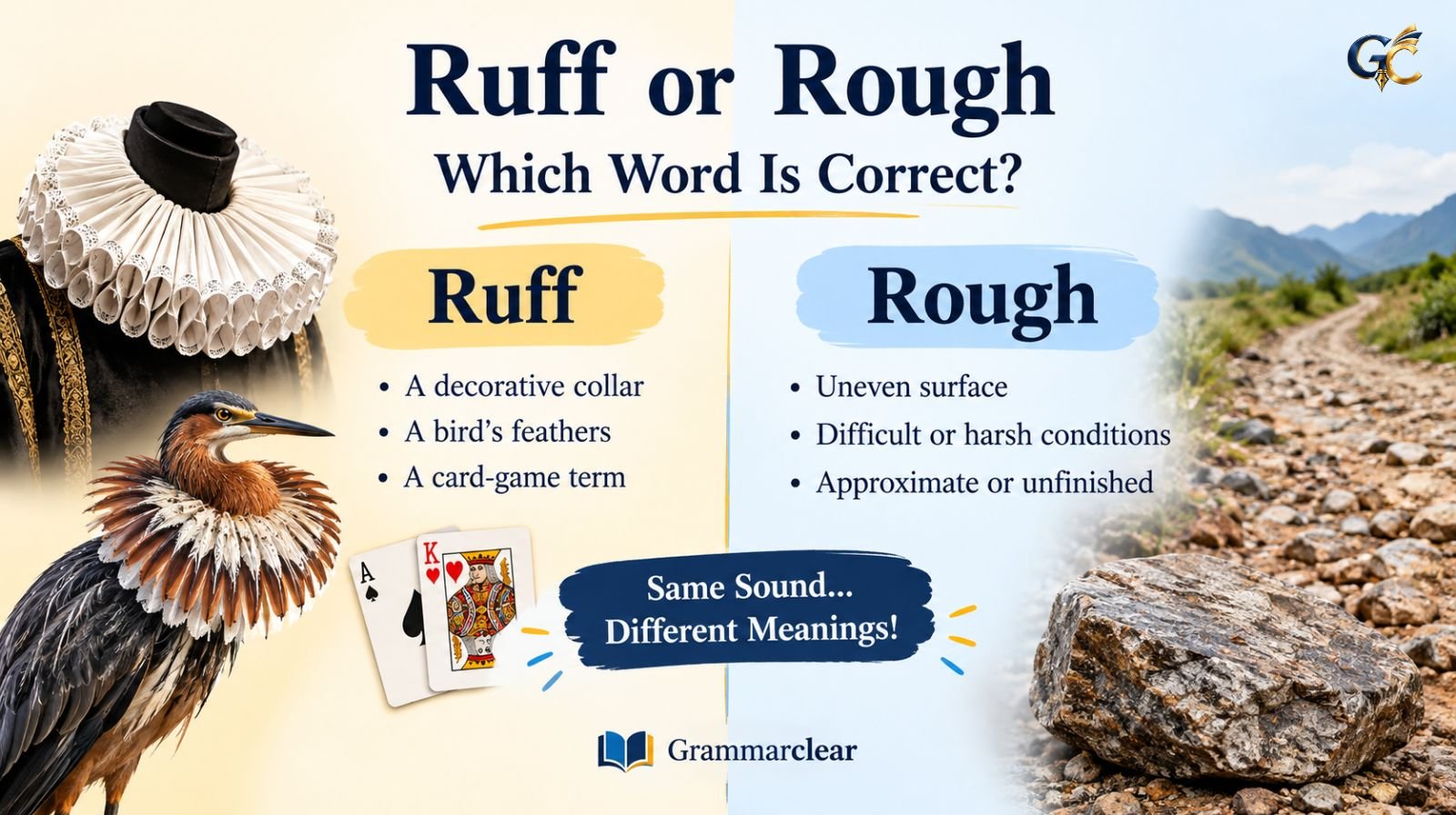
Have you ever wondered whether to write ruff or rough? These words look and sound similar, but they have different meanings and uses. Choosing the wrong one can make your writing confusing, especially when you are learning English or trying to improve your spelling.
The correct word in most everyday situations is rough. It describes something uneven, difficult, harsh, or not smooth. In contrast, ruff is a less common word that usually refers to a frilled collar worn in historical clothing, a ring of feathers around a bird’s neck, or a specific term used in card games.
In this guide, you will learn the difference between ruff and rough, understand when to use each word, and explore simple examples that make the distinction easy to remember.
What Is the Difference Between Ruff and Rough?
The main difference between ruff and rough is their meaning. Although they are pronounced the same way in many English accents, they are not interchangeable.
Meaning of Rough
Rough is the standard English word used to describe something that is not smooth, is difficult, or involves harsh conditions.
Examples:
- The road was too rough for our bicycles.
- We had a rough day at work.
- The wooden table feels rough to the touch.
- The sea became rough during the storm.
In these sentences, rough describes a physical surface, a challenging experience, or difficult conditions.
Meaning of Ruff
Ruff is a real English word, but it is used in more specific contexts. It commonly refers to a decorative, pleated collar or a circle of feathers around a bird’s neck.
Examples:
- The actor wore a white ruff in the historical play.
- The bird displayed its colorful neck ruff.
- The player used a ruff to win a trick in a card game.
Remember that ruff is not the standard spelling of the adjective meaning uneven, difficult, or harsh.
Quick Comparison Table
| Feature | Rough | Ruff |
|---|---|---|
| Main meaning | Uneven, difficult, or harsh | A frilled collar, feather arrangement, or card-game term |
| Part of speech | Usually an adjective | Usually a noun or a verb in card games |
| Common usage | Everyday English | Specialized contexts |
| Example | The road is rough. | He wore a decorative ruff. |
| Correct for difficult conditions? | Yes | No |
Quick answer: Use rough for everyday descriptions of difficult situations, uneven surfaces, and harsh conditions. Use ruff when referring to its specific meanings.
When Should You Use Rough?
Use rough when describing an uneven surface, a challenging experience, an approximate amount, or something that is not fully finished. It is a common word in everyday English.
Rough Describes an Uneven Surface
When something does not feel smooth, rough is the correct word.
Examples:
- The rough wall needs another coat of paint.
- My hands became rough during the winter.
- The path was rough and full of stones.
In each example, the word describes a physical condition.
Rough Describes Difficult Experiences
You can also use rough to describe a difficult day, a challenging period, or an unpleasant experience.
Examples:
- She had a rough week at school.
- The business went through a rough period.
- It was a rough journey through the mountains.
These expressions are common in conversations, stories, and professional writing.
Rough Means Approximate or Unfinished
Sometimes, rough means estimated rather than exact. It can also describe an early version of a plan or design.
Examples:
- Give me a rough estimate of the total cost.
- I made a rough draft of the article.
- We have a rough idea of what to do next.
Writing tip: If you mean difficult, uneven, approximate, or unfinished, choose rough, not ruff.
When Should You Use Ruff?
Although ruff is less common than rough, it is correct in specific situations. Understanding these meanings helps you avoid assuming that every unfamiliar spelling is a mistake.
Ruff as a Decorative Collar
A ruff is a stiff, often pleated collar that was popular in European clothing during the 16th and 17th centuries.
Examples:
- The museum displayed a portrait of a nobleman wearing a ruff.
- The costume designer created a white ruff for the historical performance.
- The actor adjusted his ruff before going on stage.
In these sentences, ruff refers to a particular piece of clothing.
Ruff as a Bird’s Feathers
A ruff can also refer to a distinctive arrangement of feathers around a bird’s neck. The word is particularly associated with the ruff, a species of wading bird.
Examples:
- The bird displayed its impressive neck ruff.
- The male bird’s breeding plumage included a decorative ruff.
This is a specialized use of the word rather than an everyday description.
Ruff in Card Games
In some trick-taking card games, including bridge, ruff is used as a verb meaning to play a trump card when another suit has been led.
Example:
– She decided to ruff the trick with a trump card.
This meaning is specific to card games, so most everyday writers will rarely need it.
Ruff or Rough: Common Mistakes and Easy Ways to Remember
The easiest way to distinguish these words is to connect each spelling with its meaning.
A Simple Memory Trick
Remember this sentence:
“Rough roads are hard to travel; ruffs are collars or card-game plays.”
The sentence connects rough with difficult conditions and ruff with its specialized meanings.
Common Spelling Mistakes
| Incorrect sentence | Correct sentence |
|---|---|
| The road is ruff. | The road is rough. |
| I had a ruff day. | I had a rough day. |
| The surface feels ruff. | The surface feels rough. |
| He wore a rough collar from the historical costume. | He wore a ruff from the historical costume. |
The final example depends on the intended meaning: if you mean the historical pleated collar itself, ruff is the appropriate noun.
A Quick Checklist
Before choosing a spelling, ask yourself:
- Am I describing a difficult day or situation? Use rough.
- Am I talking about an uneven or coarse surface? Use rough.
- Do I mean an approximate estimate or unfinished draft? Use rough.
- Am I referring to a historical collar, a bird’s feathers, or a card-game move? Use ruff.
This quick check can help you choose the right word in emails, essays, blog posts, and everyday conversations.
Real-Life Example: Choosing Between Ruff and Rough
Imagine that a student named Alex is writing a short story about a weekend hiking trip. Alex wants the story to sound natural and grammatically correct but is unsure whether to write ruff or rough.
In the first paragraph, Alex describes a rocky mountain trail. The original sentence reads, “The path was ruff, and walking on it was difficult.” Because the sentence describes an uneven surface, the correct version is “The path was rough, and walking on it was difficult.”
Later, Alex writes, “We had a ruff day because it started raining.” Again, the word should be rough because the sentence describes an unpleasant and challenging experience.
However, the story then introduces a historical costume displayed in a small museum. Alex writes, “The actor wore a large rough around his neck.” Here, the intended meaning is a traditional pleated collar, so the correct sentence is “The actor wore a large ruff around his neck.”
Finally, Alex reviews the entire story. Instead of relying on pronunciation, Alex checks the meaning of each sentence. Words describing difficult conditions become rough, while the historical clothing item becomes ruff.
This example shows why understanding meaning is more useful than memorizing spelling alone. Even when two words sound alike, their grammatical roles and definitions can make the correct choice clear. The same method works when editing school assignments, business documents, articles, and social media posts.
Ruff vs. Rough: Language Facts and Statistics for 2025–2026
Rough is the standard, everyday word for something uneven, difficult, harsh, or approximate. Ruff is much more specialized and appears in contexts involving historical clothing, bird anatomy, and certain card games.
For writers, this practical distinction is more useful than simply memorizing which spelling appears more frequently.
What Do Recent Statistics Tell Us?
There is no verified, widely accepted 2025–2026 statistic specifically measuring how often English writers confuse ruff and rough. Therefore, it would be misleading to invent a percentage or claim that a particular number of people make this mistake.
Instead, the reliable linguistic distinction is straightforward:
- Rough: A common English adjective with several everyday meanings; it can also function as a noun or verb in particular expressions.
- Ruff: A specialized word with specific meanings in clothing, bird terminology, and card games.
For practical writing advice, prioritize the meaning of the sentence and the standard dictionary definition rather than unsupported spelling-error statistics.
FAQs
Q1: Is ruff or rough the correct spelling?
A: Both spellings are correct, but they have different meanings. Rough describes something uneven, difficult, harsh, or approximate. Ruff refers to a decorative collar, a bird’s feathers, or a card-game action.
Q2: Does ruff mean rough?
A: No. Although the words sound alike in many English accents, they are not synonyms. Ruff has specific meanings, while rough is used for uneven surfaces, difficult experiences, and other related descriptions.
Q3: How do you spell rough correctly?
A: The correct spelling is rough, with the letters o-u-g-h, when describing a difficult day, a coarse surface, rough weather, or an approximate estimate.
Example: “The road was rough after the storm.”
Q4: Why do ruff and rough sound the same?
A: In many English accents, the letter combination ough in rough produces the same final sound as uff in ruff. This similarity can make the words confusing, but their meanings and spellings remain different.
Q5: Is rough an adjective?
A: Yes. Rough is most commonly used as an adjective.
Examples:
- A rough surface
- A rough journey
- A rough estimate
It also appears in other grammatical roles, such as the verb in “to rough up” someone, meaning to treat them violently.
Q6: What is a ruff in clothing?
A: ruff is a decorative, usually pleated collar that was especially fashionable in Europe during the 16th and 17th centuries. It often extended outward around the neck and was worn with formal clothing.
Q7: Can I write “I had a ruff day”?
A: No, not if you mean that your day was difficult or unpleasant. The correct sentence is “I had a rough day.” The word ruff does not have this everyday meaning.
Q8: What is the easiest way to remember ruff vs. rough?
A: Associate rough with rough roads, rough weather, and rough days. Associate ruff with historical collars, bird feathers, and card games. Checking the meaning of the sentence will usually reveal the correct spelling.
Conclusion:
When deciding between ruff or rough, remember that both words are correct, but they are used in different contexts.
Use rough when describing an uneven surface, a difficult experience, harsh conditions, or an approximate estimate. Use ruff when discussing a historical collar, a bird’s feathers, or a specialized card-game term.
The simplest way to avoid confusion is to focus on what you want to communicate rather than how the word sounds. With a little practice, choosing between these two spellings becomes much easier.
👉 Discover more simple and practical grammar guides on Grammar Clear

Zia Ahmad is the founder of GrammarClear, an educational platform dedicated to making English grammar simple and easy to understand. Through clear explanations and practical examples, he aims to help learners improve their grammar, writing, and communication skills with confidence.

