
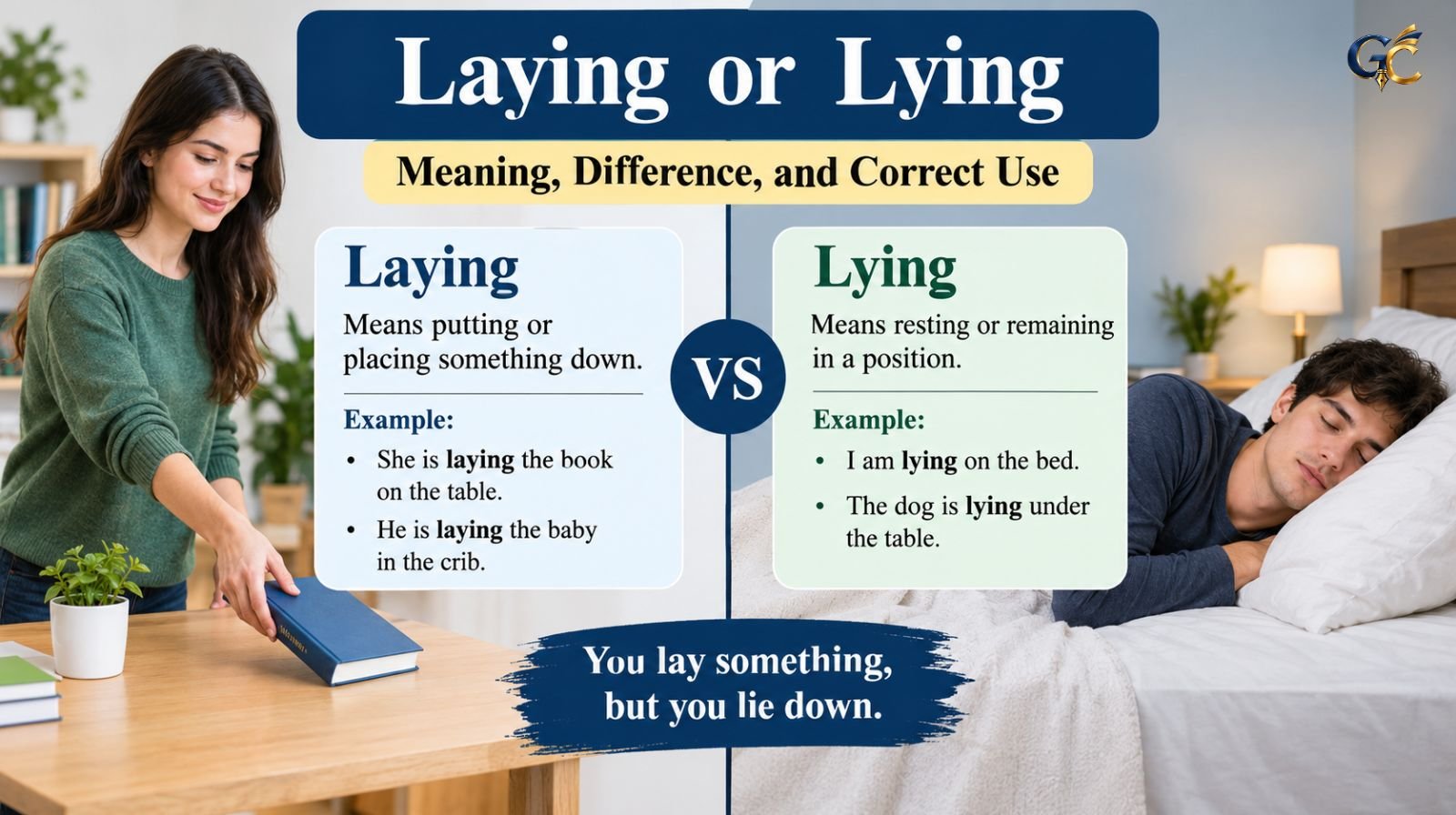
Have you ever wondered whether to write “I am laying on the bed” or “I am lying on the bed”? These expressions look similar, and both are commonly used in everyday conversations. However, only one follows standard grammar in this context.
Understanding laying or lying becomes much easier when you know what each word means and how it works in a sentence. The main difference is simple: laying means putting something down, while lying means resting or being in a position without placing an object.
In this guide, you will learn the meanings of laying and lying, the grammar rules behind them, common mistakes to avoid, and practical examples that will help you choose the correct word confidently.
Laying or Lying: What Is the Difference?
The difference between laying and lying depends on whether someone is placing something or simply resting in a position. Although these words come from different verbs, their similar sounds and overlapping verb forms often cause confusion.
What Does Laying Mean?
Laying is the present participle of the verb lay. It means placing, setting, or putting something down. In standard grammar, the verb lay takes a direct object.
A direct object is the person or thing receiving the action.
Examples:
- She is laying the book on the desk.
- He is laying the baby in the crib.
- They are laying the tiles on the kitchen floor.
- The hen is laying eggs in the nest.
In each example, something is being placed or produced. The book, baby, tiles, and eggs are connected directly to the action.
What Does Lying Mean?
Lying is the present participle of the verb lie. When lie means resting, reclining, or remaining in a particular position, it does not take a direct object.
Examples:
- I am lying on the sofa.
- The dog is lying under the table.
- She was lying in bed when the phone rang.
- The keys are lying on the kitchen counter.
Here, nobody is placing an object somewhere. Instead, a person or thing is resting or remaining in a position.
The Easiest Way to Remember the Difference
Use this simple rule:
- Laying: You lay something.
- Lying: You lie down or remain in a position.
Compare these sentences:
| Sentence | Correct word | Why? |
|---|---|---|
| I am ___ the blanket on the bed. | Laying | The blanket is being placed. |
| I am ___ on the bed. | Lying | The speaker is resting. |
| She is ___ the baby down. | Laying | The baby is the object of the action. |
| The baby is ___ in the crib. | Lying | The baby is resting in a position. |
Remember that the word immediately following a verb does not always determine whether it has an object. The important question is whether the verb’s action is being performed on a direct object.
Grammar Rules for Using Laying and Lying Correctly
To understand laying and lying fully, you also need to understand their base verbs and how their forms change with tense. This is particularly important because the past tense of lie is lay, which is also a separate verb in the present tense.
The Verb Forms of Lay
The verb lay means to put or place something down. Its main forms are:
- Present: lay
- Present participle: laying
- Past tense: laid
- Past participle: laid
Examples:
- I lay my phone on the desk every evening.
- I am laying my phone on the desk now.
- I laid my phone on the desk yesterday.
- I have laid my phone on the desk several times.
Notice that the past tense and past participle are both laid, not layed.
The Verb Forms of Lie
When lie means to rest or recline, its forms are different:
- Present: lie
- Present participle: lying
- Past tense: lay
- Past participle: lain
Examples:
- I lie on the sofa after work.
- I am lying on the sofa now.
- I lay on the sofa yesterday.
- I have lain on the sofa for an hour.
The past participle lain is grammatically correct, although it may sound formal or unusual in everyday conversation.
What About Lying as Telling an Untruth?
The verb lie has another meaning: to say something that is not true. In this sense, its forms are different.
- Present: lie
- Present participle: lying
- Past tense: lied
- Past participle: lied
Examples:
- He is lying about what happened.
- She lied to her friend.
- I have never lied about my qualifications.
Therefore, lying can describe either resting in a position or telling an untruth. The meaning depends on the context.
Common Mistakes When Choosing Laying or Lying
Even experienced English speakers sometimes confuse these words. The confusion is understandable because the past tense of lie is lay, while laying belongs to the verb lay.
Mistake 1: Saying “I Am Laying on the Bed”
Incorrect in standard grammar:
“I am laying on the bed.”
Correct:
“I am lying on the bed.”
The corrected sentence describes someone resting on the bed. There is no direct object receiving the action.
However, this sentence is correct:
“I am laying my clothes on the bed.”
Here, my clothes is the direct object, so laying is appropriate.
Mistake 2: Using Laying Instead of Lying Around
Incorrect in standard grammar:
“We spent the afternoon laying around the house.”
Correct:
“We spent the afternoon lying around the house.”
The sentence describes people relaxing without placing anything. Therefore, lying is the standard choice.
By contrast, consider this example:
“She was laying the groundwork for a new project.”
This is correct because the groundwork is the object of the verb.
Mistake 3: Confusing Laid and Lain
These two words belong to different verb patterns.
Correct examples:
- She laid the folder on the desk.
- She had lain in bed for hours before getting up.
Use laid when referring to placing something. Use lain when referring to resting or remaining in a position after forms of have.
A useful reference is the Centers for Disease Control and Prevention’s guide to lay, lie, lain, and laid, which explains these distinctions with examples.
Real-Life Examples: How to Choose the Correct Word
The easiest way to learn the difference between laying and lying is to apply the rule to situations you encounter every day. The following examples show how a small change in meaning can determine which word is correct.
Example 1: Relaxing at Home
Imagine that you return home after a long day and want to rest on your sofa.
You might write:
“I am lying on the sofa because I am tired.”
This is correct because you are describing your position.
Now imagine that you are tidying your living room and putting a blanket on the sofa.
You would write:
“I am laying a blanket on the sofa.”
This is also correct because you are placing an object.
The difference is not the sofa or the action’s location. It is whether you are resting or placing something.
Example 2: Writing an Email at Work
Suppose you are explaining to a colleague where you left a document.
You could write:
“I am laying the report on your desk.”
This sentence means you are placing the report on the desk.
If you want to describe where the report is already located, you could write:
“The report is lying on your desk.”
In the first sentence, the report receives the action. In the second, the report simply remains in a position.
Example 3: Talking About a Pet
Imagine that your dog is sleeping near the front door.
You could say:
“The dog is lying beside the door.”
If you are arranging the dog’s blanket on the floor, you could say:
“I am laying the dog’s blanket beside the door.”
Both sentences are grammatically correct, but they describe different actions.
A Practical Case Study: Correcting a Common Writing Error
Consider a fictional student named Emma who is preparing an English assignment. She writes the following sentence in her first draft:
“After finishing her homework, Emma was laying on her bed and reading a book.”
Her teacher marks the verb as incorrect. Emma is confused because she has heard people say “lay down” in everyday conversation and assumes that laying must also be correct.
To solve the problem, Emma applies a simple test: Is she placing something down, or is she describing a person resting?
In this sentence, Emma is resting on her bed. She is not placing an object anywhere. Therefore, the corrected sentence is:
“After finishing her homework, Emma was lying on her bed and reading a book.”
Next, Emma writes another sentence:
“She was laying her notebook beside her pillow before going to sleep.”
This time, laying is correct because the notebook is the object being placed.
Finally, Emma reviews a sentence about the previous evening:
“Yesterday, she lay on her bed and read for an hour.”
Although lay looks like the present-tense verb, it is the correct past-tense form of lie in this sentence.
By comparing the three examples, Emma learns that the correct word depends on meaning, grammatical structure, and tense. She begins checking whether a direct object is present before choosing laying or lying. This approach helps her correct similar mistakes in essays, emails, and other writing.
The lesson is practical: rather than memorizing isolated sentences, learn the underlying rule. Once you understand the difference between placing something and resting in a position, you can apply it to new situations with greater confidence.
Quick Reference Guide and Grammar Statistics
A comparison table and a short decision-making process can make the difference easier to remember. This section also explains what current grammar resources can and cannot tell us about how frequently these errors occur.
| Feature | Laying | Lying |
|---|---|---|
| Base verb | Lay | Lie |
| Main meaning | Putting or placing something | Resting or remaining in a position |
| Direct object | Usually required | Not required for the resting meaning |
| Present example | I am laying the book down. | I am lying on the bed. |
| Past tense of base verb | Laid | Lay |
| Past participle | Laid | Lain |
| Common mistake | I am laying down. | Using lying when placing an object |
The table describes the standard grammatical distinction between lay and lie when lie means to rest. The verb lie meaning “to tell an untruth” follows a different pattern: lie, lied, lied.
A Three-Step Method for Choosing the Right Word
When you are unsure whether to use laying or lying, follow these steps:
- Identify the meaning. Are you putting something somewhere, or describing something that is resting?
- Check for a direct object. If you are placing a book, blanket, or another object, use laying. If you are describing rest or position, use lying in the present continuous.
- Check the tense. For example, “I was lying down yesterday” is correct, while “I laid the book down yesterday” is correct for placing the book.
This method works in everyday writing, professional emails, school assignments, and other situations where grammatical accuracy matters.
What Do 2025–2026 Grammar Resources Tell Us?
There is an important distinction between evidence about grammar rules and statistics about how frequently people make a particular mistake.
The CDC’s 2025 writing guide specifically discusses the confusion between lay, lie, laying, and lying. It provides conjugation tables and example sentences to explain the standard forms.
The Cambridge Dictionary’s English Grammar Today guide also explains the difference, including the requirement for an object with lay and the use of lying for the resting meaning of lie.
These resources confirm the relevant grammatical rules. However, they do not provide a verified 2025–2026 percentage showing how many English writers confuse laying and lying. It would be misleading to invent a figure or present a general writing statistic as evidence of this specific error.
For writers, the practical takeaway is clear: learning the distinction and checking verb tense can prevent a common type of usage mistake. Accurate, readable writing helps readers understand your meaning without distraction.
FAQs
Q1: Is it lying or laying on the bed?
A: In standard grammar, lying on the bed is correct when you mean that someone is resting on it.
Example: “I am lying on the bed and reading.”
Use laying when you are putting something on the bed, as in “I am laying my clothes on the bed.”
Q2: Is “I am laying down” grammatically correct?
A: In standard formal English, “I am lying down” is the preferred form when you mean that you are reclining or getting into a resting position.
Use “I am laying the book down” when you are placing an object somewhere. Although laying down is common in casual speech without an expressed object, lying down is the traditional standard choice for resting.
Q3: What is the past tense of lying?
A: When lying means resting, its base verb is lie, and its past tense is lay.
Example: “I lay on the sofa yesterday.”
When lying means telling an untruth, the past tense is lied.
Example: “He lied about his age.”
Q4: Is laying the same as lying?
A: No. Laying comes from lay, which means to put or place something down. Lying, in the resting sense, comes from lie, which means to rest or remain in a position.
For example, “She is laying a towel on the floor” describes placing an object, while “She is lying on the floor” describes her position.
Q5: Is “laying in bed” ever correct?
A: Yes, if an object is being placed in bed or onto a bed. For example, “She is laying the baby in bed” uses laying correctly.
However, if you mean that someone is resting in bed, the standard expression is “lying in bed.”
Q6: Should I write “I was laying” or “I was lying”?
A: Choose according to the action.
- “I was lying on the couch” means you were resting.
- “I was laying the cushions on the couch” means you were placing the cushions.
The direct object and intended meaning determine the correct choice.
Q7: Is “laid” the past tense of lie or lay?
A: Laid is the past tense and past participle of lay, meaning to place something down.
Example: “She laid the keys on the counter.”
The past tense of lie, meaning to rest, is lay. Its past participle is lain.
Example: “He lay on the grass yesterday” and “He has lain on the grass before.”
Q8: How can I remember the difference between laying and lying?
A: Remember this simple rule: You lay something, but you lie down.
If you can identify the thing being placed, laying is generally appropriate. If you are describing a person or object resting in a position, use lying in the present continuous.
For the past tense, remember that lie becomes lay, while lay becomes laid.
Conclusion:
Choosing between laying and lying becomes much easier once you understand their meanings and grammatical patterns.
Laying means placing something down and normally takes a direct object. Lying, when it means resting or remaining in a position, does not take a direct object. Remember that the past tense of lie is lay, while the past tense of lay is laid.
For example, write “I am lying on the bed” when describing yourself resting, but write “I am laying a blanket on the bed” when describing the act of placing the blanket.
The next time you are unsure about laying or lying, check the meaning, identify any direct object, and confirm the tense. With regular practice, you will find it easier to choose the correct word in everyday conversations and professional writing.
👉 Discover more simple and practical grammar guides on Grammar Clear

Zia Ahmad is the founder of GrammarClear, an educational platform dedicated to making English grammar simple and easy to understand. Through clear explanations and practical examples, he aims to help learners improve their grammar, writing, and communication skills with confidence.

