
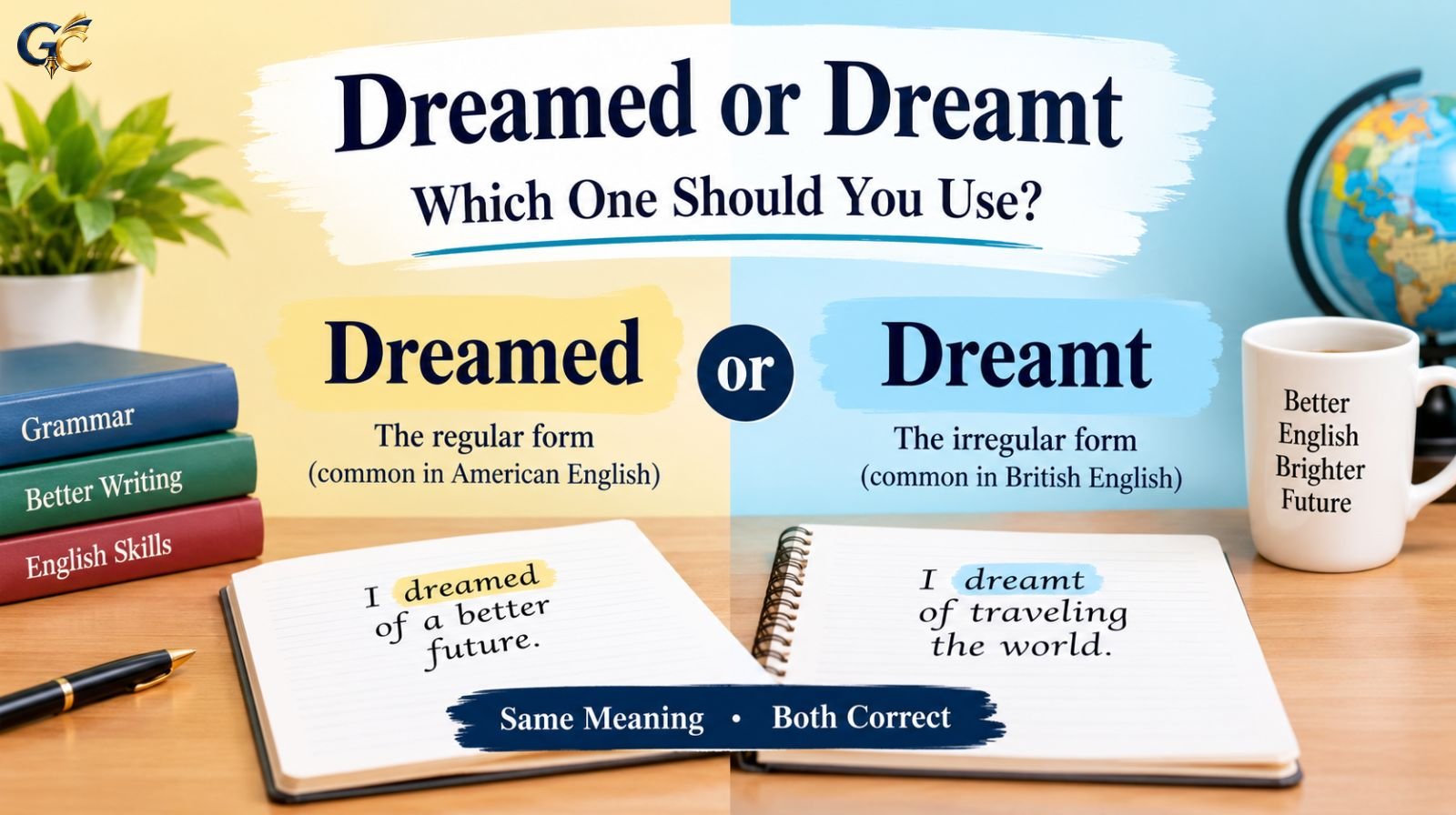
Have you ever written about a dream and wondered whether to say “Dreamed or Dreamt or “I dreamt about it”? If so, you are not alone. Many English learners and writers find these two forms confusing.
The good news is that both dreamed and dreamt are correct. They are two accepted past-tense forms of the verb dream. The main difference is their usage and regional preference, not their meaning.
In this guide, you will learn the difference between dreamed and dreamt, understand when to use each form, explore practical examples, and discover which spelling is suitable for your writing.
What Is the Difference Between Dreamed and Dreamt?
Dreamed and dreamt are both correct past forms of the verb dream. They describe something you experienced while sleeping or something you imagined and hoped for while awake.
The main difference is that dreamed is the regular form, while dreamt is the irregular form. Both are accepted in modern English, although their popularity varies by region.
Dreamed: Meaning and Usage
Dreamed is the regular past-tense form of dream. It is formed by adding -ed to the base verb.
For example:
- I dreamed about visiting Paris last night.
- She dreamed of becoming a successful writer.
- They dreamed about their future together.
Dreamed is especially common in American English. It is also widely used in British English and other varieties of English.
Dreamt: Meaning and Usage
Dreamt is the irregular past-tense form of dream. Instead of adding -ed, the verb changes to an -t ending.
For example:
- I dreamt about flying over the ocean.
- He dreamt of becoming a professional musician.
- We dreamt about living in a beautiful house.
Dreamt is often associated with British English, although it is also correct in American English.
Do Dreamed and Dreamt Have Different Meanings?
No. In ordinary usage, dreamed and dreamt have the same meaning.
Both can describe experiences during sleep or hopes and ambitions.
Compare these sentences:
- I dreamed about my childhood home.
- I dreamt about my childhood home.
Both sentences communicate the same idea. Neither spelling changes the meaning of the sentence.
Is Dreamed or Dreamt Correct in American and British English?
Both forms are grammatically correct in American and British English. However, the preferred form can vary depending on the audience.
Dreamed in American English
American English generally favors dreamed.
For example:
- I dreamed about my vacation last night.
- She dreamed of becoming a doctor.
- He had dreamed of owning a business since childhood.
If you are writing for an American audience, dreamed is a straightforward choice.
Dreamt in British English
British English commonly uses dreamt, although dreamed is also correct.
For example:
- I dreamt about my old school.
- She dreamt of traveling around the world.
- They had dreamt of opening a restaurant.
Both forms are acceptable in British writing. The choice often depends on personal preference and writing style.
Which Form Should You Use for International Readers?
If your audience includes readers from different countries, dreamed is a practical default because it is familiar and widely used.
However, dreamt is also understandable and correct. You do not need to replace it simply because your readers are international.
The important thing is to maintain consistency throughout your article or document.
How to Use Dreamed and Dreamt in Different Tenses
Dreamed and dreamt can both function as the simple past tense and past participle of dream.
Understanding their grammatical roles makes it easier to use them correctly.
Simple Past Tense
Use either form to describe an event that happened in the past.
Examples:
- I dreamed about my examination last night.
- I dreamt about my examination last night.
- She dreamed of becoming a teacher.
- She dreamt of becoming a teacher.
Both versions are correct.
Present Perfect Tense
Use dreamed or dreamt with has or have when describing an experience connected to the present.
Examples:
- I have dreamed about this place before.
- I have dreamt about this place before.
- She has dreamed of becoming a pilot for years.
- She has dreamt of becoming a pilot for years.
Both forms work after have or has.
Past Perfect Tense
Use had with dreamed or dreamt to describe an earlier past experience.
Examples:
- I had dreamed about that journey before I took it.
- I had dreamt about that journey before I took it.
- They had dreamed of success for many years.
- They had dreamt of success for many years.
The choice between dreamed and dreamt does not change the tense.
Dreamed vs. Dreamt: Comparison Table
The following table summarizes the main differences between the two forms.
Feature
Dreamed
Dreamt
Base verb
Dream
Dream
Past tense
Dreamed
Dreamt
Past participle
Dreamed
Dreamt
Grammar type
Regular form
Irregular form
American English
More common
Less common
British English
Correct and used
Commonly associated
Meaning
Same
Same
Correct spelling
Yes
Yes
Quick Rule to Remember
Use dreamed if you prefer the regular -ed form or are writing primarily for an American audience.
Use dreamt if you prefer the shorter irregular form or are following a British English style.
Remember: Neither form is universally more correct than the other.

Real-Life Example: Choosing Dreamed or Dreamt in a Blog Article
Imagine that Sara is writing a personal blog post about her childhood ambition.
She wants to describe how she always hoped to become a professional photographer. While writing, she types:
“When I was young, I dreamt of becoming a photographer.”
Later, she wonders whether she should change dreamt to dreamed.
Sara checks the grammar and discovers that both forms are correct. She also learns that dreamed is more common in American English, while dreamt is frequently associated with British English.
Because Sara’s blog uses British English spelling and vocabulary, she decides to keep dreamt. Her sentence now reads:
“When I was young, I dreamt of becoming a photographer.”
In another article, Sara writes for an American audience. She chooses the sentence:
“When I was young, I dreamed of becoming a photographer.”
Both sentences express the same ambition. The difference is simply the spelling preference.
Sara also notices that she has used dreamt throughout her first article. Rather than changing individual sentences randomly, she keeps the same form throughout the post.
This example shows an important writing principle: grammar choices should support clarity and consistency. Writers do not need to treat every regional variation as an error.
Whether you choose dreamed or dreamt, your sentence can be grammatically correct as long as you use the word in the appropriate context.
Dreamed or Dreamt: What Does Recent Usage Data Tell Us?

There is no single universal percentage that describes how often all English speakers use dreamed or dreamt. Usage varies by country, publication, writing style, and context.
Therefore, it is important not to treat a single regional preference as a rule for all English speakers.
What Dictionary Evidence Shows
Cambridge Dictionary recognizes dreamed and dreamt as forms of the verb dream. Its American English entry identifies dreamed as the American form, while dreamt is commonly associated with British English.
definition in the Cambridge English Dictionary
A 2025 article revised in March 2026 by LanguageTool also explains that both forms are correct and that dreamed is widely used in both American and British English.
Dreamed or Dreamt?
What Historical Usage Research Shows
Historical corpus research provides another useful perspective.
A study using the Corpus of Late Modern English Texts examined the two forms across three historical periods:
Period
Dreamt occurrences
Dreamed occurrences
These figures come from historical texts, not from all English speakers today. They show that dreamed became more frequent in the examined texts over time. They should not be presented as current 2025–2026 usage percentages.
Keio University User Platform
What Should Writers Take Away?
The available evidence supports three practical conclusions:
- Both forms are accepted.
- Dreamed is especially common in American English.
- Dreamt remains an established form, particularly in British English.
For everyday writing, choose the form that suits your audience and use it consistently.
Common Mistakes to Avoid
Although dreamed and dreamt are both correct, writers can still make mistakes when using them.
Treating Dreamt as Incorrect
Incorrect assumption: “Dreamt is not a real English word.”
Correction: Dreamt is a recognized past-tense and past-participle form of dream.
Example:
- Correct: I dreamt about the ocean.
- Correct: I dreamed about the ocean.
Using Dreamed and Dreamt Inconsistently
Switching between the forms is not automatically a grammar error. However, using one form consistently can make your writing feel more polished.
For example, if your article uses dreamed throughout, avoid switching to dreamt without a reason.
Confusing Dreamed With Dream
Dream is the base form, while dreamed and dreamt are past forms.
Examples:
- Present: I dream about traveling.
- Past: I dreamed about traveling.
- Past: I dreamt about traveling.
Do not use the base form dream when the sentence requires a simple past-tense verb.
FAQs
Q1: Is dreamed or dreamt correct?
A: Both dreamed and dreamt are correct past-tense forms of dream. They have the same basic meaning.
Q2: Is dreamt British or American?
A: Dreamt is commonly associated with British English, but it is also accepted in American English. Dreamed is generally more common in American usage.
Q3: Is dreamed more correct than dreamt?
A: No. Neither form is universally more correct. The choice depends on regional preference, writing style, and consistency.
Q4: What is the past tense of dream?
A: The past tense of dream can be either dreamed or dreamt.
Example: “I dreamed about my holiday” or “I dreamt about my holiday.”
Q5: What is the past participle of dream?
A: The past participle can also be dreamed or dreamt.
Examples:
- I have dreamed about this before.
- I have dreamt about this before.
Q6: Can I use dreamt in American English?
A: Yes. Dreamt is grammatically acceptable in American English, although dreamed is more common.
Q7: Which form should I use in formal writing?
A: Both forms are acceptable in formal writing. Choose the form that matches your preferred variety of English or the style guide you are following.
Q8: Do dreamed and dreamt have different meanings?
A: No. They generally have the same meaning and can describe dreams during sleep or hopes and ambitions.
Conclusion:
The answer is simple: both dreamed and dreamt are correct.
Dreamed is the regular past-tense form and is especially common in American English. Dreamt is the irregular form and is frequently associated with British English.
Both words can describe something you experienced while sleeping or something you hoped to achieve.
If you are writing for an American audience, dreamed is a practical choice. If you prefer British English or the shorter irregular form, dreamt is also suitable.
The most important rule is to use the form that fits your audience and remain consistent throughout your writing.
Now that you understand the difference between dreamed and dreamt, you can use either form with confidence.
👉 Explore more useful grammar tips and guides on Grammar Clear

Zia Ahmad is the founder of GrammarClear, an educational platform dedicated to making English grammar simple and easy to understand. Through clear explanations and practical examples, he aims to help learners improve their grammar, writing, and communication skills with confidence.

