
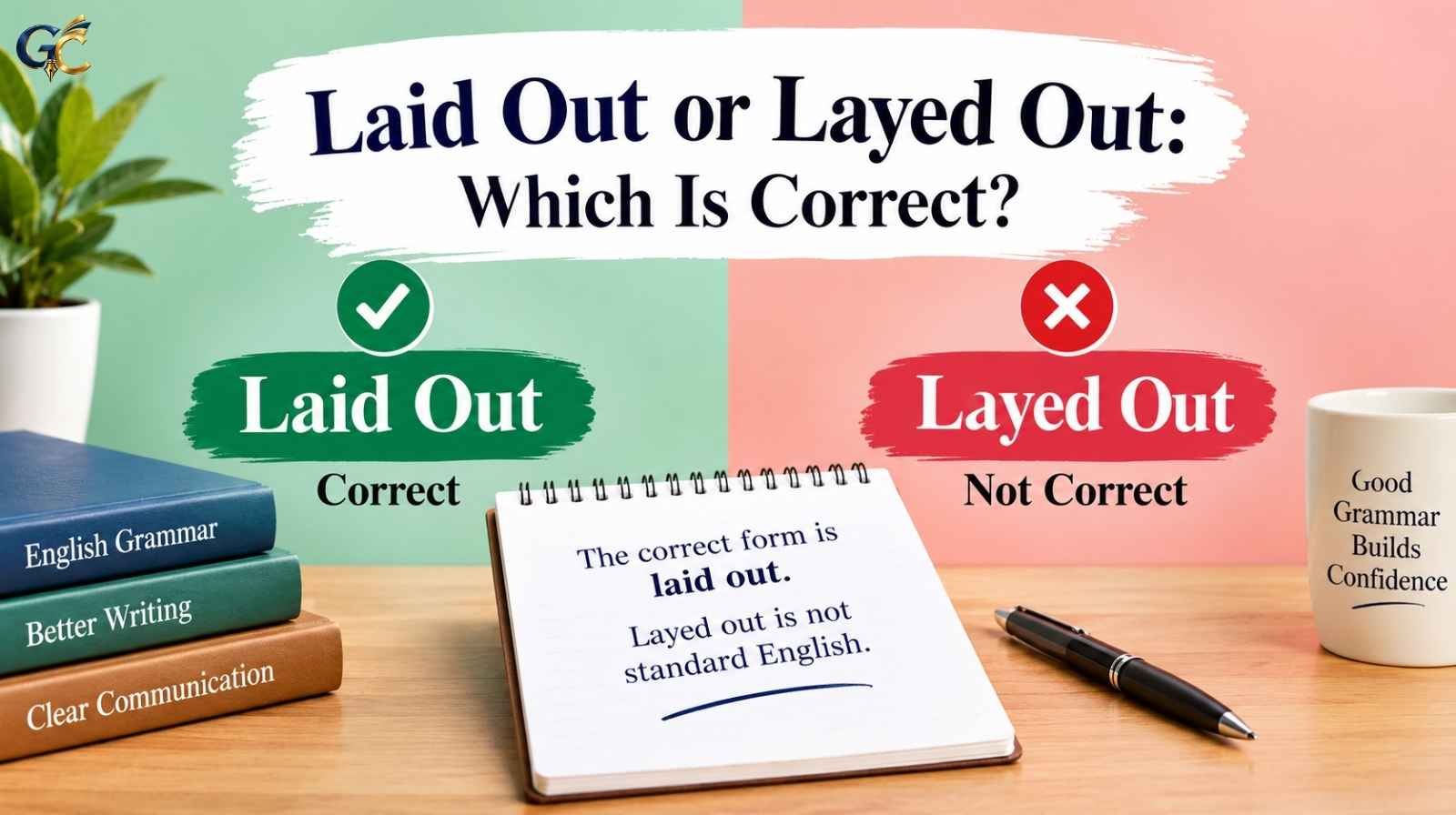
Have you ever stopped while writing and wondered whether laid out or layed out is correct? The answer is simple: “laid out” is the correct form, while “layed out” is not standard English.
The confusion happens because many English verbs form their past tense by adding -ed. However, lay is an irregular verb. Its past tense and past participle are laid, not layed. Therefore, when you use the phrasal verb lay out in the past tense, the correct form is laid out.
In this guide, you’ll learn what laid out means, why layed out is incorrect, how to use the phrase naturally, and how to remember the difference.
Quick Answer: Laid Out or Layed Out?
Laid out is correct. Layed out is incorrect in standard English.
| Phrase | Correct? | Example |
|---|---|---|
| Laid out | ✅ Yes | She laid out the documents. |
| Layed out | ❌ No | She layed out the documents. |
The reason is the verb pattern:
lay → laid → laid
Not:
lay → layed → layed
Oxford lists laid as both the past simple and past participle of lay, while Cambridge likewise gives laid as the past tense and past participle of lay out.
What Does “Laid Out” Mean?
Laid out is the past form of lay out. Depending on context, it can mean arranged, displayed, planned, designed, or explained clearly.
Laid Out Means “Arranged”
You can use laid out when objects have been placed or arranged in a particular way.
For example:
- She laid out the clothes on the bed.
- We laid out the books on the table.
- The tools were laid out in neat rows.
- The designer laid out the photographs across the page.
Cambridge defines lay something out as arranging something, particularly on a surface or according to a particular design or pattern.
Laid Out Can Mean “Explained Clearly”
The phrase can also refer to presenting information, instructions, plans, or ideas in a clear way.
For example:
- The manager laid out the company’s new strategy.
- The teacher laid out the rules before the exam.
- The report laid out the main problems.
- She laid out her reasons for leaving.
This meaning is especially common in professional and academic writing. Cambridge also recognizes lay out as meaning to explain or describe something clearly, usually in writing.
Laid Out Can Mean “Planned or Designed”
The phrase can describe how something has been organized or designed.
For example:
The architect laid out the floor plan carefully.
Here, laid out means the architect arranged or planned the different parts of the design.
Why Is “Laid Out” Correct?
The key is understanding the verb lay.
The Verb Forms of Lay
Unlike regular verbs such as play → played, lay is irregular.
Its main forms are:
| Form | Verb |
|---|---|
| Base form | lay |
| Past tense | laid |
| Past participle | laid |
| -ing form | laying |
So we get:
- I lay out the documents every morning.
- Yesterday, I laid out the documents.
- I have laid out the documents already.
- I am laying out the documents now.
Oxford confirms that lay has the forms lay, laid, laid, laying.
Laid Out or Layed Out: The Grammar Rule
The easiest rule is:
If the base verb is “lay,” its past form is “laid,” not “layed.”
Therefore:
lay out → laid out
not:
lay out → layed out
Compare these examples:
- We lay out the materials every morning.
- We laid out the materials yesterday.
- We have laid out everything already.
The form layed out incorrectly applies the regular -ed pattern to an irregular verb.
Laid Out vs. Layed Out: Common Examples
Here are several natural examples:
- The teacher laid out the instructions clearly.
- She laid out her clothes before going to bed.
- The designer laid out the magazine pages.
- They laid out the food on a large table.
- The manager laid out the company’s new goals.
- The evidence was laid out in chronological order.
- We laid out all the options before making a decision.
- The architect laid out the building’s floor plan.
Incorrect Examples With “Layed Out”
These sentences contain the common mistake:
- ❌ The teacher layed out the instructions.
- ❌ She layed out her clothes.
- ❌ The designer layed out the pages.
- ❌ They layed out the evidence.
Correct them by replacing layed with laid:
- ✅ The teacher laid out the instructions.
- ✅ She laid out her clothes.
- ✅ The designer laid out the pages.
- ✅ They laid out the evidence.
A Simple Way to Remember “Laid Out”
A useful memory trick is to remember the three important forms together:
Lay → Laid → Laid
Once you know that pattern, laid out becomes much easier to remember.
For example:
Present:
I lay out the plan.
Past:
I laid out the plan.
Present perfect:
I have laid out the plan.
You can also compare it with another irregular verb:
- pay → paid
- say → said
- lay → laid
The important point is that lay does not become “layed” in standard English.
Don’t Confuse “Lay” With “Lie”
Another reason this topic causes confusion is that lay and lie have different meanings and verb forms.
Lay generally means to put or place something somewhere:
She laid the book on the desk.
Lie means to be in a resting or horizontal position:
She lay on the sofa yesterday.
Oxford specifically notes that lay takes an object, while lie does not.
This distinction explains why English learners sometimes struggle with forms such as lay, laid, lie, and lain.
2026 Usage and Reference Check

A useful way to verify a grammar question is to check multiple authoritative sources rather than relying on how a word “looks.”
For this question, 3 reference checks point to the same standard form:
| 2026 reference check | Result |
|---|---|
| Oxford Learner’s Dictionaries | laid = past and past participle of lay |
| Cambridge Dictionary | laid out = past/past participle form of lay out |
| Dictionary.com | laid = simple past and past participle of lay |
That gives us a 3/3 agreement among these reference sources on the underlying verb form: lay → laid.
There is therefore no reason to choose layed out in standard edited English. If you’re writing an essay, article, email, business document, or website copy, laid out is the reliable choice.
Google’s current Search guidance also emphasizes accurate, helpful, people-first content and specifically recommends avoiding easily verifiable factual or spelling errors.
Practical Case Study: Choosing the Correct Form in Professional Writing
Imagine that a project manager is preparing an important report for a client. The report explains the company’s new marketing strategy and includes a sentence that originally reads: “The team layed out the new campaign strategy in three stages.”
At first glance, layed might look reasonable because the writer is thinking of regular past-tense verbs such as played, planned, or organized. However, the sentence uses the verb lay out, whose base verb is lay. Because lay is irregular, its past tense is laid.
The corrected sentence is:
The team laid out the new campaign strategy in three stages.
The correction does more than fix a spelling mistake. It makes the report look polished and grammatically reliable. The same principle applies when writing instructions, presentations, academic assignments, website content, or business emails.
The writer could also change the sentence depending on the intended meaning. For example, “The team laid out the strategy clearly” emphasizes explanation, while “The designer laid out the campaign materials on the table” describes physical arrangement.
The important lesson is that you should identify the base verb first. Once you recognize lay out, the past form becomes automatic: laid out. This simple check can prevent a surprisingly common error in professional writing.
Quick Checklist: How to Choose the Right Form
Before publishing or submitting your sentence, use this checklist:
- Am I using the verb lay out?
- Am I describing a completed action?
- If yes, use laid out.
- Do not add -ed to create layed.
- Remember: lay → laid → laid.
- Check whether I actually mean lie rather than lay.
Quick Formula
Present: lay out
Past: laid out
Past participle: laid out
Ongoing: laying out
Example:
Today I lay out the plan.
Yesterday I laid out the plan.
I have laid out the plan already.
I am laying out the plan now.
FAQs
Q1: Is “laid out” or “layed out” correct?
A: Laid out is correct. Layed out is not the standard past form of lay out.
Q2: Why is “layed out” wrong?
A: Because lay is an irregular verb. Its past tense and past participle are laid, not layed. Therefore, the correct past form of lay out is laid out.
Q3: What does “laid out” mean?
A: Laid out can mean arranged, displayed, planned, designed, or explained clearly.
For example:
The instructions were laid out clearly.
Q4: What is the past tense of “lay out”?
A: The past tense of lay out is laid out.
Present: They lay out the materials.
Past: They laid out the materials.
Q5: Is “layed” ever correct?
A: For the ordinary verb lay, layed is not the standard past-tense form. Use laid instead.
Q6: Is “laid out” formal or informal?
A: Laid out is neutral and works in both everyday and formal writing. You can use it in conversations, school assignments, business writing, reports, and professional content.
Q7: Is “laid out” the same as “layout”?
A: No. Laid out is a verb phrase, while layout is generally a noun.
For example:
The designer laid out the webpage.
The webpage has a clean layout.
Q8: What is the easiest way to remember “laid out”?
A: Remember this pattern:
Lay → Laid → Laid
So whenever you’re talking about a completed action involving lay out, choose laid out.
Conclusion:
When you’re deciding between laid out or layed out, the correct choice is straightforward: use “laid out.”
The phrase comes from the verb lay, whose past tense and past participle are laid. Therefore:
Lay out → Laid out
not:
Lay out → Layed out
Use laid out when you mean something was arranged, organized, planned, designed, displayed, or explained clearly. Whether you’re writing an email, school assignment, business report, article, or social media post, laid out is the standard form.
👉 Explore more useful grammar tips and guides on Grammar Clera

Zia Ahmad is the founder of GrammarClear, an educational platform dedicated to making English grammar simple and easy to understand. Through clear explanations and practical examples, he aims to help learners improve their grammar, writing, and communication skills with confidence.

