
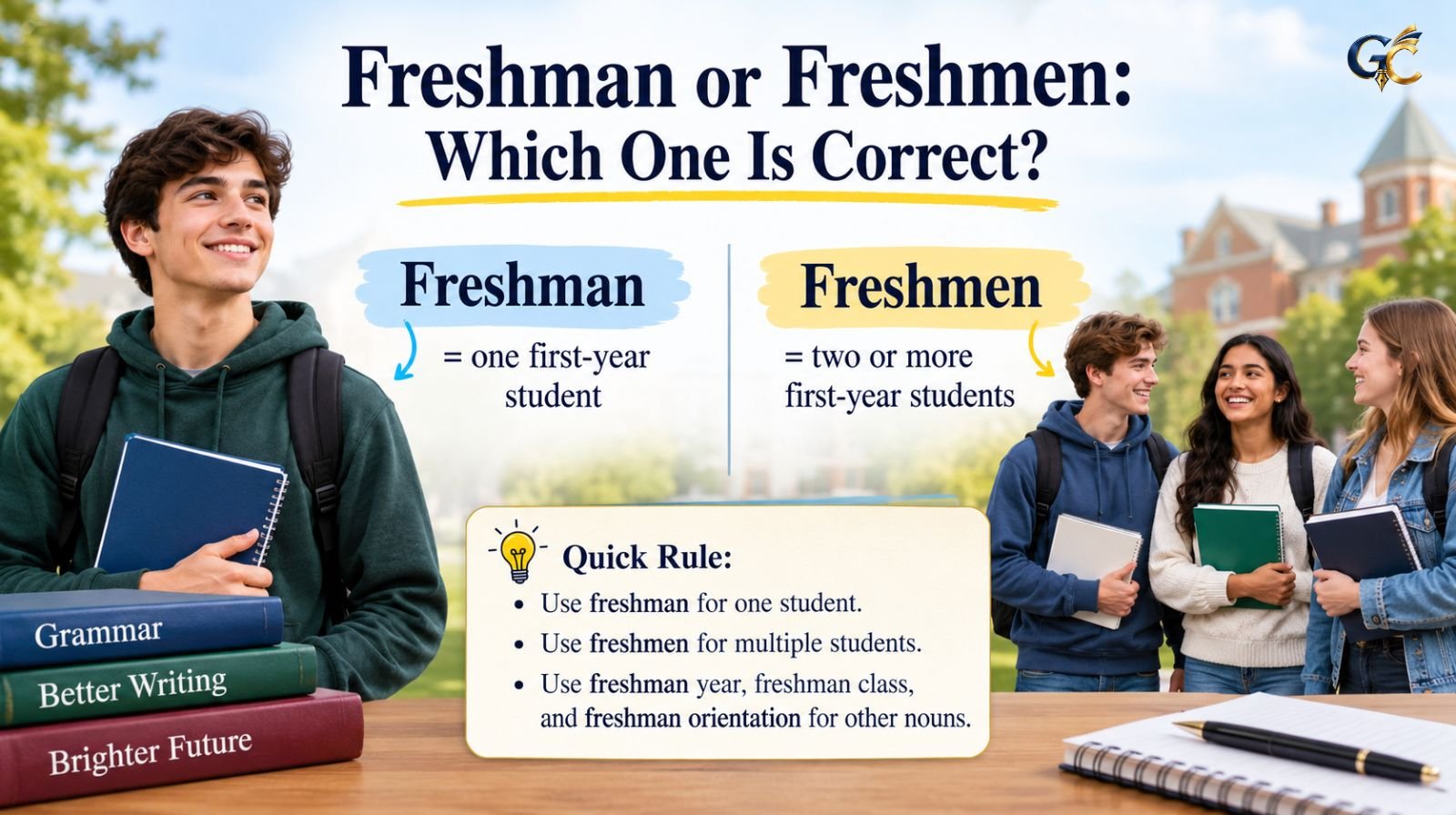
Have you ever wondered whether to write freshman or freshmen when talking about first-year students? Both words are correct, but they have different meanings. Choosing the wrong one can make your sentence grammatically incorrect or confusing.
The difference between freshman and freshmen is simple: freshman refers to one first-year student, while freshmen refers to two or more first-year students. These terms are commonly used in American schools, colleges, and universities.
In this guide, you will learn the meaning of each word, understand how to use it correctly, explore practical examples, and discover easy ways to remember the difference.
What Is the Difference Between Freshman and Freshmen?

The main difference between freshman and freshmen is the number of students being discussed. Freshman is singular, while freshmen is plural.
Freshman: Meaning and Usage
The word freshman refers to one student in their first year of high school or college. It is a singular noun.
Examples:
- My brother is a freshman at university.
- She joined the freshman orientation program.
- A freshman asked the professor a question.
- He is excited about his first year as a freshman.
In each sentence, freshman refers to one student or describes something associated with first-year students.
Freshmen: Meaning and Usage
The word freshmen is the plural form of freshman. It refers to two or more students in their first year.
Examples:
- The freshmen attended an introduction session.
- Many freshmen live in the university dormitories.
- The professor welcomed the new freshmen.
- Several freshmen joined the campus clubs.
Because these sentences refer to multiple students, freshmen is the appropriate word.
| Word | Meaning | Example |
|---|---|---|
| Freshman | One first-year student | He is a freshman. |
| Freshmen | Two or more first-year students | They are freshmen. |
Easy rule: Use freshman for one student and freshmen for multiple students.
Why Do People Confuse Freshman and Freshmen?

Although the difference seems small, these words are easy to mix up because they look and sound similar. The key is understanding singular nouns, plural nouns, and adjectives.
The Irregular Plural Rule
Most English nouns form their plurals by adding -s or -es. For example, student becomes students, and class becomes classes.
However, freshman follows an irregular plural pattern similar to man and men.
- One man, two men.
- One freshman, two freshmen.
- One woman, two women.
Therefore, freshmen is the correct plural form of freshman, not freshmans.
Freshman Year or Freshmen Year?
The correct expression is freshman year, even when discussing a student’s experience or an entire group.
Examples:
- My freshman year was exciting.
- They enjoyed their freshman year at college.
- Freshman year can bring many new experiences.
Why? In this phrase, freshman describes the noun year. It is functioning as a modifier rather than naming multiple students.
The same principle applies to these expressions:
- Freshman class
- Freshman orientation
- Freshman courses
- Freshman students
For example, “The freshman class attended orientation” is correct, even though the class includes many students.
How to Avoid Common Grammar Mistakes
Use these simple corrections to improve your writing:
| Incorrect | Correct |
|---|---|
| She is a freshmen. | She is a freshman. |
| The freshman were excited. | The freshmen were excited. |
| My freshmen year was difficult. | My freshman year was difficult. |
| The freshmen class arrived. | The freshman class arrived. |
| Three freshmans joined the club. | Three freshmen joined the club. |
Freshman vs. Freshmen: Real-Life Examples

Understanding grammar rules becomes easier when you see how people use these words in everyday situations.
At School and University
Students and teachers frequently use both words when discussing classes, enrollment, and campus activities.
Examples:
- Daniel is a freshman at his new university.
- The freshmen gathered in the auditorium.
- Every freshman must complete the registration form.
- Several freshmen volunteered for the event.
- Our freshman orientation begins on Monday.
Notice that every freshman is singular because every refers to each student individually.
In Everyday Conversation
These words can also describe people who are new to an activity, organization, or position.
Examples:
- She is a freshman member of the debate club.
- The freshmen on the team are learning the rules.
- He felt nervous during his freshman year.
- The organization welcomed its new freshmen.
The word freshman can also refer to a newcomer in certain contexts, such as a newly elected member of a legislative body. The same singular and plural distinction applies.
A Real-Life Example: Writing a University Announcement
Imagine that a university administrator is preparing an announcement for students who are about to begin their first academic year.
The original announcement reads:
“Welcome to all new freshmen! Every freshmen should attend the freshman orientation program. The freshmen class will meet in the main auditorium, where each student will receive a campus guide.”
Although the announcement communicates its message, it contains two grammatical errors. The phrase every freshmen should be every freshman, and the freshmen class should be the freshman class.
A corrected version would read:
“Welcome to all new freshmen! Every freshman should attend the freshman orientation program. The freshman class will meet in the main auditorium, where each student will receive a campus guide.”
This example demonstrates an important point: a sentence may discuss hundreds of students without requiring the word freshmen in every phrase. The correct form depends on how the word functions in the sentence, not simply on how many students are involved.
The administrator can use freshmen when addressing the group directly, freshman after every, and freshman before orientation program and class. Learning this distinction helps students, teachers, and content writers produce clearer announcements, academic materials, and website content.
Freshman and Freshmen: 2025–2026 Statistics and Usage

The distinction between freshman and freshmen matters in educational writing because both terms appear in discussions about student enrollment, university admissions, and first-year experiences.
What Do Recent Enrollment Statistics Show?
According to the National Student Clearinghouse Research Center’s January 2026 report, U.S. postsecondary enrollment data for fall 2025 showed the following trends:
- About 2.5 million freshmen enrolled in postsecondary institutions in fall 2025.
- Freshman enrollment remained broadly stable, with a reported decline of 0.2% compared with the previous fall.
- Public four-year institutions recorded a 1.9% increase in freshmen, reaching approximately 971,000 students.
- Community colleges enrolled approximately 965,000 freshmen, an increase of 0.5%.
These figures illustrate why the words are useful in educational reporting. When discussing one student, use freshman. When reporting on a group of first-year students, use freshmen.
However, enrollment statistics do not determine grammar rules. The singular and plural distinction remains the same regardless of the number of students enrolled in a particular year.
Why These Figures Matter for Writers
Writers preparing university announcements, education articles, and student guides can use these examples to practise correct grammar:
- Correct: The university welcomed thousands of freshmen.
- Correct: Each freshman received an enrollment guide.
- Correct: The freshman enrollment report was published in January.
The first sentence uses the plural noun freshmen. The second uses the singular noun after each. The third uses freshman as a modifier describing the report.
How to Choose Between Freshman and Freshmen

When you are unsure which spelling to use, follow this simple step-by-step guide.
Step 1: Identify What You Are Describing
Ask yourself whether you mean one student or multiple students.
- One student: The freshman is waiting.
- Multiple students: The freshmen are waiting.
Step 2: Check Whether the Word Describes Another Noun
If freshman comes before a noun such as year, class, or orientation, it normally stays singular.
Examples:
- Her freshman year was memorable.
- The freshman class met yesterday.
- Freshman orientation starts next week.
Step 3: Check Subject-Verb Agreement
Singular and plural nouns generally require matching verbs.
| Subject | Correct sentence |
|---|---|
| A freshman | A freshman is here. |
| One freshman | One freshman was absent. |
| Several freshmen | Several freshmen are here. |
| Many freshmen | Many freshmen were absent. |
Step 4: Consider a Gender-Neutral Alternative
Although freshman and freshmen are established terms in American English, some institutions prefer more inclusive wording.
You can use:
- First-year student for one student.
- First-year students for multiple students.
- First-year class when describing the group or cohort.
For example, “All first-year students must attend orientation” is a clear alternative to “All freshmen must attend orientation.”
This wording can be especially useful in formal university communications.
FAQs
Q1: Is freshman or freshmen correct?
A: Both are correct. Use freshman for one first year student and freshmen for two or more first-year students.
Q2: Is freshmen the plural of freshman?
A: Yes. Freshmen is the standard plural form of freshman, just as men is the plural of man.
Q3: Should I write freshman year or freshmen year?
A: Write freshman year. Here, freshman describes the noun year, so it does not change to the plural form.
Q4: Is freshman class or freshmen class correct?
A: Freshman class is the standard expression. Although the class contains many students, freshman functions as a modifier describing the class.
Q5: Can I use freshman for a female student?
A: Yes. In American English, freshman can refer to a student of any gender. However, first-year student is a gender-neutral alternative that many institutions prefer.
Q6: Is freshmen’s a correct word?
A: Yes. Freshmen’s is the possessive form of freshmen, used to show that something belongs to or is associated with multiple first-year students.
Example: The freshmen’s dormitory is near the library.
Q7: What is the difference between freshman and first-year student?
A: Both can describe a student in the first year of a program. Freshman is common in American English, while first-year student is a clear, gender-neutral alternative.
Q8: Is it correct to say “all freshmen students”?
A: It is understandable, but all freshmen or all first-year students is usually more natural and concise.
Example: All freshmen must attend orientation.
Conclusion:
The difference between freshman and freshmen comes down to singular and plural usage. Freshman refers to one first-year student, while freshmen refers to two or more students.
Remember these simple rules:
- Use freshman for one student.
- Use freshmen for multiple students.
- Use freshman year, freshman class, and freshman orientation when the word describes another noun.
- Consider first-year student when you want gender-neutral wording.
Once you understand these patterns, choosing the correct word becomes much easier.
👉 Discover more simple and practical grammar guides on Grammar Clear

Zia Ahmad is the founder of GrammarClear, an educational platform dedicated to making English grammar simple and easy to understand. Through clear explanations and practical examples, he aims to help learners improve their grammar, writing, and communication skills with confidence.

