
Have you ever wondered whether to write past or passed in a sentence? These two words sound exactly alike, which makes them easy to confuse. However, they have different meanings and grammatical uses.
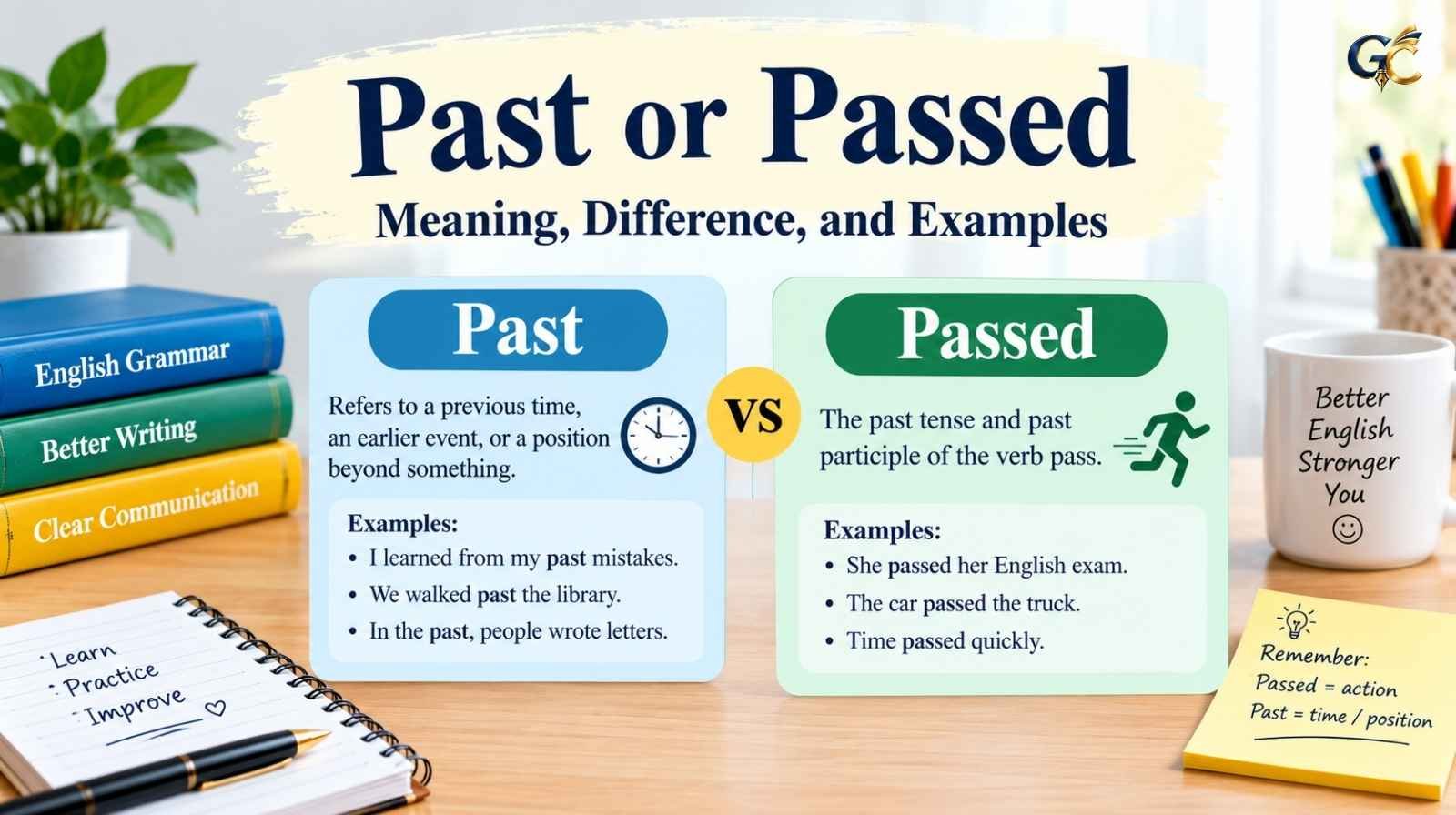
The difference between past or passed is simple once you understand one important rule: past usually refers to an earlier time or a position beyond something, while passed is the past tense and past participle of the verb pass.
For example, you can say, “We walked past the school” or “We passed the school.” Both sentences can be correct, but the words perform different grammatical roles.
In this guide, you will learn the meaning of each word, explore common mistakes, compare real-life examples, and discover an easy way to choose the correct word every time.
What Is the Difference Between Past and Passed?
The easiest way to distinguish past from passed is to check its meaning and grammatical role in the sentence.
- Past refers to a previous time, an earlier event, or a position beyond something.
- Passed describes an action involving the verb pass, such as moving beyond a place, succeeding in a test, or handing something to another person.
What Does Past Mean?
The word past can function as a noun, adjective, preposition, or adverb. Its meaning depends on how it is used.
Examples:
- I learned from my past mistakes.
- We walked past the library.
- In the past, people wrote more letters by hand.
- The train went past our station.
In these sentences, past refers to earlier time, previous experiences, or movement beyond a location.
What Does Passed Mean?
The word passed is the past tense and past participle of the verb pass. It describes an action or event that has happened or been completed.
Examples:
- She passed her English examination.
- The car passed the truck.
- He passed me the notebook.
- Three hours passed before the meeting started.
In each example, passed expresses an action or the passage of time.
Past vs. Passed Comparison Table
| Past | Passed |
|---|---|
| Refers to previous time or a position beyond something | Describes an action involving pass |
| Can be a noun, adjective, preposition, or adverb | Past-tense and past-participle verb form |
| The past year was difficult. | She passed the test. |
| We walked past the store. | We passed the store. |
| It is half past five. | Time passed quickly. |
Quick rule: Use past for previous time or a position beyond something. Use passed when you need the verb pass in a past-tense or past-participle form.
When to Use Past or Passed in a Sentence
Understanding the difference between these words becomes easier when you see how they work in everyday situations.
When to Use Past
Use past when referring to previous time, something that happened earlier, or movement beyond a particular point.
Examples:
- Past experience: My past experiences helped me become more confident.
- Past time: We met several years ago in the past.
- Movement: She walked past the bakery.
- Clock time: It is half past six.
- Previous events: The past weekend was wonderful.
Notice that past does not function as the main verb in these examples. It describes time, position, or a previous situation.
When to Use Passed
Use passed when describing an action involving the verb pass.
Examples:
- Examination: Maria passed her final exam.
- Movement: The bus passed our house.
- Giving something: He passed me the salt.
- Passage of time: The afternoon passed quickly.
- Approval: The committee passed the proposal.
The word passed can also follow helping verbs such as has, have, and had.
For example:
- She has passed her driving test.
- The deadline has passed.
- Several weeks have passed since our last meeting.
How to Remember Past vs. Passed
Try replacing the word with a similar expression to check whether the sentence makes sense.
- If you mean earlier, previous, or beyond, consider past.
- If you mean an action performed by someone or something using the verb pass, consider passed.
- Read the complete sentence to ensure the word fits its grammatical role.
For example:
- We drove past the hospital. (We went beyond it.)
- We passed the hospital on our way home. (We moved beyond it.)
Both sentences are correct. The first uses past to indicate position, while the second uses passed as the verb.
Common Mistakes With Past and Passed
Even confident English writers sometimes confuse these words because they sound identical. Fortunately, a few simple rules can help you avoid the most common errors.
Past Due or Passed Due?
The correct expression is past due.
Use it when a payment, assignment, or other obligation has not been completed by its deadline.
Examples:
- My electricity bill is past due.
- The assignment is past due.
- The payment became past due last week.
Incorrect: My electricity bill is passed due.
Here, past indicates that the deadline has already gone by.
Walked Past or Walked Passed?
The correct expression is generally walked past when describing movement beyond a place or person.
Examples:
- She walked past the classroom.
- He walked past the security guard.
- We walked past the restaurant without stopping.
Incorrect: She walked passed the classroom.
In these sentences, walked is already the main verb, and past describes the direction or position.
However, this sentence is also correct:
“She passed the classroom on her way to the office.”
Here, passed is the main verb.
Has Past or Has Passed?
When you use has, have, or had to form a perfect tense of the verb pass, use passed.
Correct examples:
- The deadline has passed.
- Time has passed quickly.
- She has passed her driving test.
- Several months had passed before they met again.
Incorrect: The deadline has past.
Remember, past can still appear in sentences containing helping verbs when it serves a different grammatical role.
For example: “We have moved past that problem.”
This sentence is correct because moved is the verb and past indicates moving beyond the problem.
A Real-Life Example: Choosing the Correct Word
Imagine a student named Daniel writing an email to his teacher about an English examination and a late assignment.
His first draft reads:
“Dear Teacher, I am happy because I have past my English exam. Unfortunately, my assignment is passed due because I forgot to submit it last Friday.”
Although the meaning is understandable, Daniel has made two word-choice mistakes.
Correcting the Mistakes
His revised email reads:
“Dear Teacher, I am happy because I have passed my English exam. Unfortunately, my assignment is past due because I forgot to submit it last Friday.”
Now both expressions are correct.
Daniel uses passed because passing an examination describes an achievement. He uses past due because the assignment deadline has already gone by.
He then practices with a few additional sentences:
- “I passed my mathematics test.” This describes an achievement.
- “My past performance was not very good.” This refers to previous performance.
- “I walked past the teacher’s office.” This describes movement beyond a place.
- “The deadline has passed.” This describes an event that has occurred.
By comparing these examples, Daniel learns that he does not need to memorize every sentence individually. Instead, he can identify the grammatical role of the word and choose the correct form.
This approach helps him write clearer emails, assignments, and examination answers. It also teaches him an important lesson: understanding the meaning of a word is more reliable than choosing its spelling based only on sound.
Past or Passed: Grammar Facts and Usage Data for 2025–2026
English grammar rules provide a reliable way to understand the difference between past and passed. However, it is important to distinguish established language facts from statistics about how frequently people make mistakes.
What Do Grammar References Say?
Established English language references consistently explain the distinction:
- Cambridge Dictionary: Identifies passed as the past simple and past participle of pass.
- MLA Style Center: Explains that passed functions as a verb form, while past can function as a noun, adjective, preposition, or adverb.
- Cambridge Dictionary’s entry for past: Explains its uses in references to earlier time and other contexts.
These definitions support the grammar rules and examples presented in this guide.
Are There Statistics for 2025–2026?
There is no verified, authoritative 2025–2026 statistic available here that specifically measures how often English writers confuse past and passed. Therefore, providing a percentage or claiming that one word is misused more frequently would be misleading.
Instead, the most reliable approach is to use established dictionary definitions and recognized grammar guidance to understand the difference.
Why Correct Word Choice Matters
Choosing the correct word helps readers understand your message clearly. This is especially useful when writing:
- School assignments and examination answers
- Professional emails and business documents
- Blog posts and website articles
- Everyday messages and social media posts
Learning the distinction between past and passed can improve the accuracy and readability of your writing without relying on unsupported statistics.
FAQs
Q1: Is it past or passed?
A: Both words are correct, but they have different meanings. Past refers to previous time or a position beyond something. Passed is the past-tense form and past participle of pass.
Examples:
- We walked past the store.
- She passed her examination.
Q2: Is it past due or passed due?
A: Past due is correct when something is overdue.
Example: My electricity bill is past due.
The word past indicates that the deadline has gone by.
Q3: Is it walked past or walked passed?
A: Use walked past when describing someone moving beyond a person or place.
Example: He walked past the gate.
The word walked is the verb, while past describes the position or direction.
Q4: Is it the deadline has past or has passed?
A: The correct sentence is “The deadline has passed.”
Passed is the past participle of pass and follows the helping verb has.
Q5: Can past and passed appear in the same sentence?
A: Yes. Both words can appear in one sentence because they serve different grammatical functions.
Example: “She passed the old school where she had spent her past years.”
Here, passed describes movement, while past refers to an earlier period.
Q6: What is the past tense of pass?
A: The past tense of pass is passed. Its past participle is also passed.
Examples:
- Present: I pass the library every day.
- Past: I passed the library yesterday.
- Present perfect: I have passed the library several times.
Q7: How can I remember the difference between past and passed?
A: Remember this simple rule: Passed is a verb form; past refers to earlier time or a position beyond something.
For example, you passed your exam, learned from your past, and walked past a building.
Q8: Is passed always related to movement?
A: No. Passed can describe several kinds of actions, including succeeding in an examination, giving something to another person, approving a proposal, or time going by.
Examples:
- She passed her test.
- He passed me the book.
- Parliament passed the law.
- Two hours passed quickly.
Conclusion:
The difference between past or passed becomes simple once you understand their grammatical roles. Past refers to earlier time, a previous event, or a position beyond something. Passed is the past-tense form and past participle of the verb pass.
Remember these examples:
- I learned from my past mistakes.
- She passed her examination.
- We walked past the restaurant.
- The deadline has passed.
Whenever you are unsure which word to use, focus on the meaning and structure of your sentence rather than how the words sound. With regular practice, you can choose the correct spelling naturally and confidently.
👉 Discover more simple and practical grammar guides on Grammar Clear

Zia Ahmad is the founder of GrammarClear, an educational platform dedicated to making English grammar simple and easy to understand. Through clear explanations and practical examples, he aims to help learners improve their grammar, writing, and communication skills with confidence.

