
Have you ever wondered whether to write breath or breathe? These two words look almost identical, but they have different meanings, pronunciations, and grammatical uses. Choosing the wrong one can make your sentence confusing or grammatically incorrect.
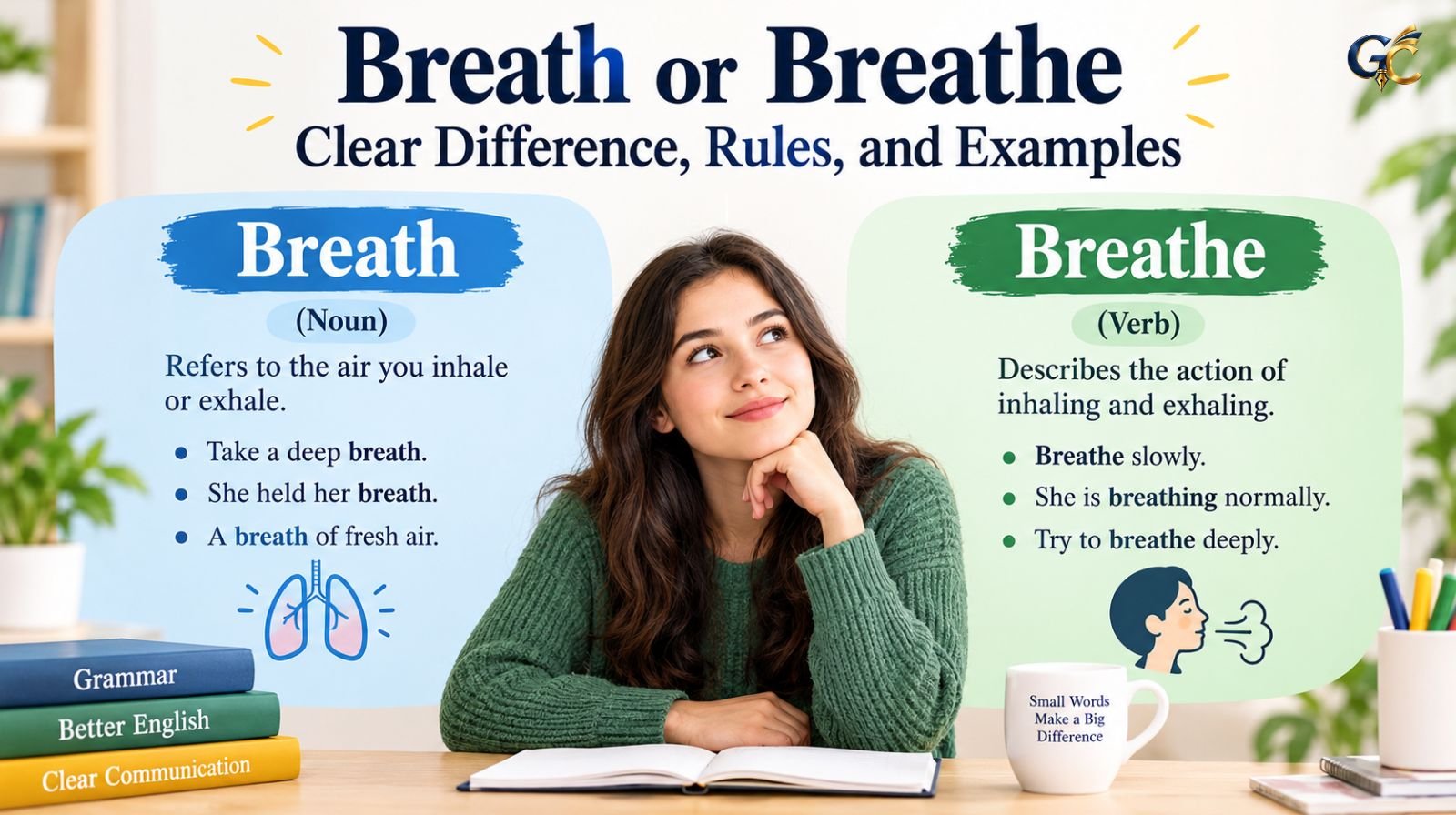
The difference between breath and breathe is simple: breath is a noun that refers to the air you inhale or exhale, while breathe is a verb that describes the action of taking air into and out of your lungs.
For example, you take a deep breath before a presentation, but you breathe slowly to calm your nerves.
In this guide, you will learn the meaning of each word, their pronunciation, the grammar rules, common mistakes, and practical examples to help you use them confidently in everyday English.
What Is the Difference Between Breath and Breathe?
The main difference between breath and breathe is their part of speech. One names the action’s result or the air itself, while the other describes the action.
What Does Breath Mean?
Breath is a noun. It refers to the air you take into your lungs or release when you exhale. It can also describe a single cycle of inhaling and exhaling.
Examples:
- Take a deep breath before you begin speaking.
- Her breath was visible in the cold morning air.
- He held his breath while waiting for the result.
- I could feel my breath becoming faster after running.
In these sentences, breath names something rather than describing an action.
What Does Breathe Mean?
Breathe is a verb. It means to inhale and exhale air. It can also describe taking a moment to relax or allowing something to have space.
Examples:
- Remember to breathe slowly when you feel nervous.
- The doctor asked the patient to breathe deeply.
- It was difficult to breathe in the smoky room.
- Open the window to let the room breathe.
Here, breathe describes an action or process.
Breath vs. Breathe at a Glance
| Feature | Breath | Breathe |
|---|---|---|
| Part of speech | Noun | Verb |
| Meaning | Air taken in or released | To inhale and exhale |
| Pronunciation | /breθ/ — sounds like “breth” | /briːð/ — sounds like “bree-th” |
| Final sound | Unvoiced “th” | Voiced “th” |
| Example | Take a deep breath. | Breathe deeply. |
Quick rule: If you are naming the air or a single inhalation, use breath. If you are describing the action of inhaling and exhaling, use breathe.
How to Pronounce Breath and Breathe Correctly
Although the spellings differ by only one letter, the pronunciation is noticeably different. Learning the sounds makes it easier to remember which word to use.
How to Pronounce Breath
The word breath rhymes with words such as death and left only approximately in some accents; more accurately, it shares the short vowel sound in bed and the final unvoiced “th” in think.
Pronunciation: BRETH (/brɛθ/).
Examples:
- Take a breath.
- His breath smelled fresh.
- She caught her breath.
The final “th” is unvoiced, meaning your vocal cords do not vibrate when you make the sound.
How to Pronounce Breathe
The word breathe has a long “ee” vowel sound, like the one in see. Its final “th” is voiced, similar to the sound in this.
Pronunciation: BREE-th (/briːð/).
Examples:
- Breathe slowly.
- I can breathe easily now.
- Try to breathe through your nose.
An Easy Pronunciation Trick
Say these two sentences aloud:
- “Take a deep breath.”
- “Remember to breathe.”
Notice that breath has a shorter vowel sound, while breathe has a longer “ee” sound. Practicing this difference can improve both your speaking and spelling.
Grammar Rules for Using Breath and Breathe
Understanding basic grammar rules helps you choose the correct word without second-guessing yourself.
Rule 1: Use Breath as a Noun
Use breath when referring to air, a single inhalation or exhalation, or the sensation associated with breathing.
Examples:
- I need to catch my breath after climbing the stairs.
- She took a deep breath before answering.
- His breath became visible in the freezing air.
A useful clue is that breath often appears after words such as a, the, deep, and short.
Rule 2: Use Breathe as a Verb
Use breathe when describing the act of inhaling and exhaling.
Examples:
- Try to breathe calmly.
- The baby was breathing peacefully.
- We need clean air to breathe.
You can also change the verb according to tense:
- Present: I breathe slowly.
- Present continuous: I am breathing slowly.
- Past: I breathed slowly.
- Future: I will breathe slowly.
Notice that the past tense of breathe is breathed, not breath.
Rule 3: Check the Words Around It
Sometimes the surrounding words make the choice obvious.
| Sentence | Correct word | Reason |
|---|---|---|
| Take a deep ___ | Breath | A noun is needed |
| Remember to ___ | Breathe | A verb is needed |
| She held her ___ | Breath | Refers to air |
| He could hardly ___ | Breathe | Describes an action |
| I am trying to ___ | Breathe | Follows “to” |
| She was out of ___ | Breath | Common noun expression |
Remember: After to, the base verb is generally required when to marks an infinitive, as in “to breathe.” However, to can also be a preposition, so always consider the sentence’s meaning.
Common Expressions, Examples, and Mistakes
Both words appear in everyday expressions, including conversations about stress, exercise, health, and emotions. Learning these expressions will help you recognize the correct spelling naturally.
Common Expressions With Breath
Here are some popular phrases that use breath as a noun.
- Take a deep breath: Inhale deeply, often to relax.
- Hold your breath: Stop breathing temporarily or wait anxiously for something.
- Catch your breath: Recover normal breathing after physical activity or surprise.
- Out of breath: Breathing hard after exercise or exertion.
- A breath of fresh air: Something refreshing, new, or different.
- Under your breath: Speaking so quietly that others may struggle to hear you.
Examples:
- I took a deep breath before my job interview.
- We were out of breath after running uphill.
- She whispered the answer under her breath.
- His new ideas were a breath of fresh air for the team.
Common Expressions With Breathe
These expressions use breathe as a verb.
- Breathe deeply: Take slow, deep breaths.
- Breathe easily: Breathe without difficulty; it can also mean to feel relieved.
- Breathe in: Inhale air.
- Breathe out: Exhale air.
- Breathe life into something: Make something more lively or interesting.
- Live and breathe something: Be deeply interested in or devoted to something.
Examples:
- Breathe in slowly and breathe out gently.
- I could finally breathe easily after hearing the good news.
- The designer breathed life into the old building.
- She lives and breathes music.
Mistakes to Avoid
| Incorrect | Correct | Explanation |
|---|---|---|
| Take a deep breathe. | Take a deep breath. | A noun is needed. |
| I cannot breath. | I cannot breathe. | A verb follows “cannot.” |
| He held his breathe. | He held his breath. | The expression requires a noun. |
| She needs to breath. | She needs to breathe. | The infinitive verb is required. |
| I am out of breathe. | I am out of breath. | This expression uses the noun. |
The easiest way to avoid these mistakes is to identify the role of the word in your sentence before choosing its spelling.
A Real-Life Example: How One Spelling Change Improves Writing
Imagine a student named Alex preparing a short speech for a school presentation. Alex understands the topic well but feels nervous about speaking in front of the class. While writing the speech, Alex types the following sentences:
“I took a deep breathe before I started. My teacher reminded me to take my time and breath slowly. After a few minutes, I was out of breathe, so I stopped to rest.”
Although the meaning is understandable, the sentences contain three spelling mistakes. Alex has confused the noun breath with the verb breathe.
Correcting the Sentences
Alex reviews each sentence and identifies what the word needs to do.
- “I took a deep breath before I started.” The word refers to a single inhalation, so the noun is correct.
- “My teacher reminded me to take my time and breathe slowly.” The word describes an action, so the verb is needed.
- “After a few minutes, I was out of breath, so I stopped to rest.” The phrase “out of breath” is a fixed expression that uses the noun.
What Alex Learns
Instead of memorizing every sentence separately, Alex learns a simple rule: breath names something, while breathe describes doing something.
Alex then practices with other examples, such as “hold your breath,” “breathe deeply,” and “catch your breath.” Over time, the distinction becomes easier to recognize while writing.
This example illustrates a useful editing technique for students, bloggers, and professionals: read the entire sentence, identify whether a noun or verb is required, and then check the spelling. The technique works in essays, emails, social media posts, and website articles.
The lesson: Correct spelling is not just about adding or removing a letter. It is about choosing the word that fits the meaning and grammar of the sentence.
What Do Recent Education Statistics Tell Us About Grammar?
There is no reliable, widely established 2025–2026 statistic specifically measuring how often English writers confuse breath and breathe. It would be misleading to invent a percentage or claim that a particular number of people make this exact mistake.
However, official education data can provide useful context about the importance of spelling and grammar skills.
What the 2025–2026 Data Shows
According to the UK Department for Education’s 2025–2026 Key Stage 2 attainment statistics, 74% of pupils in England met the expected standard in grammar, punctuation, and spelling, compared with 73% in 2025.
These figures cover a broad range of language skills. They do not measure confusion between breath and breathe specifically, and they should not be interpreted as evidence about this particular spelling error.
How to Apply This Information
For English learners and writers, the practical takeaway is to develop a reliable understanding of parts of speech, word endings, and sentence structure.
- Review whether a word is functioning as a noun or a verb.
- Read sentences aloud to notice differences in pronunciation.
- Proofread common expressions such as “take a breath” and “breathe deeply.”
- Use a trusted dictionary when a word’s meaning or grammatical role is unclear.
A small amount of deliberate practice can make your writing clearer and help you avoid common word-choice mistakes.
FAQs
Q1: What is the main difference between breath and breathe?
A: Breath is a noun that refers to the air you inhale or exhale. Breathe is a verb that describes inhaling and exhaling.
Example: Take a deep breath and breathe slowly.
Q2: Is it take a breath or take a breathe?
A: The correct expression is take a breath because the sentence requires a noun.
Example: Take a breath before answering the question.
Q3: Is it hard to breath or hard to breathe?
A: The correct phrase is hard to breathe because to introduces the base form of the verb.
Example: It was hard to breathe after running uphill.
Q4: How do you spell breathing?
A: The correct spelling is breathing. It is formed by adding -ing to breathe and removing the final e.
Example: She was breathing slowly during the exercise.
Q5: What is the past tense of breathe?
A: The past tense of breathe is breathed.
Example: He breathed deeply before speaking.
Remember that breath is a noun, while breathed is a past-tense verb.
Q6: Why do breath and breathe sound different?
A: Breath has a short vowel sound, as in bed, and ends with an unvoiced “th.” Breathe has a long “ee” sound, as in see, and ends with a voiced “th.”
These pronunciation differences help distinguish the words when speaking.
Q7: Is it hold your breath or hold your breathe?
A: The correct expression is hold your breath. The word your is followed by the noun breath in this expression.
Example: I held my breath while waiting for the final result.
Q8: How can I remember when to use breath or breathe?
A: Use this simple memory trick:
- Breath = noun: Take a breath.
- Breathe = verb: Breathe slowly.
You can also remember that breathe has an extra e, which helps signal its longer vowel sound. Practice with everyday expressions to make the distinction easier to recall.
Conclusion:
The difference between breath or breathe becomes easy once you understand their grammatical roles. Breath is a noun that refers to the air you inhale or exhale, while breathe is a verb that describes the action of inhaling and exhaling.
Remember these examples:
- Take a deep breath before speaking.
- Breathe slowly when you feel nervous.
- Hold your breath while waiting.
- Remember to breathe normally.
When you are unsure which spelling to use, check whether your sentence needs a noun or a verb. This simple technique will help you avoid common spelling mistakes and communicate more clearly.
👉 Discover more simple and practical grammar guides on Grammar Clear

Zia Ahmad is the founder of GrammarClear, an educational platform dedicated to making English grammar simple and easy to understand. Through clear explanations and practical examples, he aims to help learners improve their grammar, writing, and communication skills with confidence.

