
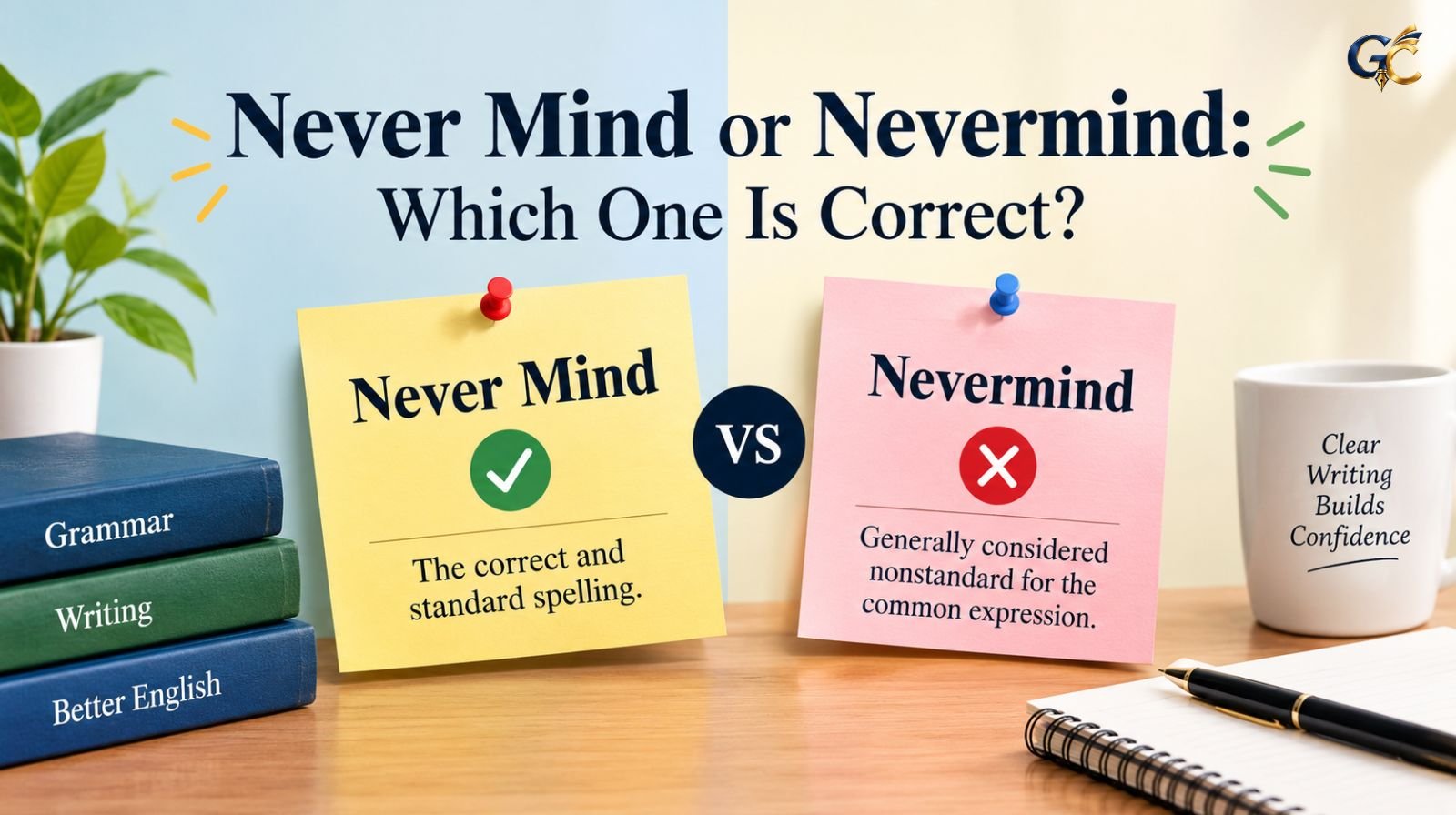
Have you ever wondered whether to write “never mind” or “nevermind” in a text message, email, or blog post? These two forms look almost identical, but only one is generally accepted as the standard spelling in modern English.
Never mind is the correct standard form in most situations. It is a two-word phrase used to tell someone to disregard something, stop worrying about it, or forget what was just mentioned. Although nevermind appears in informal writing, it is generally considered nonstandard in edited American English.
Understanding the difference between these spellings will help you write more clearly and avoid common grammar mistakes. In this guide, you will learn the meaning of never mind, how to use it in sentences, when to choose the two-word form, and why the confusion occurs.
What Is the Difference Between Never Mind and Nevermind?
The main difference between never mind and nevermind is standard spelling. The two-word form is the established choice in ordinary writing, while the one-word version appears mainly in informal contexts.
Never Mind: The Standard Spelling
Never mind is a phrase that means to forget something, disregard a statement, or stop worrying about a particular matter.
For example:
- Never mind what I said earlier.
- Never mind; I have already found the answer.
- If you cannot come today, never mind.
- Never mind the noise; keep studying.
In each sentence, never mind tells someone not to focus on something or suggests that a particular matter is no longer important.
Nevermind: The Informal or Nonstandard Form
Nevermind is a spelling you may encounter in online conversations, social media posts, song titles, and other informal contexts. However, it is not the standard spelling for the ordinary expression.
For example:
- Nonstandard: Nevermind, I will do it myself.
- Standard: Never mind, I will do it myself.
The meaning is usually clear, but the two-word form is the safer choice for school assignments, professional emails, website articles, and formal documents.
Quick Comparison Table
| Feature | Never mind | Nevermind |
|---|---|---|
| Spelling | Two words | One word |
| Standard usage | Correct standard form | Generally nonstandard for the phrase |
| Meaning | Disregard or forget something | Usually intended to convey the same meaning |
| Formal writing | Recommended | Avoid |
| Casual texting | Recommended | Sometimes seen |
The easiest rule to remember is simple: when you mean “forget it” or “don’t worry about it,” write “never mind.”
Why Do People Confuse Never Mind and Nevermind?
The confusion comes from pronunciation, informal writing habits, and exposure to familiar one-word spellings.
Both Forms Sound the Same
When people speak, they do not pronounce the space between words. As a result, listeners may not know whether an expression should be written as one word or two.
For example, someone might say:
“Never mind, I have already finished.”
Because the phrase sounds like a single unit, a writer may type nevermind without realizing that the standard expression uses two words.
Informal Writing Encourages Joined Words
Social media, text messages, and online comments often contain shortened expressions and unconventional spellings. Writers sometimes use nevermind because it looks quicker or more natural to them.
However, common usage online does not necessarily determine standard spelling. If you want your writing to be clear and grammatically reliable, use never mind for the usual expression.
Familiar Titles Can Cause Confusion
One reason readers recognize Nevermind is the famous album title Nevermind by Nirvana. A proper title can use a spelling that differs from the standard form of an everyday expression.
Therefore, seeing Nevermind in a title does not mean you should write it as one word in every sentence.
Never Mind in Real-Life Writing: A Practical Example
Consider a student named Daniel who is preparing an important college assignment. He wants his writing to look professional, so he pays attention to common spelling and grammar mistakes.
The Original Situation
Daniel writes the following message to a classmate:
“Nevermind, I found the information I needed for my assignment.”
His classmate understands the message immediately. There is no confusion about what Daniel means. However, Daniel wants to use standard written English in his assignment-related communication.
He reviews the sentence and changes it to:
“Never mind, I found the information I needed for my assignment.”
The revised version uses the standard two-word expression.
Applying the Rule to Different Situations
Later, Daniel uses the same expression in three other situations:
- In a text message: “Never mind, I found my notebook.”
- In an email: “Never mind my previous question; I have resolved the issue.”
- In an assignment: “The first explanation is incomplete, never mind the second.”
Each example uses never mind in a slightly different way. In the first, Daniel withdraws a concern. In the second, he asks the recipient to disregard an earlier question. In the third, the phrase emphasizes that the second explanation is even less satisfactory.
What Daniel Learns
Daniel discovers that the spelling rule does not change simply because the communication format changes. The two-word version remains the safest choice in everyday messages, professional emails, and academic work.
He also learns that context matters. The expression can mean “forget it,” “do not worry,” or “let alone,” depending on the sentence.
This example demonstrates a practical lesson for anyone improving their English: understanding a word’s function is often more useful than memorizing its spelling alone. Once you recognize the ordinary expression never mind, you can use it confidently in different situations.
2025–2026 Usage Notes: What Does the Evidence Tell Us?
There is an important distinction between current language usage data and established spelling guidance. A recent statistic is not automatically useful for deciding whether a spelling is standard.
What Reliable Dictionaries Establish
Dictionary entries distinguish the common phrase never mind from the more specialized noun nevermind. The two-word expression means to disregard something, stop worrying, or indicate that something does not matter. The closed form has a narrower, older or dialectal noun use related to attention or concern.
For example:
- Standard expression: “Never mind; I will try again tomorrow.”
- Specialized noun usage: “Pay him no nevermind.”
The second example is an uncommon expression and is not the best model for ordinary professional writing.
Are There Reliable Statistics for 2025–2026?
No verified, representative 2025–2026 statistic is available here that establishes the percentage of writers using each spelling or proves that one form is more grammatically correct.
That matters because search frequency, social media usage, and spelling correctness are different measurements. A spelling may appear frequently online without becoming the preferred form in edited English.
For a practical spelling decision, dictionary definitions and established editorial conventions are more useful than an unsupported percentage.
Sources for Further Reading
The following reference works help explain the established meanings and usage:
- Dictionary.com entries for “never mind” and “nevermind.”
- Collins English Dictionary definitions and examples of “never mind.”
- Webster’s New World College Dictionary standard definitions and usage information.
These sources support the central distinction: use never mind for the familiar everyday expression, and reserve nevermind for its limited specialized uses.
FAQs
Q1: Is Never Mind or Nevermind Correct?
A: Never mind is the standard spelling for the ordinary expression meaning “forget it,” “do not worry,” or “disregard that.” Nevermind has a limited noun usage but is not the recommended spelling for the common phrase.
Q2: Is Nevermind One Word or Two Words?
A: For the everyday expression, it is two words: never mind. The one-word spelling appears in informal writing and in specialized noun usage, but two words are preferred in standard English.
Q3: Is Never Mind Correct in American English?
A: Yes. Never mind is the standard form in American English. You can use it in conversations, emails, academic assignments, and professional documents.
Q4: Can I Use Nevermind in Text Messages?
A: You may encounter nevermind in informal text messages, and readers will usually understand it. However, never mind is still the safer spelling if you want to follow standard written English.
Q5: Does Never Mind Mean Forget It?
A: Yes. One common meaning of never mind is “forget it” or “do not worry about it.”
For example:
“Never mind what I said earlier; it is no longer important.”
The phrase can also mean “let alone” in comparisons.
Q6: Should Never Mind Have a Hyphen?
A: No. The standard expression is written as two separate words without a hyphen.
Correct: “Never mind the delay.”
Incorrect for the ordinary expression: “Never-mind the delay.”
Q7: Is Never Mind Formal or Informal?
A: Never mind is acceptable in both casual and formal contexts, although it can sound conversational. In a highly formal document, alternatives such as disregard, please ignore, or do not be concerned may sometimes be more appropriate.
Q8: How Can I Remember the Correct Spelling?
A: Remember that the standard phrase contains two words: never mind. Whenever you mean “forget it,” “do not worry,” or “ignore that,” write the words separately.
Conclusion:
When choosing between never mind or nevermind, the safest answer is never mind, written as two words. It is the standard form for telling someone to forget something, stop worrying, or disregard a previous statement.
Although nevermind appears in informal messages and has a limited noun usage, it is generally not the preferred spelling for the everyday expression. Therefore, use never mind in your articles, emails, school assignments, and professional communication.
Remember these simple examples:
- “Never mind, I found the answer.”
- “Never mind what happened yesterday.”
- “I cannot afford a bicycle, never mind a car.”
Once you understand this rule, you can avoid a common spelling mistake and write with greater confidence.
👉 Discover more simple and practical grammar guides on Grammar Clear

Zia Ahmad is the founder of GrammarClear, an educational platform dedicated to making English grammar simple and easy to understand. Through clear explanations and practical examples, he aims to help learners improve their grammar, writing, and communication skills with confidence.

