
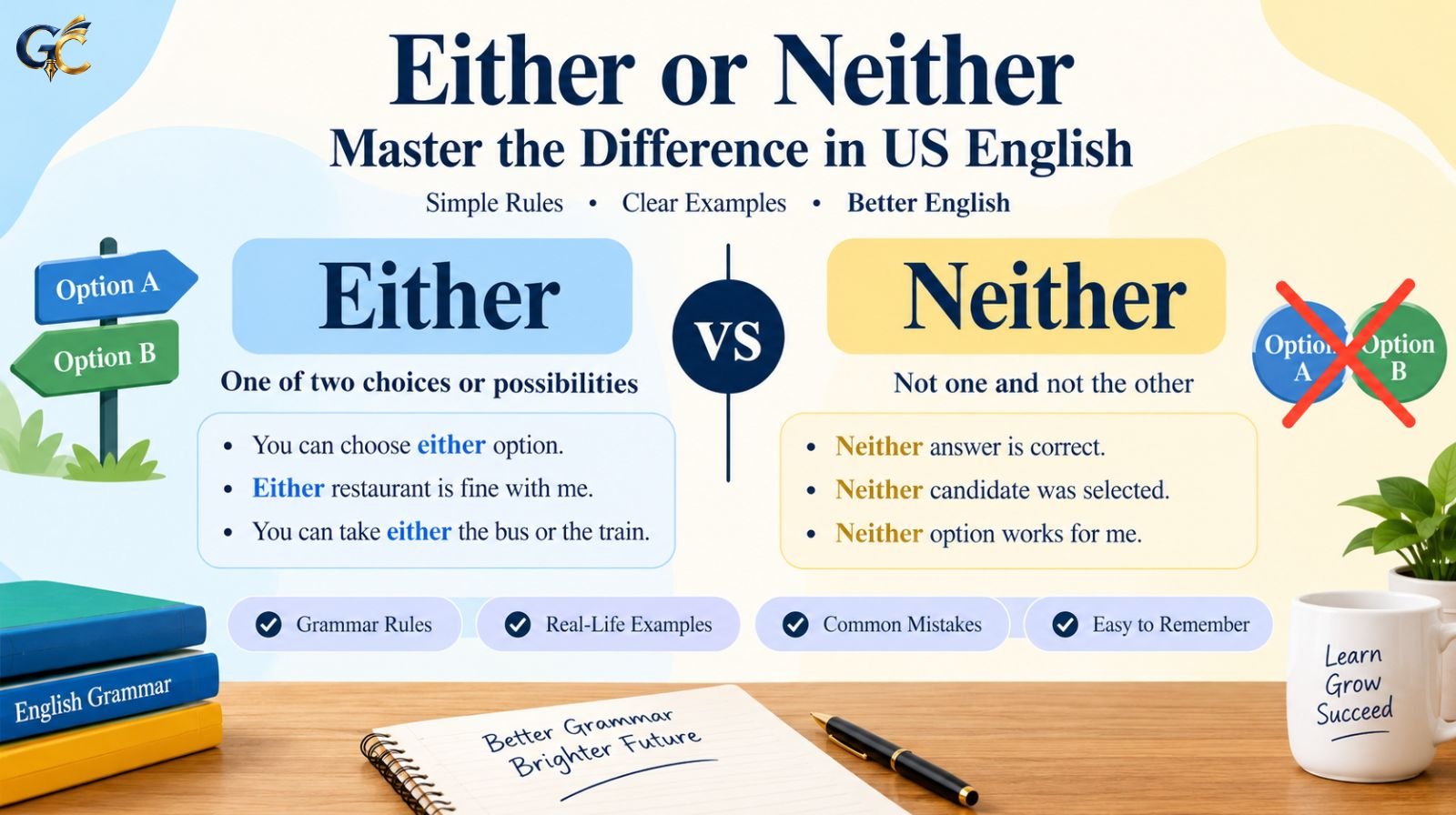
Choosing between either or neither can be confusing, especially when you’re trying to talk about two people, two things, or two choices in English. Although these words look and sound similar, they express different ideas.
The easiest way to remember the difference is this: either generally refers to one of two possibilities, while neither means not one and not the other. Once you understand this basic contrast, phrases such as either…or and neither…nor become much easier to use.
In this guide, you’ll learn exactly when to use either or neither, how they work in American English, how to form sentences correctly, and how to avoid common mistakes.
Either or Neither: What Is the Difference?

The main difference between either and neither is whether you are talking about a choice or rejecting both options.
- Either = one of two choices or possibilities
- Neither = not one and not the other
For example:
- Either answer is acceptable.
→ One of the two answers is acceptable; it doesn’t matter which one. - Neither answer is correct.
→ Both answers are incorrect.
This distinction is simple once you see the logic behind the words.
What Does Either Mean?
Either is commonly used when there are two possibilities and you are choosing one, or when either possibility is acceptable.
Examples:
- You can choose either option.
- Either restaurant is fine with me.
- You can take either the bus or the train.
- Either answer could be correct.
Cambridge Dictionary explains that either can function as a determiner, pronoun, adverb, or conjunction and is commonly used when referring to two choices or possibilities.
What Does Neither Mean?
Neither expresses a negative idea involving two people or things. It means not either one.
Examples:
- Neither answer is correct.
- Neither candidate was selected.
- Neither option works for me.
- Neither restaurant is open.
If there are two choices and you reject both, neither is normally the right word.
The Quick Memory Trick
Think of the words this way:
| Word | Basic meaning | Example |
|---|---|---|
| Either | One of two | Either answer is acceptable. |
| Neither | Not one and not the other | Neither answer is acceptable. |
So, if you’re selecting or allowing a choice, think either.
If you’re rejecting both choices, think neither.
How to Use Either Correctly
Either has several common uses in US English. Understanding these patterns will make your writing sound more natural and precise.
Either + Singular Noun
When either comes directly before a noun referring to two possibilities, the noun is normally singular.
Examples:
- Either choice is acceptable.
- Either student can answer the question.
- Either car will get you there.
- Either option should work.
Not:
- ❌ Either choices are acceptable.
- ❌ Either students can answer.
When you use either as a determiner before a singular countable noun, the noun stays singular.
Either of + Plural Noun or Pronoun
Use either of before a plural noun with a determiner or before a pronoun.
Examples:
- Either of the answers could be correct.
- Either of the students can help.
- Either of them can drive.
- Either of us can make the reservation.
Notice the pattern:
either + singular noun
but
either of + plural noun/pronoun
This is one of the most useful patterns to remember.
Either…or
The structure either…or presents two alternatives.
Examples:
- You can either stay home or come with us.
- We can either drive or take the train.
- Either John or Mike will call you.
- You can choose either coffee or tea.
Cambridge describes either…or as a structure used to connect two choices or possibilities.
A helpful rule is to keep the grammatical structures after either and or parallel:
- Either study at home or go to the library.
- Either the blue shirt or the black shirt.
Avoid mixing unrelated structures when a parallel construction is possible.
Either at the End of a Negative Sentence
Either can also appear at the end of a negative sentence when it means “also.”
For example:
- I don’t like coffee either.
- She isn’t coming either.
- We didn’t see the movie either.
- He can’t swim either.
Compare:
I like coffee too.
with:
I don’t like coffee either.
Cambridge notes that not…either is used to add another piece of negative information.
How to Use Neither Correctly
Neither is used when two people or things are both excluded from a statement.
Neither + Singular Noun
Like either, neither can come directly before a singular countable noun.
Examples:
- Neither answer is correct.
- Neither student passed the test.
- Neither car is available.
- Neither option seems practical.
The meaning is negative for both choices.
For example:
Neither candidate won.
This means Candidate A did not win, and Candidate B did not win.
Neither of + Plural Noun or Pronoun
Use neither of with plural nouns that have a determiner or with pronouns.
Examples:
- Neither of the answers is correct.
- Neither of the students was ready.
- Neither of them called me.
- Neither of us knew the answer.
In formal writing, neither of is commonly followed by a singular verb when it functions as the subject. Cambridge gives examples such as “Neither of the birthday cards was suitable.”
In everyday American speech, however, you may sometimes hear a plural verb:
Neither of them were available.
For formal writing, Neither of them was available is the safer choice.
Neither…nor
The structure neither…nor is the negative counterpart of either…or.
Compare:
Either John or Sarah will attend.
with:
Neither John nor Sarah will attend.
The first sentence says one of the two will attend. The second says both will not attend.
More examples:
- Neither the manager nor the assistant was available.
- She speaks neither French nor Spanish.
- Neither option nor the alternative seems practical.
Cambridge identifies neither…nor as a structure that connects negative alternatives.

Either vs. Neither: The Easiest Way to Choose
If you frequently confuse these words, use this simple decision process.
Step 1: Are There Two Options?
Both either and neither are commonly associated with two people or things.
For example:
- two restaurants
- two answers
- two candidates
- two possible routes
If you’re discussing more than two items, words such as any, none, or all may be more appropriate depending on the meaning.
Step 2: Are You Accepting One Choice?
Use either.
You can choose either seat.
The meaning is that both seats are possible choices.
Step 3: Are You Rejecting Both Choices?
Use neither.
Neither seat is comfortable.
The meaning is that both seats are unsuitable.
Either vs. Neither Comparison
| Situation | Correct word | Example |
|---|---|---|
| One of two choices is acceptable | Either | Either option is fine. |
| Both choices are rejected | Neither | Neither option is fine. |
| Two alternatives | Either…or | Either call me or email me. |
| Two negative alternatives | Neither…nor | Neither John nor Lisa called. |
| Negative statement + “also” | Either | I don’t want it either. |
| Negative agreement | Neither | Neither do I. |
This table gives you a quick way to determine which word fits your sentence.
Either or Neither in Real-Life US English

Understanding grammar rules is useful, but seeing these words in everyday situations makes the distinction much easier to remember.
At a Restaurant
Imagine two friends deciding where to eat.
Alex: Should we go to the Italian restaurant or the Mexican restaurant?
Sam: Either is fine with me.
Here, Sam is willing to choose either restaurant.
Now imagine neither restaurant is open:
Alex: Are the Italian or Mexican restaurants open?
Sam: Neither is open.
Both possibilities have been ruled out.
At Work
Consider a workplace decision:
You can either email the report or upload it to the shared folder.
This gives the employee two acceptable methods.
Now compare:
Neither the manager nor the assistant approved the report.
This means both people did not approve it.
In Everyday Conversation
You may also hear:
“I don’t like either.”
This means the speaker does not like option A or option B.
Another common response is:
“Neither do I.”
For example:
“I don’t enjoy long meetings.”
“Neither do I.”
Here, neither do I means “I don’t enjoy them either.”
Cambridge confirms that neither + auxiliary/modal + subject is used to agree with a negative statement.
A Real-Life Example: Choosing Between Two Jobs
Imagine a recent college graduate, Maya, receives two job offers. One company offers remote work but a lower salary. The second company offers a higher salary but requires Maya to work in an office every day.
At first, Maya tells her friend:
“I could either accept the remote job or take the higher-paying position.”
Her friend asks which one she prefers. Maya replies:
“Either job could work for me. I just need to decide which benefit matters more.”
A few days later, however, Maya learns that the remote company has frozen hiring and the second company has filled the position. She tells her friend:
“Neither job is available anymore.”
The meaning has changed completely. When Maya was considering the two offers, she used either because both were possible choices. Once both offers disappeared, she used neither because neither option remained available.
This example shows why the words cannot normally be treated as interchangeable. Either keeps two possibilities open; neither closes both possibilities.
The same distinction appears in everyday decisions about restaurants, transportation, products, schools, schedules, and work. If you’re saying “one of these two” or “it doesn’t matter which one,” either is usually appropriate. If you’re saying “not this one and not that one,” neither is the better choice.

Either or Neither: 2025–2026 Language Data
Grammar questions about either and neither matter because English is used across a highly multilingual population in the United States.
A March 2025 analysis by the Pew Research Center reported that about 78% of people ages 5 and older in the United States speak only English at home, while another 14% speak a language other than English at home and report speaking English very well. About 9% were reported as not proficient in English. The analysis used Census Bureau American Community Survey data.
More recent Census Bureau data available in 2026 from the 2024 American Community Survey show approximately 321.7 million people ages 5 and older in the United States in the relevant language table, including about 247.7 million who speak only English at home.
These numbers do not measure how often people use either or neither, but they illustrate why clear English grammar remains important for a large and diverse population. For students, professionals, educators, and writers, understanding small distinctions such as either vs. neither can make communication more precise.
Common Mistakes With Either and Neither

Even fluent English speakers sometimes make mistakes with these structures.
Mistake 1: Using “Neither” With a Double Negative
Avoid:
❌ I don’t like neither option.
In standard English, this creates a double-negative construction.
Better:
✅ I like neither option.
or:
✅ I don’t like either option.
Cambridge specifically recommends not…either rather than not…neither.
Mistake 2: Saying “Either” When You Mean “Neither”
Compare:
Either answer is correct.
This suggests that either of the two answers can be accepted.
But:
Neither answer is correct.
means both answers are wrong.
Changing just one word completely changes the meaning.
Mistake 3: Using “Both” With a Negative Verb
You may hear:
❌ Both answers aren’t correct.
This can be ambiguous because it may mean that the two answers are not both correct, without clearly saying whether one or both are wrong.
If you mean that both are wrong, use:
✅ Neither answer is correct.
Cambridge recommends neither of rather than both of…not when expressing this negative meaning.
Mistake 4: Using “Not…Neither”
Avoid:
❌ She doesn’t want neither option.
Use:
✅ She doesn’t want either option.
or:
✅ She wants neither option.
Both corrected versions clearly express the intended negative meaning.
Mistake 5: Forgetting Subject-Verb Agreement
Pay attention to the verb when either or neither introduces a pair of subjects.
For example:
Either John or Sarah is coming.
When both alternatives are singular, a singular verb is appropriate.
With plural alternatives:
Either the teachers or the students are responsible.
Subject-verb agreement can become more complicated when the alternatives differ in number. Grammar references such as Cambridge emphasize that the number and person of the subject determine the verb form, while Grammarly specifically discusses the difficulty of choosing is or are with either/or and neither/nor constructions.
FAQs
Q1: What is the difference between either and neither?
A: Either generally refers to one of two choices or possibilities, while neither means not one and not the other.
Example:
Either answer is acceptable.
Neither answer is acceptable.
Q2: Is “either or” positive or negative?
A: Either…or normally presents alternatives without making the sentence negative.
Example:
You can either call me or send an email.
The negative counterpart is neither…nor:
You can choose neither the first option nor the second.
Q3: Is “neither nor” the opposite of “either or”?
A: Yes. In basic usage, either…or presents alternatives, while neither…nor excludes both alternatives.
Either John or Mike will come.
Neither John nor Mike will come.
Q4: Can I say “I don’t like either”?
A: Yes. In a negative sentence, either can mean that you don’t like one option and you don’t like the other.
For example:
I don’t like either restaurant.
This means you don’t like Restaurant A or Restaurant B.
Q5: Should I say “neither of them is” or “neither of them are”?
A: For formal writing, neither of them is is the safer choice because neither is traditionally treated as singular.
Example:
Neither of them is available.
In informal speech, plural agreement such as “neither of them are” is also heard.
Q6: What is the difference between “either” and “any”?
A: Either normally refers to two choices, while any is generally used when there are more than two possibilities or when the number is unspecified.
Examples:
You can choose either shirt.
→ Two shirts are being considered.
You can choose any shirt.
→ There may be several shirts.
Q7: Can “neither” be used by itself?
A: Yes. When two options have already been mentioned, neither can stand alone.
Example:
“Would you like tea or coffee?”
“Neither, thanks.”
Q8: Is “neither do I” grammatically correct?
A: Yes. Neither do I is a standard way to agree with a negative statement.
Example:
“I don’t like spicy food.”
“Neither do I.”
It has essentially the same meaning as:
“I don’t like spicy food either.”
Cambridge lists neither do I and similar structures as standard ways to express negative agreement.
Conclusion: Either or Neither?
The difference between either or neither becomes much easier once you focus on the meaning.
Use either when you’re talking about one of two possibilities, two acceptable choices, or two alternatives:
You can choose either option.
Use neither when you mean not one and not the other:
Neither option works.
Remember the two key patterns:
- Either…or → two alternatives
- Neither…nor → two negative alternatives
Also remember that either works naturally in negative sentences:
I don’t want either one.
And neither can agree with a negative statement:
“I don’t like it.”
“Neither do I.”
Once you understand this basic contrast, you’ll be able to use either and neither more confidently in emails, essays, conversations, and everyday US English.
👉 Explore more useful grammar tips and guides on Grammar Clear

Zia Ahmad is the founder of GrammarClear, an educational platform dedicated to making English grammar simple and easy to understand. Through clear explanations and practical examples, he aims to help learners improve their grammar, writing, and communication skills with confidence.

