
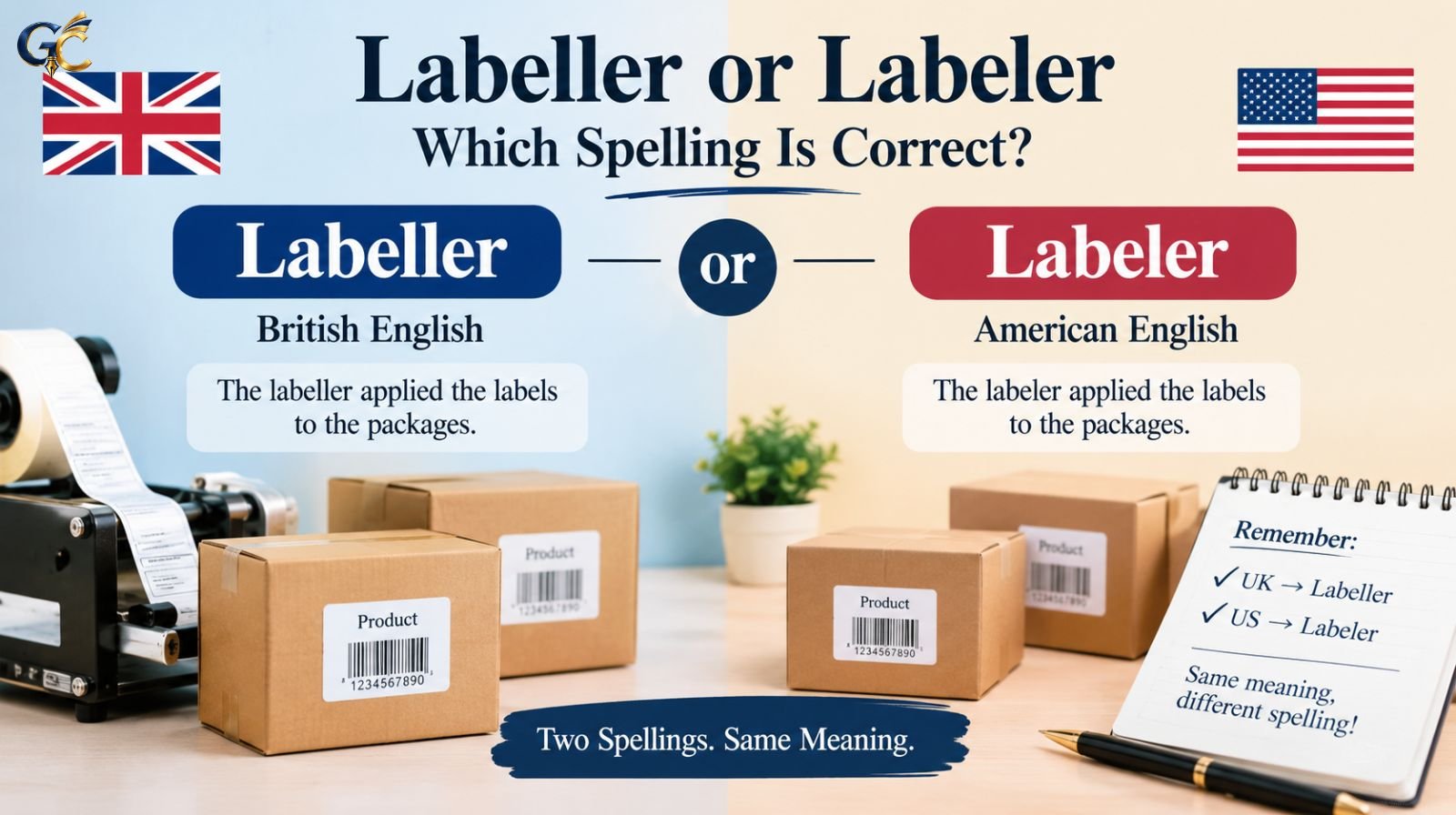
If you are unsure whether labeller or labeler is the correct spelling, you are not alone. Both forms appear in English writing, especially when discussing people or machines that apply labels. The good news is that both “labeller” and “labeler” are correct. The difference is mainly based on the variety of English you are using.
Labeller is the spelling commonly associated with British English, while labeler is the US spelling. Both words have the same meaning.
In this guide, you will learn the difference between labeller and labeler, where each spelling is used, how to use them in sentences, and which version you should choose for your own writing.
What Is the Difference Between Labeller and Labeler?
The main difference between labeller and labeler is spelling, not meaning.
Both words are nouns formed from the verb label. They can describe a person who puts labels on things or, depending on context, a device or machine that applies labels.
Labeller: British English
Labeller is the spelling commonly used in British English.
For example:
The labeller checked each package before it was shipped.
British English commonly uses double l in related forms such as:
- labeller
- labelling
- labelled
Labeler: American English
Labeler is the standard American spelling.
For example:
The labeler applied the stickers to the packages automatically.
American English generally uses a single l in these forms:
- labeler
- labeling
- labeled
Collins specifically lists labeller as the British form and labeler as the US form.
Labeller or Labeler: Which Spelling Should You Use?
If you need a quick answer, use the spelling that matches your version of English.
| Form | Common English variety | Example |
|---|---|---|
| Labeller | British English | The labeller applied the product labels. |
| Labeler | American English | The labeler applied the product labels. |
Neither spelling is inherently wrong. The important point is regional consistency.
Use “Labeller” in British English
If your document follows British English conventions, labeller is the natural choice.
You may encounter this spelling in writing connected with:
- The UK
- British publications
- British educational materials
- Some Commonwealth English contexts
For example:
The labeller inspected the bottles before they left the factory.
Use “Labeler” in American English
If you are writing for an American audience, labeler is the appropriate form.
For example:
The labeler was installed on the production line yesterday.
The same regional distinction appears in other forms of the word. Cambridge identifies labelled as the UK spelling and labeled as the US spelling.
Why Does British English Use “Labeller”?
The spelling difference becomes easier to understand when you look at related forms of label.
British English commonly uses a doubled l when certain suffixes are added:
- label → labeller
- label → labelling
- label → labelled
American English generally keeps one l:
- label → labeler
- label → labeling
- label → labeled
Labeller vs. Labeler and Related Words
Consider these examples:
British: The machine is labelling the boxes.
American: The machine is labeling the boxes.
Similarly:
British: The boxes were labelled correctly.
American: The boxes were labeled correctly.
This is not a difference in pronunciation or meaning. It is primarily a difference in spelling conventions.
Cambridge lists labelling as the UK form and identifies labeling as the US equivalent.
How to Use Labeller and Labeler in Sentences
Understanding the rule is useful, but seeing the words in context makes the difference much clearer.
Examples With “Labeller”
Here are some examples using the British spelling:
- The labeller applies labels to each bottle.
- The factory purchased a new automatic labeller.
- The labeller needs to be cleaned after each production run.
- The packaging team inspected the labeller before starting work.
Examples With “Labeler”
Here are equivalent examples using the American spelling:
- The labeler applies labels to each bottle.
- The factory purchased a new automatic labeler.
- The labeler needs to be cleaned after each production run.
- The packaging team inspected the labeler before starting work.
Notice that the meaning remains essentially the same. Only the regional spelling changes.
Person or Machine?
The word can refer to either a person or a machine depending on context.
For example:
The labeller carefully attached the labels by hand.
Here, the word refers to a person.
But:
The labeller automatically places labels on bottles.
Here, it refers to a machine.
The same distinction applies to labeler.
Merriam-Webster’s dictionary listing defines labeler as “one that labels,” confirming its use as a noun for something or someone that labels.
A Real-Life Example: Choosing the Right Spelling at Work
Imagine a packaging company based in London preparing a technical manual for its employees. The manual explains how workers should operate a machine that attaches labels to food containers.
Because the company uses British English throughout its documentation, the writer chooses labeller. The manual might say, “Before operating the labeller, check that the label roll is properly positioned.”
Now imagine a similar company based in Chicago. Its technical documentation follows American English. In that manual, the same machine might be called a labeler: “Before operating the labeler, check that the label roll is properly positioned.”
Neither company has made a spelling mistake. Each has chosen the form that matches its established English style.
The important lesson is consistency. If the London manual used “labeller” in one section but suddenly changed to “labeler” in another, readers might wonder whether the two words referred to different machines. Likewise, an American manual should normally maintain its chosen spelling throughout.
This is especially useful for businesses, technical writers, editors, and bloggers. When your audience is clearly associated with one English variety, matching its spelling conventions makes your content easier to read and more consistent.
Labeller vs. Labeler: A Simple Comparison
Here is a quick checklist you can use when deciding which spelling to choose:
| Question | If the answer is… | Use |
|---|---|---|
| Are you writing in British English? | Yes | Labeller |
| Are you writing in American English? | Yes | Labeler |
| Are you following a British style guide? | Yes | Labeller |
| Are you following an American style guide? | Yes | Labeler |
| Are you writing for a specific regional audience? | Yes | Match that audience |
| Are both spellings appearing in one document? | Yes | Choose one style and stay consistent |
A Simple Rule to Remember
Think of it this way:
UK → Labeller
US → Labeler
The same pattern can help you remember:
UK: labelling, labelled, labeller
US: labeling, labeled, labeler
Labeller or Labeler: What About SEO and Online Writing?
Writers sometimes wonder whether choosing one spelling will affect search visibility.
For an article targeting a particular audience, it is useful to understand the terminology and spelling that audience actually uses. However, spelling should not be changed simply to manipulate search engines.
Google’s guidance emphasizes creating helpful, reliable, people-first content rather than producing content primarily to manipulate search rankings.
Choose Spelling Based on Your Audience
If you are writing specifically for American readers, labeler will generally fit the surrounding American spelling conventions.
If your audience uses British English, labeller may feel more natural.
For example, an American article might consistently use:
labeler → labeling → labeled
A British article might use:
labeller → labelling → labelled
Consistency Matters
Do not randomly switch between the two forms.
For example, this looks inconsistent:
The labeler is currently labelling the products.
A consistent American version would be:
The labeler is currently labeling the products.
A consistent British version would be:
The labeller is currently labelling the products.
The goal is not to prove that one spelling is universally better. The goal is to use the spelling appropriate to your chosen English variety.
Labeller or Labeler: 2025–2026 Search and Language Context
Spelling questions remain relevant because people increasingly use online search to check words, definitions, and usage before publishing or submitting writing.
Recent search-industry data also illustrates how important online search remains. Statista reported that Google accounted for more than 90% of the worldwide search-engine market across all devices in its 2025 overview, although exact shares vary by device, country, and measurement method.
In the United States, Statista reported that Google accounted for 60.3% of core search queries in May 2025, with Microsoft at 28.8%.
These figures do not show that one spelling of labeller/labeler is linguistically more correct. Instead, they provide useful context for why clear, accurate answers to everyday spelling questions continue to matter online.
The language itself remains straightforward: reputable dictionaries recognize the regional distinction between labeller and labeler. Collins lists the British labeller and US labeler, while Cambridge documents the broader British/American spelling pattern in forms such as labelled/labeled and labelling/labeling.
Common Mistakes With Labeller and Labeler
Mistake 1: Assuming One Is Always Wrong
It is incorrect to assume that either spelling is universally wrong.
Both labeller and labeler are established forms. The appropriate choice depends on the English variety being used.
Mistake 2: Mixing UK and US Spellings
A writer may use labeler in one paragraph and labelling in another without realizing that they are following different spelling conventions.
Choose a consistent style.
Mistake 3: Confusing “Label” With “Labeller”
The base word is label.
For example:
Please label the boxes.
A person or machine that performs the action can be called a:
labeller or labeler
Cambridge defines label as both a noun for information attached to something and a verb meaning to attach such information or identify something.
FAQs
Q1: Is labeller or labeler correct?
A: Both labeller and labeler are correct spellings. Labeller is associated with British English, while labeler is the US spelling.
Q2: Is labeller British or American?
A: Labeller is the British spelling. American English generally uses labeler.
Q3: Is labeler American spelling?
A: Yes. Labeler is the standard American spelling for someone or something that labels. Merriam-Webster lists labeler as a noun meaning “one that labels.”
Q4: Do labeller and labeler have different meanings?
A: No. They have the same basic meaning. Both can refer to a person or machine that applies or attaches labels.
Q5: Which spelling should I use in the UK?
A: Use labeller if you are following standard British English spelling conventions.
Q6: Which spelling should I use in the US?
A: Use labeler when writing in American English.
Q7: Is “labeller” a spelling mistake?
A: No. Labeller is a legitimate British English spelling. It is not a spelling mistake simply because American English uses labeler.
Q8: Can I use both labeller and labeler in the same article?
A: You can mention both when explaining the difference, but within your normal writing it is best to follow one regional spelling consistently.
Conclusion:
So, labeller or labeler which spelling is correct? The answer is both.
Use labeller when following British English spelling conventions, and use labeler when writing in American English. The two words have the same meaning and can describe a person or machine that applies labels.
The easiest way to remember the difference is:
British English → labeller
American English → labeler
The related forms follow the same pattern: labelling/labeling and labelled/labeled.
If you are writing an article, email, assignment, product description, or technical document, choose the spelling that matches your intended audience and remain consistent throughout.
👉 Explore more useful grammar tips and guides on Grammar Clear

Zia Ahmad is the founder of GrammarClear, an educational platform dedicated to making English grammar simple and easy to understand. Through clear explanations and practical examples, he aims to help learners improve their grammar, writing, and communication skills with confidence.

