
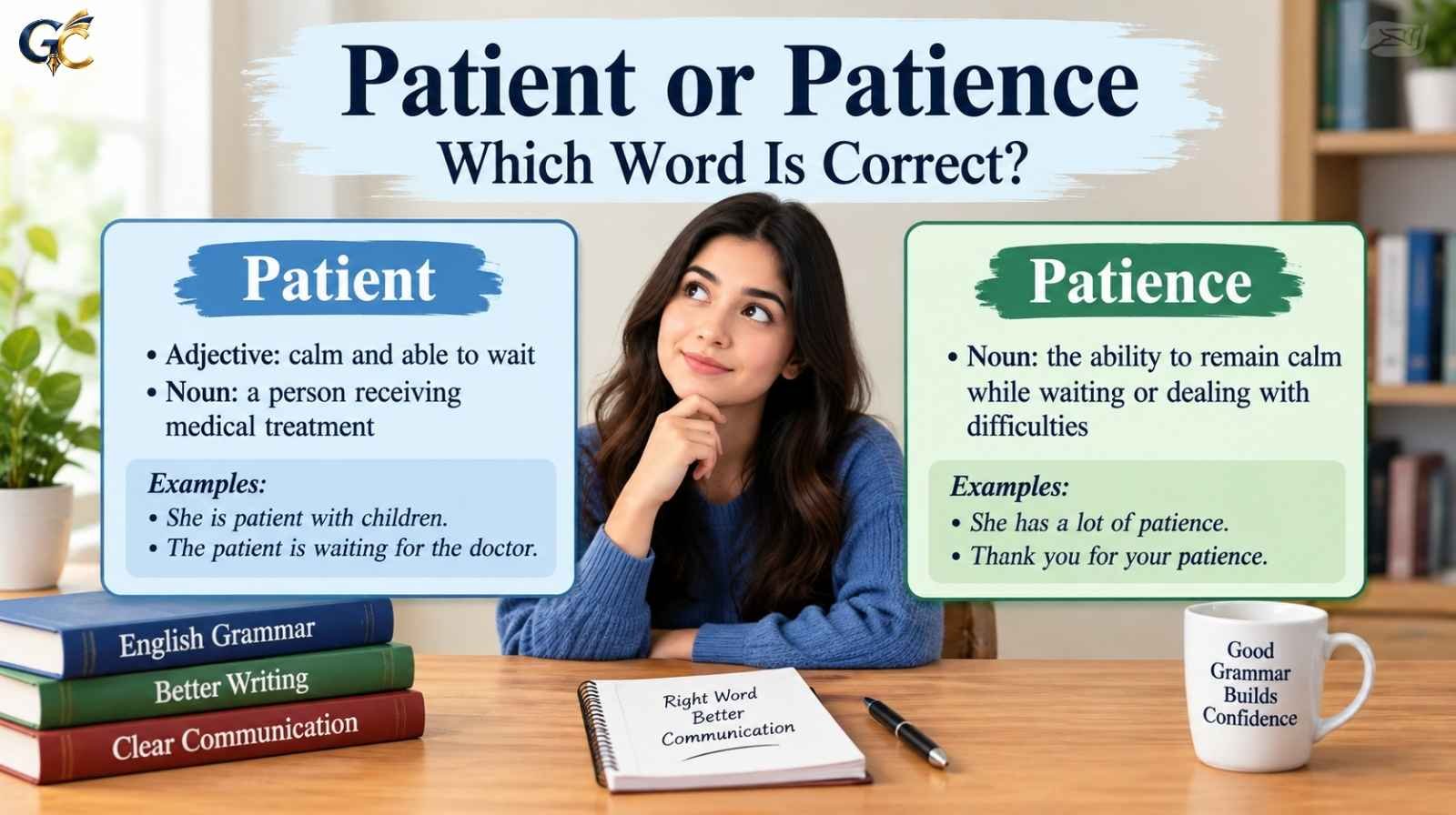
Patient or Patience are both correct English words, but they have different meanings and grammatical roles. If you are wondering whether to write patient or patience, the correct choice depends on what you want to say.
Patient can be an adjective meaning calm and able to wait, or a noun referring to someone receiving medical treatment. Patience, on the other hand, is a noun describing the ability to remain calm while waiting, dealing with difficulties, or handling annoying situations.
For example:
- She is very patient with children.
- She has a lot of patience with children.
- The patient is waiting for the doctor.
Although these words are closely related, they cannot always replace one another. This guide explains the difference between patient and patience, shows you how to use each word correctly, and gives you simple examples to remember the distinction.
What Is the Difference Between Patient and Patience?
The easiest way to remember the difference is this:
Patient describes a person or refers to someone receiving medical care, while patience is the quality or ability of remaining calm.
Cambridge Dictionary defines patient as an adjective describing someone who can wait or deal with difficulties without becoming annoyed. It also defines patient as a noun for someone receiving medical treatment.
Patience is a noun meaning the ability to wait, continue despite difficulties, or tolerate something without becoming annoyed or angry.
Patient as an Adjective
When patient is an adjective, it describes someone’s behavior or personality.
Examples:
- My teacher is very patient.
- Please be patient while we solve the problem.
- She is patient with young children.
- You need to be patient when learning a new language.
Here, patient describes a person who can wait or handle difficulties calmly.
Patient as a Noun
Patient can also be a noun in medical contexts.
Examples:
- The patient is waiting for the doctor.
- The nurse checked the patient.
- The hospital admitted a new patient.
- The doctor spoke with the patient.
In these sentences, patient does not mean calm. It means a person receiving medical care. Cambridge lists this as a separate noun meaning.
Patience as a Noun
Patience is the quality of remaining calm when something takes time or becomes difficult.
Examples:
- Learning a language requires patience.
- Thank you for your patience.
- He has a lot of patience with children.
- My patience was running out.
Notice that we normally say have patience, show patience, need patience, or lose patience.
Patient vs. Patience: A Simple Comparison
| Word | Part of Speech | Main Meaning | Example |
|---|---|---|---|
| Patient | Adjective | Able to wait calmly | She is very patient. |
| Patient | Noun | Person receiving medical treatment | The patient saw the doctor. |
| Patience | Noun | Ability to remain calm and wait | He has great patience. |
| Patiently | Adverb | In a patient manner | She waited patiently. |
The relationship becomes easier to see when you compare the words:
Patient → describes the person
Patience → describes the quality
For example:
- Ali is patient.
- Ali has patience.
- Ali waited patiently.
All three sentences are connected, but each word performs a different grammatical job.
How to Use Patient Correctly
Using patient correctly depends on whether you are using it as an adjective or a noun.
Patient as an Adjective
Use patient when you want to describe someone who can wait calmly or tolerate difficulty.
Examples:
- You should be patient with your students.
- My mother is very patient.
- Try to be patient while we finish the work.
- A good teacher should be patient.
A common structure is:
patient + with + person/thing
For example:
- She is patient with her children.
- He is patient with beginners.
- The manager was patient with the new employee.
Cambridge specifically gives patient with someone/something as a common construction.
Patient as a Medical Noun
Use patient when talking about someone receiving medical treatment.
Examples:
- The patient needs additional tests.
- The doctor examined the patient.
- The patient was discharged from the hospital.
- Every patient deserves respectful care.
In this meaning, patient has nothing to do with waiting calmly. Context tells you which meaning is intended.
Common Mistake With Patient
A common mistake is using patience when an adjective is required.
Incorrect:
She is very patience.
Correct:
She is very patient.
Why? Because is very needs an adjective describing the person.
Another example:
Incorrect:
Please be patience.
Correct:
Please be patient.
You are describing someone’s required behavior, so patient is the correct adjective.
How to Use Patience Correctly
Patience is a noun. Use it when you are talking about the quality or ability to remain calm.
Patience With People
Use patience when describing tolerance toward another person.
Examples:
- Parents need a lot of patience.
- She has incredible patience with children.
- Teaching requires patience.
- He showed great patience with the new employee.
Patience While Waiting
You can also use patience when something takes longer than expected.
Examples:
- Thank you for your patience.
- The long delay tested my patience.
- You need patience when waiting for results.
- His patience finally ran out.
The expressions lose your patience, test someone’s patience, and try someone’s patience are common English constructions. Cambridge provides examples of these uses.
Patience in Difficult Situations
Patience is not limited to waiting. It can also describe staying calm while dealing with something difficult.
For example:
Learning to play the piano requires patience.
The sentence means that learning takes time and effort, so a learner needs the ability to continue without becoming frustrated.
Similarly:
Good communication requires patience.
Here, patience refers to the quality needed to listen, understand, and respond calmly.

Patient or Patience: How Can You Remember the Difference?
A simple trick can help you choose the right word.
Think “Person” for Patient
If you are describing a person, patient is often the right choice.
- She is patient.
- He is a patient teacher.
- Please be patient.
But remember that patient can also be a medical noun.
Think “Quality” for Patience
If you are talking about the quality of staying calm, use patience.
- She has patience.
- He needs more patience.
- Thank you for your patience.
- The situation tested my patience.
Quick Decision Guide
Ask yourself:
- Am I describing someone? → Use patient.
- Am I talking about the quality of staying calm? → Use patience.
- Am I talking about someone receiving medical care? → Use patient.
- Am I describing how someone waits or behaves? → Use patiently.
For example:
Sarah is patient.
You are describing Sarah.
Sarah has patience.
You are talking about Sarah’s quality.
Sarah waited patiently.
You are explaining how Sarah waited.
A Real-Life Example: Patient vs. Patience in Everyday Writing
Imagine that a teacher is helping a student who is struggling with English grammar. The student keeps making the same mistake and becomes frustrated because the lesson is taking longer than expected.
The teacher does not become angry. Instead, she explains the rule again and gives the student another example. In this situation, we could say:
The teacher was patient with the student.
Here, patient is an adjective describing the teacher.
We could also say:
The teacher showed great patience.
In this sentence, patience is a noun describing the quality the teacher demonstrated.
Now imagine that the student finally understands the grammar rule after several attempts. The teacher smiles and says, “Good job. Learning grammar takes time.”
If we describe the teacher’s behavior, patient is appropriate:
She was patient while explaining the rule.
If we describe the quality that helped her continue teaching, patience is appropriate:
Her patience helped the student succeed.
This example shows why the two words can appear in very similar sentences while still having different grammatical functions. The choice is not about which spelling is “more correct.” Both patient and patience are correct words; the important thing is choosing the one that fits the meaning and grammar of your sentence.
Patient vs. Patience: Data and Usage Facts

There is an important point about data here: patient and patience are not competing spellings of the same word, so a percentage comparing which one is “correct” would be misleading.
Current dictionary references confirm that they have different grammatical functions. Cambridge identifies patient as both an adjective and a noun, while patience is primarily a noun describing the ability to remain calm or tolerate delay and difficulty.
A useful usage breakdown is therefore:
- Patient: adjective + noun
- Patience: noun
- Patiently: adverb
- Impatient: adjective describing a lack of patience
- Impatience: noun describing a lack of patience
These distinctions remain useful for modern writing in 2025–2026, particularly for students, bloggers, professionals, and anyone trying to improve English accuracy.
Grammarly also includes “Patience vs. Patients” among commonly confused English words, showing that this family of words causes frequent confusion in writing.
The key lesson is simple: do not choose between patient and patience based on spelling. Choose based on grammatical function and meaning.
Common Mistakes With Patient and Patience
Mistake 1: “Please Be Patience”
Incorrect:
Please be patience.
Correct:
Please be patient.
After be, you need the adjective patient.
Mistake 2: “She Has a Lot of Patient”
Incorrect:
She has a lot of patient.
Correct:
She has a lot of patience.
The sentence is talking about a quality, so the noun patience is required.
Mistake 3: “He Is Patience”
Incorrect:
He is patience.
Correct:
He is patient.
The word after is describes the person, so patient is the appropriate adjective.
Mistake 4: Confusing Patient With Patients
Do not confuse patient with patients.
- patient = one person receiving medical care
- patients = more than one person receiving medical care
For example:
The patient is waiting.
The patients are waiting.
This is different from patience, which refers to the quality of remaining calm.
FAQs
Q1: Is patient or patience correct?
A: Both patient and patience are correct words. Patient can be an adjective meaning able to wait calmly and a noun meaning someone receiving medical treatment. Patience is a noun meaning the ability to remain calm while waiting or dealing with difficulties.
Q2: What is the difference between patient and patience?
A: Patient describes someone who can wait calmly, while patience is the quality of being able to wait or tolerate difficulties calmly.
Example:
She is patient.
She has patience.
Q3: Is it “be patient” or “be patience”?
A: The correct phrase is “be patient.”
For example:
Please be patient while we fix the problem.
Patient is an adjective, so it correctly describes the person’s behavior.
Q4: Is patience a noun or adjective?
A: Patience is a noun. It refers to the ability or quality of remaining calm while waiting, dealing with difficulties, or tolerating something annoying.
For example:
Patience is important when learning a new skill.
Q5: Is patient an adjective or noun?
A: Patient can be both an adjective and a noun.
As an adjective:
She is patient with children.
As a noun:
The patient spoke with the doctor.
Q6: What is the adjective form of patience?
A: The adjective form is patient.
For example:
He has patience.
becomes:
He is patient.
The adverb form is patiently:
He waited patiently.
Q7: What is the difference between patient and patiently?
A: Patient is an adjective, while patiently is an adverb.
Examples:
She is patient.
She waited patiently.
The first describes the person. The second describes how she waited.
Q8: Is “thank you for your patience” correct?
A: Yes. “Thank you for your patience” is a standard and correct English expression. It is commonly used when asking someone to wait or acknowledging that they have waited calmly.
Final Verdict:
So, patient or patience which word is correct?
The answer is both are correct, but they are used differently.
Use patient when you are describing someone who can wait calmly or when referring to someone receiving medical treatment.
She is patient with her students.
Use patience when you are talking about the quality or ability to remain calm while waiting or dealing with difficulties.
Teaching requires patience.
And when you want to describe how someone waits, use patiently:
He waited patiently for his turn.
Remember the simple rule:
Patient = a person or a quality describing someone
Patience = the quality itself
Patiently = the way someone behaves
Once you understand this difference, choosing between patient and patience becomes much easier. For more clear explanations of commonly confused English words, keep exploring Grammarclear and improve your grammar one word at a time.
👉 Explore more useful grammar tips and guides on Grammar Clear

Zia Ahmad is the founder of GrammarClear, an educational platform dedicated to making English grammar simple and easy to understand. Through clear explanations and practical examples, he aims to help learners improve their grammar, writing, and communication skills with confidence.

