
Have you ever typed “More Then or More Than” and wondered whether it should actually be “more than”? You are not alone. These two words look and sound very similar, so it is easy to confuse them when writing quickly.
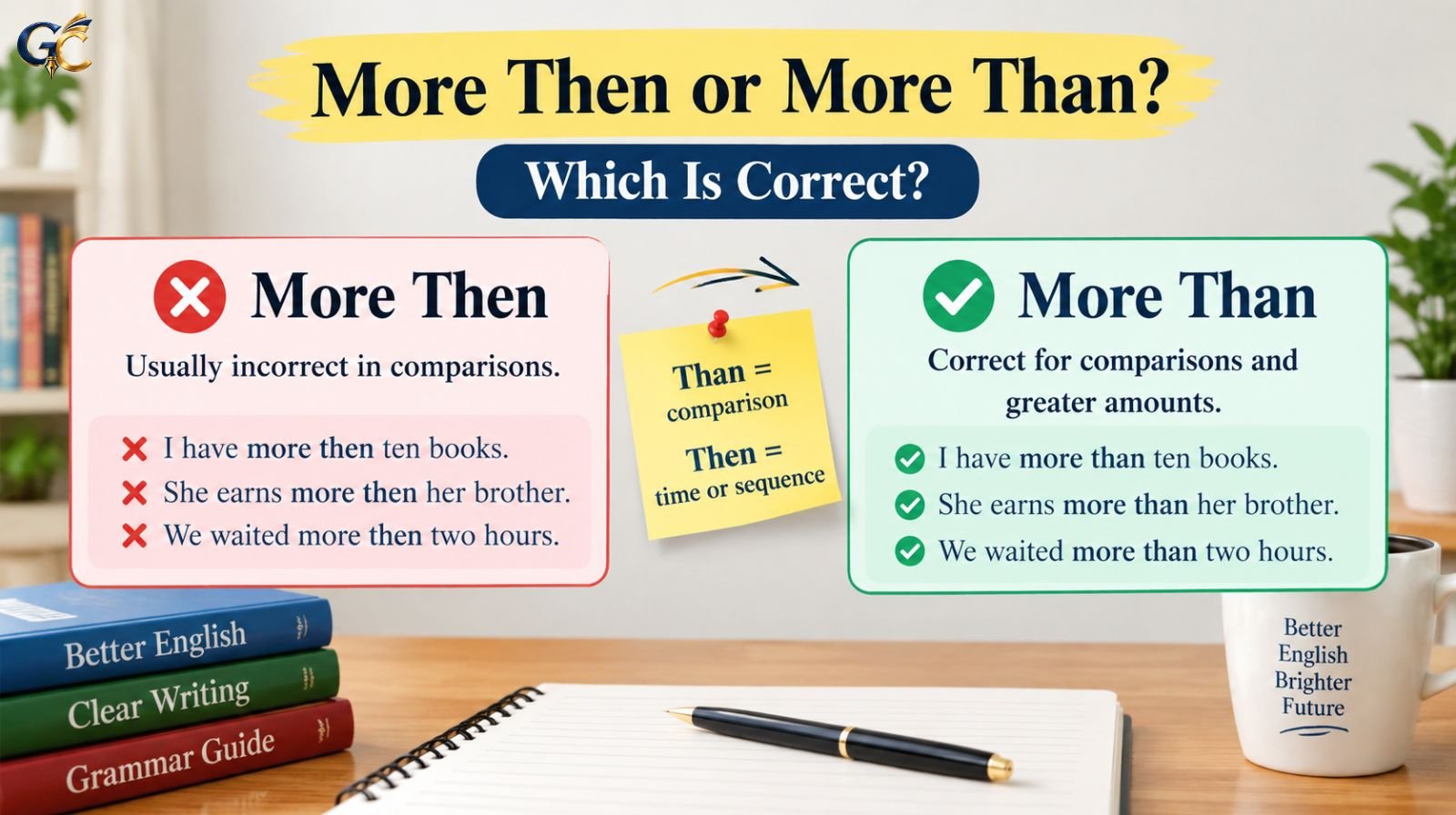
The correct phrase is “more than” when you are making a comparison or talking about a greater quantity, amount, or degree. “Then”, on the other hand, is normally connected with time, sequence, or what happens next. Cambridge Dictionary specifically explains that than is used with “more” or “less” to compare numbers or amounts.
In this guide, you will learn the difference between more then and more than, see clear examples, understand the rare situations where “more” and “then” can appear next to each other, and discover an easy way to remember the correct choice.
More Then or More Than: The Quick Answer
If you are asking whether “more then” or “more than” is correct in an ordinary comparison, the answer is:
More than is correct. ✅
More then is usually incorrect. ❌
For example:
- ✅ I have more than ten books.
- ❌ I have more then ten books.
- ✅ She earns more than her brother.
- ❌ She earns more then her brother.
- ✅ We waited more than two hours.
- ❌ We waited more then two hours.
The reason is simple: than is used for comparisons, while then usually refers to time, sequence, or a result. Cambridge Dictionary gives “than” as the word used to join parts of a comparison and specifically lists its use with “more” and “less.”
The Simple Rule
Remember this:
Than = comparison
Then = time, order, or result
So, if you are comparing something, use than.
Example:
My new laptop is faster than my old one.
If you are talking about what happens next, use then.
Example:
First, finish your work; then you can relax.
What Does “More Than” Mean?
More than is a standard English phrase used to show that something is greater in quantity, amount, degree, or extent.
It can be used with numbers, people, objects, actions, qualities, and ideas.
More Than for Quantity
Use more than when one amount is greater than another.
Examples:
- I have more than 50 dollars.
- The library has more than 10,000 books.
- More than 100 students attended the event.
- She has lived there for more than five years.
Cambridge Dictionary confirms that than is used with “more” to compare numbers and amounts.
More Than for Comparison
You can also use more than to compare people, objects, actions, or ideas.
Examples:
- Ali studies more than Ahmed.
- I enjoy reading more than watching television.
- This job requires more than basic computer skills.
- She cares about her family more than anything else.
The comparison does not always involve numbers. It can describe a difference in preference, ability, importance, or degree.
More Than for Degree or Emphasis
Sometimes more than means that something goes beyond what is expected or required.
Examples:
- She is more than capable of doing the job.
- We have more than enough food.
- He was more than happy to help.
- The result was more than we expected.
In these sentences, more than adds emphasis or expresses an amount or degree beyond a particular point.
What Does “Then” Mean?
Then has a completely different job from than.
It commonly refers to a particular time, the next step in a sequence, or a result.
Cambridge Dictionary defines then as referring to a time and also uses it for something happening next or afterward.
Then for Time
Use then when you mean “at that time.”
Examples:
- I lived in Lahore then.
- She was working there then.
- I did not understand the problem then.
- We can discuss it then.
Here, then is connected with a specific time.
Then for Sequence
Use then when describing what happens next.
Examples:
- First, read the instructions; then answer the questions.
- We ate dinner and then watched a movie.
- Finish your homework, then go outside.
- She opened the door and then walked inside.
Purdue University’s writing guidance similarly distinguishes than for comparisons from then for time and sequence.
Then for a Result
Then can also introduce a result or consequence.
Examples:
- If you study regularly, then you will improve.
- If the weather is bad, then we will stay home.
- If you need help, then call me.
So, then is not a comparison word. It normally deals with time, order, or consequence.
More Than vs. More Then: Key Differences
Understanding the difference becomes much easier when you place the two words side by side.
Comparison Table
| Phrase | Main Use | Correct Example |
|---|---|---|
| More than | Comparison or greater amount | I have more than ten books. |
| Then | Time | I lived there then. |
| Then | Sequence | Eat first, then sleep. |
| Than | Comparison | She is taller than me. |
| More then | Usually an error in comparisons | ❌ I have more then ten books. |
The most important distinction is that than belongs to comparison structures, while then is associated with time, sequence, and results.
A Simple Memory Trick
Try this:
Than = comparison
Think:
- bigger than
- faster than
- better than
- more than
- less than
Now remember:
Then = next
Think:
- first this, then that
- eat, then sleep
- work, then relax
This simple association can prevent many common grammar mistakes.
Check Whether You Are Comparing
When you see more, ask yourself:
“Am I comparing an amount, number, person, thing, or degree?”
If the answer is yes, you almost certainly need than.
For example:
I have more you.
You are comparing two amounts, so the correct sentence is:
I have more than you.
Likewise:
This book costs more $20.
You are comparing the price with $20, so:
This book costs more than $20.
Common Examples of “More Than”
The phrase appears in many types of everyday writing.
More Than With Numbers
- There were more than 500 visitors.
- The phone costs more than $300.
- She has read more than 20 books.
- The project took more than three months.
More Than With People
- Sarah knows more than I do.
- He works more than his colleagues.
- I trust her more than anyone else.
- They need more than one person to complete the task.
More Than With Qualities
- The movie was more than entertaining.
- She is more than capable of handling the task.
- His explanation was more than helpful.
- The experience was more than expected.
More Than Enough
One especially common expression is more than enough.
Examples:
- We have more than enough food.
- You have more than enough time.
- This explanation is more than enough for beginners.
- She has more than enough experience.
Notice that “more then enough” is incorrect.
Can “More Then” Ever Be Correct?
This is where the answer needs a small qualification.
“More then” is not the normal phrase for making a comparison. However, the individual words more and then can occasionally appear next to each other when then has its normal meaning of “at that time.”
For example:
I exercised more then than I do now.
Here, the first then means “at that time,” while the second than introduces the comparison.
A clearer version would be:
I exercised more back then than I do now.
This makes the meaning easier to understand.
Why the Phrase Looks Confusing
The problem is that than and then are visually and phonetically similar.
Compare:
- than
- then
Only one letter changes, but the grammatical jobs are different.
That is why a sentence such as:
❌ I waited more then two hours.
looks close to the correct sentence:
✅ I waited more than two hours.
However, in standard comparison grammar, than is the appropriate choice.
A Better Way to Rewrite Rare Cases
If you genuinely mean a past time, consider moving then elsewhere in the sentence.
Instead of:
I worked more then than I do now.
Write:
I worked more back then than I do now.
This version is clearer and immediately tells the reader that then refers to a past period.
A Real-Life Writing Example: Catching the “Then” Mistake
Imagine a university student preparing an English assignment about study habits. She writes:
“I spend more then three hours studying every evening.”
The meaning is understandable, but the word then is incorrect because the sentence is comparing her study time with the three-hour amount. The correct sentence is:
“I spend more than three hours studying every evening.”
Now imagine the same student writes:
“First, I review my notes, then I complete my practice questions.”
Here, then is correct because the sentence describes a sequence: reviewing notes happens first, and completing practice questions happens afterward.
This small example shows why proofreading should focus on meaning rather than simply how a word sounds. Both than and then are real English words, so a spell checker may not always identify the intended grammatical choice.
This is particularly important for students, bloggers, job applicants, and professionals. A reader may understand a sentence containing more then, but the error can still make the writing look less polished.
The practical lesson is simple: whenever you write more, pause for a second and ask whether you are making a comparison. If you are comparing quantity, amount, degree, or preference, use than. If you are talking about what happened next or what happened at a particular time, use then.
That habit takes only a moment but can prevent a surprisingly common mistake.
What the Data Says About English Grammar in 2025–2026
There is an important limitation when discussing statistics about “more then” versus “more than.” Major dictionaries and language organizations do not publish a reliable 2025–2026 percentage showing how often writers make this exact mistake. Therefore, claiming that a specific percentage of people use “more then” would be misleading.
However, current language resources show the enormous scale of English usage. As of 2026, Cambridge Dictionary states that its dictionaries are based on the Cambridge English Corpus, a database containing more than 2 billion words. This gives a useful sense of the scale of real-world English language evidence behind modern dictionary resources.
There is also recent research into grammar errors among English learners. A 2025 study of 140 Pakistani undergraduate ESL students examined grammatical errors in creative writing at the National University of Modern Languages, Faisalabad. The study highlights the importance of grammatical accuracy for learners writing in English, although it did not establish a specific error rate for “more then” versus “more than.”
So the evidence supports a useful conclusion: grammar accuracy remains an important part of English learning and writing, but there is no sound basis for inventing a precise 2025–2026 statistic for this particular mistake.
How to Remember More Than vs More Then
You do not need to memorize a complicated grammar rule.
Use This Three-Step Check
Step 1: Look at the meaning.
Are you comparing something?
If yes, use than.
Step 2: Look for time or sequence.
Does the word mean “at that time,” “next,” or “after that”?
If yes, use then.
Step 3: Check the sentence.
Ask:
“Could I replace this word with ‘next’ or ‘at that time’?”
If yes, then may be correct.
If you are comparing quantities or degrees, than is the correct choice.
Quick Practice Examples
I have more five dollars.
Correct: than
I have more than five dollars.
Finish your work, take a break.
Correct: then
Finish your work, then take a break.
She is more experienced I am.
Correct: than
She is more experienced than I am.
We ate dinner and went home.
Correct: then
We ate dinner and then went home.
FAQs
Q1: Is “more then” or “more than” correct?
A: More than is correct when you are comparing amounts, quantities, degrees, people, or things.
Example:
She has more than five years of experience.
More then is usually a mistake when it is intended as a comparison.
Q2: Why do people confuse “than” and “then”?
A: The words look and sound very similar, but they have different grammatical functions.
Than is associated with comparison, while then commonly refers to time, sequence, or a result.
Q3: Is “more than” always correct?
A: More than is the standard choice when you are expressing a comparison or greater amount.
Examples:
- more than ten
- more than enough
- more than expected
- more than I thought
However, a sentence can occasionally contain the separate words more and then when then refers to a particular time. Such cases are different from the common phrase more than.
Q4: Is “more then” ever grammatically correct?
A: It can occur in unusual sentences where then independently means “at that time,” but this is not the normal comparison phrase.
For clarity, it is often better to rewrite such sentences.
Instead of:
I worked more then than I do now.
Use:
I worked more back then than I do now.
Q5: What is an easy way to remember than and then?
A: Remember:
Than = comparison.
Then = next/time.
For example:
She is taller than me.
But:
First eat, then sleep.
Q6: Which is correct: “more than 10” or “more then 10”?
A: The correct form is:
More than 10 ✅
For example:
More than 10 students attended the class.
Q7: Is “more than enough” correct?
A: Yes. More than enough is a standard and very common expression.
Example:
We have more than enough time to finish the project.
Q8: Is “more than me” grammatically correct?
A: Yes, it can be correct depending on the sentence structure and style.
For example:
She knows more than me.
In more formal writing, you may also see:
She knows more than I do.
The important point for this topic is that than, not then, introduces the comparison.
Conclusion:
So, more then or more than: which is correct?
In normal comparison sentences, the answer is more than. Use than when you are comparing quantities, amounts, degrees, people, things, or ideas.
Use then when you are talking about time, sequence, or a result.
The easiest rule to remember is:
Than = comparison
Then = time or sequence
Therefore:
- ✅ more than five dollars
- ✅ more than enough
- ✅ more experienced than me
- ❌ more then five dollars
- ❌ more then enough
Once you understand what each word means, the choice becomes much easier. Before publishing an article, sending an email, or submitting an assignment, take a quick look at every than/then you have used. That small proofreading step can make your writing clearer and more professional.
👉 Explore more useful grammar tips and guides on Grammar Clear

Zia Ahmad is the founder of GrammarClear, an educational platform dedicated to making English grammar simple and easy to understand. Through clear explanations and practical examples, he aims to help learners improve their grammar, writing, and communication skills with confidence.

