
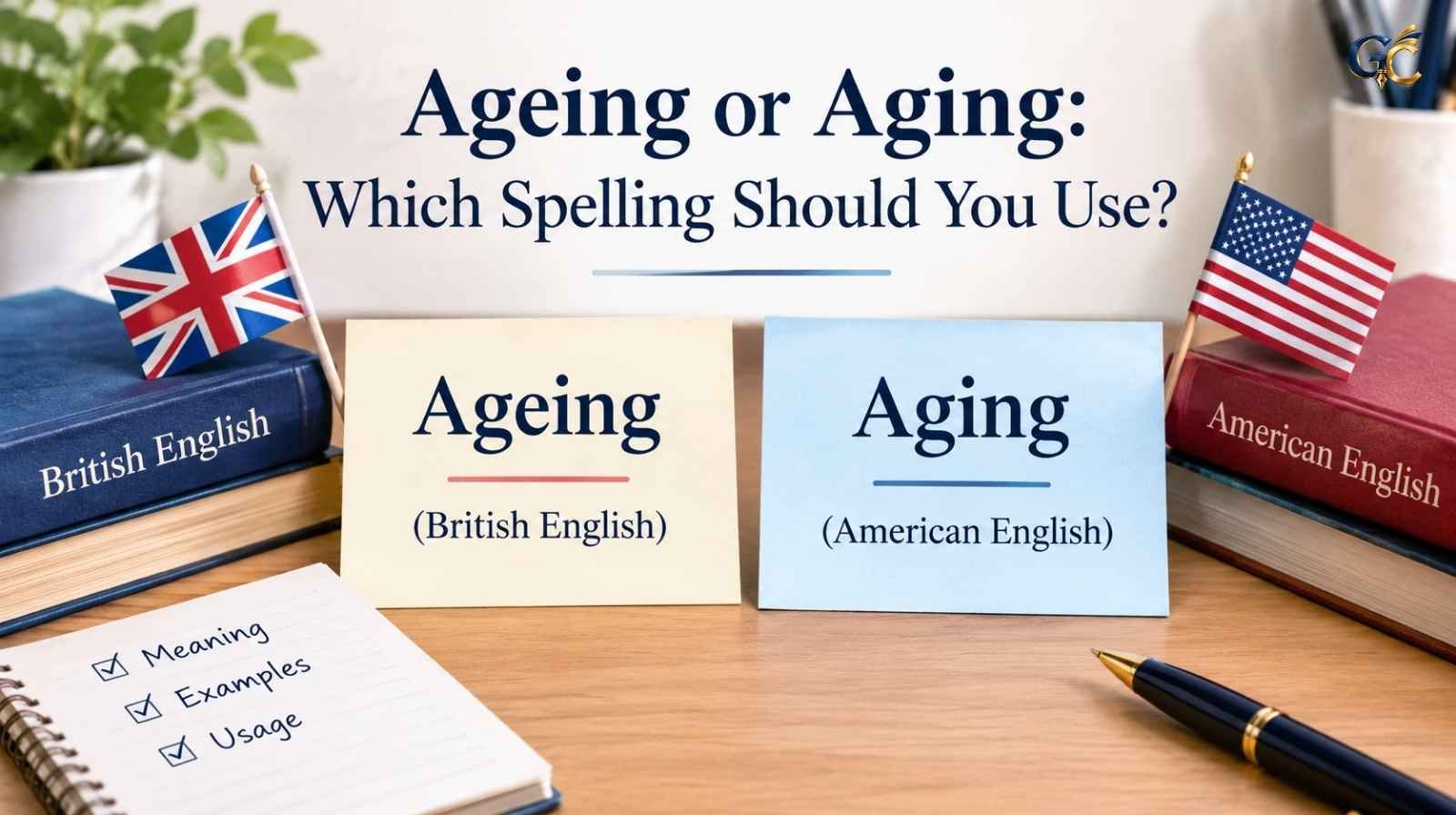
Have you ever wondered whether to write ageing or aging? Both spellings are correct, but choosing the right one depends on the variety of English you are using. This small spelling difference can confuse writers, students, bloggers, and anyone who wants to improve their grammar.
The good news is that ageing and aging have the same meaning. Both describe the process of getting older or becoming older over time. The main difference is regional: aging is standard in American English, while ageing is generally preferred in British English.
In this guide, you will learn when to use each spelling, understand the difference through practical examples, and discover simple ways to avoid mistakes in your writing.
Ageing or Aging: Which Spelling Is Correct?
Both ageing and aging are correct English spellings. Neither is universally more correct than the other. The choice depends mainly on your audience and the spelling convention you follow.
What Does Aging Mean?
Aging is the process of growing older or showing changes associated with the passage of time. It can describe people, animals, plants, materials, and even organizations.
Examples:
- Aging is a natural part of human life.
- The aging building needs several repairs.
- Scientists are studying the effects of aging on memory.
In these examples, aging describes a process or condition that develops over time.
What Does Ageing Mean?
Ageing has exactly the same meaning as aging. The difference is spelling rather than definition.
Examples:
- Ageing is a natural part of human life.
- The ageing building needs several repairs.
- Researchers are studying the effects of ageing on memory.
These sentences communicate the same ideas as the American English versions.
Which Spelling Should You Choose?
Use this simple rule:
- Aging: Choose this spelling for American English.
- Ageing: Choose this spelling for British English.
For example, an American newspaper might publish an article about aging parents, while a British publication might discuss ageing parents.
Both are correct. The important thing is to use the spelling that suits your intended audience and remain consistent throughout your writing.
The Difference Between Ageing and Aging in British and American English
The main difference between ageing and aging is the English variety in which each spelling is preferred. Understanding regional spelling conventions will help you make the right choice in articles, academic assignments, professional emails, and website content.
Aging in American English
In American English, aging is the standard spelling. American dictionaries and publications generally use this form.
Examples:
- The aging population is creating new challenges for healthcare.
- She is interested in the science of aging.
- The company specializes in aging wine.
If you write for readers in the United States, aging is usually the most appropriate choice.
Ageing in British English
In British English, ageing is generally the preferred spelling. The extra letter e follows the spelling pattern used in words such as ageing in British publications.
Examples:
- The ageing population requires better public services.
- Scientists are researching the process of ageing.
- The ageing bridge will be inspected next month.
If your audience is primarily in the United Kingdom, ageing is usually the better choice.
British English vs. American English: Comparison Table
| Feature | Aging | Ageing |
|---|---|---|
| Preferred variety | American English | British English |
| Meaning | Growing older | Growing older |
| Spelling | Without the extra e | With the extra e |
| Example | Aging population | Ageing population |
| Best audience | Primarily US readers | Primarily UK readers |
Remember that these are general conventions, not absolute restrictions. Both spellings are understood internationally, and publishers may have their own style preferences.
How to Use Ageing and Aging in Everyday Writing
Knowing the spelling difference is useful, but you should also understand how to use the word naturally in sentences. Both spellings can describe people, changes in health, older technology, and the passage of time.
Using Ageing or Aging as a Noun
As a noun, the word refers to the process of becoming older.
Examples:
- Ageing is a natural process that affects everyone.
- Researchers are exploring how aging affects memory.
- The study focuses on the effects of ageing on quality of life.
The spelling depends on your chosen English variety, not on the grammatical role of the word.
Using Ageing or Aging as an Adjective
As an adjective, the word describes someone or something that is getting older.
Examples:
- Her ageing parents live nearby.
- The company is replacing its aging computers.
- An ageing population can create new demands for healthcare and social services.
Both spellings work in these sentences. Choose the one that matches your audience.
Using the Word in Professional Writing
For professional writing, consistency is particularly important. A business report written in American English should generally use aging, while a report following British English conventions should generally use ageing.
For example:
- American English: “The company is investing in solutions for its aging infrastructure.”
- British English: “The company is investing in solutions for its ageing infrastructure.”
This small detail helps maintain a consistent editorial style.
Real-Life Example: Choosing the Right Spelling for a Blog
Imagine that a blogger is preparing two articles about the effects of getting older. The first article targets readers in the United States, while the second is written for a British audience.
At first, the blogger uses ageing in both articles. Although readers can understand the word, the spelling does not match the usual American English convention in the first article.
The blogger then checks a reputable dictionary and discovers that aging is the standard American spelling, while ageing is preferred in British English. Cambridge Dictionary confirms this regional distinction, and Oxford Learner’s Dictionaries similarly identifies aging as especially common in North American English.
The blogger revises the American article to use aging population, aging process, and aging parents. In the British article, the blogger retains ageing population, ageing process, and ageing parents.
The next step is to check the remaining content. The blogger searches each article for both spellings, corrects inconsistent instances, and updates the editorial checklist to specify American or British English for future posts.
This example illustrates an important writing principle: choosing the right spelling is not simply about correcting an individual word. It is also about making the entire article consistent and appropriate for its audience.
For bloggers, students, and professional writers, this approach is easy to apply. Identify your readers, select the relevant spelling convention, and review your work before publishing.
Ageing or Aging: Current Dictionary Evidence and Usage
When comparing spelling variations, reputable dictionaries provide more useful evidence than personal opinions or unsupported claims about which spelling is more popular.
What Do Dictionaries Say?
Current dictionary entries support the following distinction:
- Cambridge Dictionary: Identifies aging as the US spelling of ageing.
- Oxford Learner’s Dictionaries: Labels ageing as British English and notes that aging is especially common in North American English.
- Merriam-Webster: Recognizes both aging and ageing as forms of the word age. English meaning – Cambridge Dictionary+2
These references establish that both spellings are legitimate and that regional convention guides the choice.
What About 2025–2026 Statistics?
There is an important distinction between dictionary evidence and statistical evidence. The dictionary references above confirm established usage, but they do not provide a numerical comparison of how frequently people used ageing and aging during 2025 or 2026.
Without a reliable, dated corpus study or other suitable dataset, it would be misleading to claim that a particular percentage of writers prefer one spelling. The same applies to claims that Google ranks one spelling better simply because it is more common.
For practical writing decisions, the available dictionary evidence is sufficient: use aging for standard American English and ageing for standard British English.
Does Google Prefer One Spelling?
There is no sound basis for claiming that Google universally prefers ageing over aging, or the reverse, solely because of spelling.
For SEO, focus on the language and spelling conventions of your target audience. Use your chosen form naturally in your title, headings, and article, and avoid repeating keywords unnaturally. Clear, helpful content is more valuable than forcing both spellings into every paragraph.
FAQs
Q1: Is ageing or aging the correct spelling?
A: Both are correct. Ageing is the usual British English spelling, while aging is the usual American English spelling.
Q2: Why does ageing have an extra e?
A: British English generally retains the final e in this word, whereas American English usually drops it when forming aging. This is an established spelling difference.
Q3: Is ageing British English or American English?
A: Ageing is the preferred British English spelling. American English generally uses aging.
Q4: Do ageing and aging mean the same thing?
A: Yes. Both describe the process of growing older or becoming older in appearance, condition, or usefulness.
Q5: Is it an aging process or an ageing process?
A: Both expressions are correct. Use aging process in American English and ageing process in British English.
Q6: Which spelling should I use in an SEO article?
A: Choose the spelling that matches your target readers. For a US audience, use aging. For a UK audience, use ageing. Keep your spelling consistent throughout the article.
Q7: Can I use both ageing and aging in the same article?
A: You can, but it is generally better to follow one spelling convention throughout the article. Use both only when there is a clear reason, such as explaining the difference between British and American English.
Q8: Are ageing and aging pronounced the same way?
A: Yes. Both are normally pronounced /ˈeɪ.dʒɪŋ/, approximately “AY-jing.”
Conclusion:
When choosing between ageing or aging, remember that both spellings are correct. The difference is primarily regional, not grammatical.
Use ageing when following British English conventions and aging when following American English conventions. Both words have the same meaning, and neither spelling is universally superior.
Before publishing your next article, check your target audience and make sure your spelling remains consistent from the title to the conclusion.
👉 Discover more simple and practical grammar guides on Grammar Clear

Zia Ahmad is the founder of GrammarClear, an educational platform dedicated to making English grammar simple and easy to understand. Through clear explanations and practical examples, he aims to help learners improve their grammar, writing, and communication skills with confidence.

