
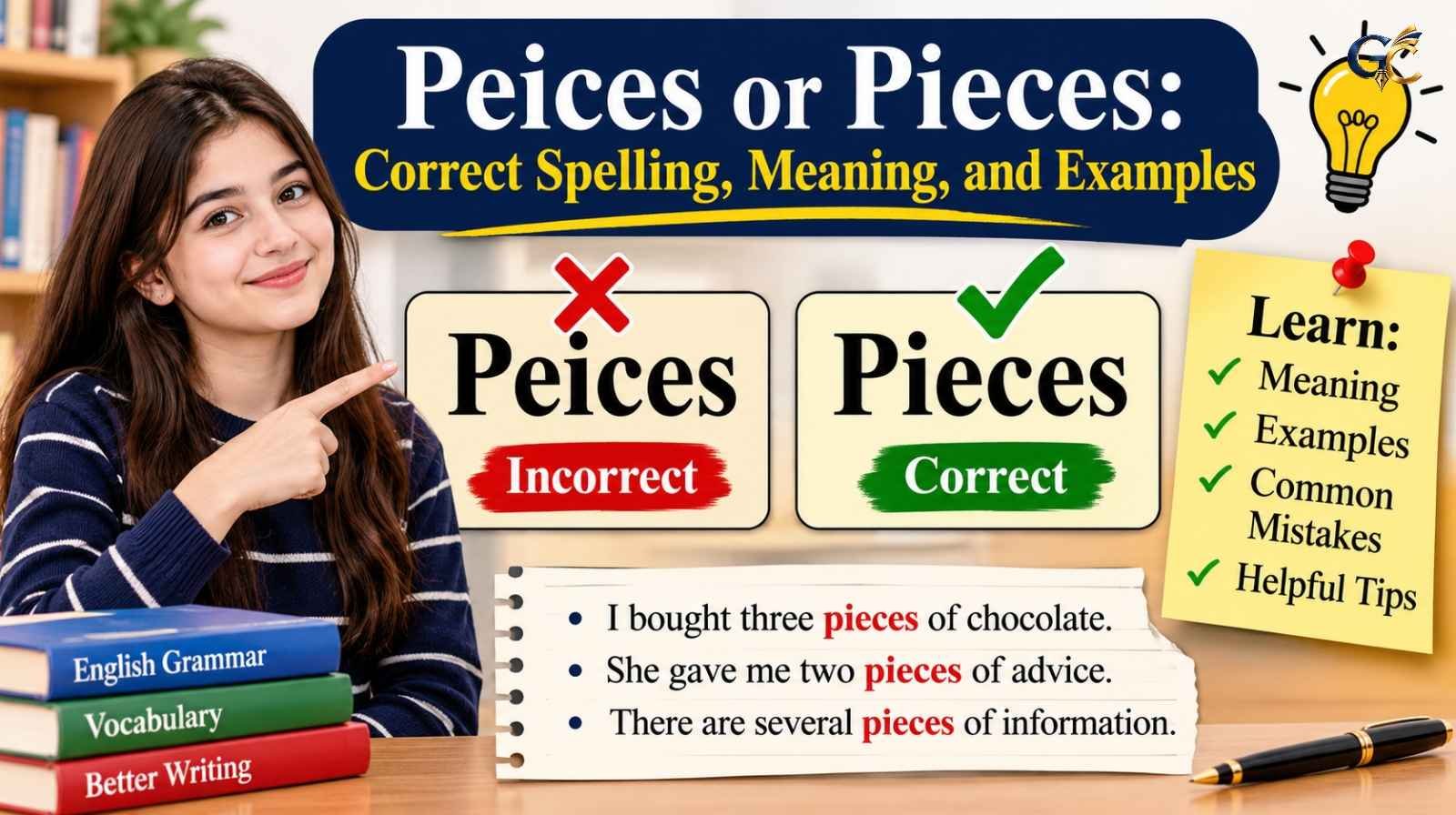
Have you ever stopped while writing an email or text message because you were unsure whether to use peices or pieces? You are not alone. English spelling can sometimes be confusing, especially when two words contain the same letters but appear in a different order.
One common spelling mistake is writing “peices” instead of “pieces.” Although the two spellings look similar, only one is recognised as the correct spelling in standard English.
Whether you are writing a professional email, completing a school assignment, preparing a business report, or chatting with a friend, knowing the correct spelling helps you communicate clearly and confidently.
In this article, we will explore the difference between peices and pieces, explain the meaning of the correct word, and provide practical examples from everyday situations.
Peices or Pieces: Which Is the Correct Spelling?

The correct spelling is pieces.
Peices is a misspelling and is not accepted as a standard English word. It is a common spelling error that occurs when people accidentally place the letters i and e in the wrong order.
For example:
- Incorrect: I bought three peices of chocolate.
- Correct: I bought three pieces of chocolate.
The word pieces is the plural form of piece. It refers to individual parts, sections, portions, or items that belong to a larger whole.
You can use it when talking about food, furniture, clothing, documents, artwork, information, and many other things.
Here is another example:
- Incorrect: Sarah gave me two peices of advice.
- Correct: Sarah gave me two pieces of advice.
Remember that whenever you want to describe separate parts of something, pieces is the spelling you should use.
What Does Pieces Mean?
The word pieces is the plural form of the noun piece.
A piece is a part or portion of something that can be separated from the whole. When there is more than one, we use pieces.
For example, if you break a biscuit into four parts, each part can be described as a piece. Together, they are four pieces of the biscuit.
However, the meaning of pieces goes beyond physical objects. It can also refer to written work, music, information, and abstract ideas.
Let’s explore some common meanings.
Pieces as Parts of Something
This is one of the most common uses of the word.
It describes individual sections that make up a larger object.
Examples:
- James broke the glass into several pieces.
- The children used small pieces of wood to build a toy house.
- I found three pieces of the broken plate under the table.
Real-life scenario:
Imagine that Daniel accidentally drops his favourite ceramic cup in the kitchen. The cup breaks into several parts.
He might tell his sister:
“The cup fell off the table, and now there are pieces of glass everywhere.”
In this situation, pieces describes the separate parts of the broken cup.
Pieces as Portions of Food
The word is also frequently used when discussing food.
It can describe individual portions of something that has been divided.
Examples:
- I would like two pieces of chicken.
- Maria bought five pieces of cake for the children.
- Could you cut the pizza into eight pieces?
Email scenario:
Imagine that you are organising a small office celebration and need to order food for your colleagues.
You could write:
“Hi Michael,
I’m arranging refreshments for Friday’s office celebration. Could you please order three pieces of cake for each member of the team? Thank you for your help.
Best regards,
Emily”
Here, pieces refers to individual portions of cake.
Pieces as Items or Objects
Sometimes, pieces refers to separate objects that belong to a particular collection or group.
Examples:
- The shop sells beautiful pieces of furniture.
- I purchased two pieces of jewellery yesterday.
- The museum displayed several ancient pieces from its collection.
Real-life scenario:
Imagine that Olivia is shopping for her new apartment. She visits a furniture store and finds a beautiful table and a matching chair.
She tells her friend:
“I found two lovely pieces of furniture for my living room.”
The word pieces identifies the separate furniture items.
Pieces as Written or Creative Work
Pieces can also refer to individual works created by writers, artists, musicians, and other professionals.
Examples:
- The journalist published three interesting pieces this week.
- My teacher asked me to submit two pieces of writing.
- The artist displayed several beautiful pieces at the exhibition.
Workplace scenario:
Suppose a magazine editor named Rebecca is reviewing articles submitted by a freelance writer.
She sends the following email:
Subject: Review of Your Recent Submissions
Hi Daniel,
Thank you for sending your latest work. I have reviewed the three pieces you submitted, and I particularly enjoyed the article about modern architecture. I’ll share my feedback on the remaining pieces by Thursday.
Best regards,
Rebecca
In this example, pieces refers to individual articles written by Daniel.
Why Do People Confuse Peices and Pieces?
The confusion between peices and pieces mainly comes from the order of the letters.
Both spellings contain the same five letters:
- P
- I
- E
- C
- S
However, the correct arrangement is P-I-E-C-E-S, not P-E-I-C-E-S.
This type of mistake is common because English spelling does not always follow predictable patterns.
People may also make this error because they pronounce the word correctly but have difficulty remembering its written form.
For example, someone might type:
“Please send me the peices of information before the meeting.”
Although the intended meaning is understandable, the spelling is incorrect.
The correct sentence is:
“Please send me the pieces of information before the meeting.”
A simple way to avoid this mistake is to remember that piece contains the letter combination IE, not EI.
Peices vs Pieces: Key Differences
Understanding the difference is straightforward once you compare the two spellings.
| Word | Correctness | Meaning |
|---|---|---|
| Peices | Incorrect | No standard English meaning |
| Pieces | Correct | Plural of piece; parts or portions of something |
Here are some additional examples:
Incorrect: I need a few peices of paper.
Correct: I need a few pieces of paper.
Incorrect: John collected different peices of information.
Correct: John collected different pieces of information.
Incorrect: There are missing peices in this puzzle.
Correct: There are missing pieces in this puzzle.
The important thing to remember is that pieces is always the correct spelling when you intend to use the plural form of piece.
How to Use Pieces in Everyday Sentences
The best way to remember a word is to practise using it in different situations.
Below are practical examples showing how to use pieces naturally in everyday English.
In Everyday Conversations
You can use pieces when talking casually with friends, relatives, or colleagues.
Examples:
- Can you give me a few pieces of paper?
- I found some pieces of chocolate in the cupboard.
- Please pick up the pieces of the broken toy.
- We need more pieces to complete the puzzle.
Conversation example:
David: “Have you finished the puzzle?”
Sarah: “Not yet. I’m still looking for a few missing pieces.”
David: “Check under the sofa. I saw something there earlier.”
Sarah: “Thanks! I’ll have a look.”
This conversation shows how naturally the word fits into ordinary communication.
In Professional Emails
When writing professional emails, correct spelling is particularly important because it helps you maintain a clear and professional impression.
Here is an example.
Subject: Missing Pieces of Information
Hi Amanda,
I hope you’re doing well. I’ve reviewed the documents you sent yesterday, but a few pieces of information appear to be missing. Could you please provide the remaining details when you have a moment? This will help us complete the report before the deadline. Thank you for your assistance.
Kind regards,
James
In this example, pieces of information refers to individual details required to complete a report.
In Academic Writing
Students can use pieces when discussing information, evidence, research, or written work.
Examples:
- The researcher examined several pieces of evidence.
- Students were asked to submit two pieces of written work.
- The assignment contains important pieces of information about climate change.
Academic scenario:
Imagine that a university student named Grace is preparing a research paper.
She writes:
“The study considered several pieces of evidence before reaching its final conclusion.”
Here, pieces refers to different elements of supporting evidence.
In Business Communication
Businesses frequently use the word when discussing products, equipment, materials, and information.
Examples:
- We ordered 50 pieces of office equipment.
- The supplier delivered several pieces of damaged furniture.
- Please check whether all the pieces are included in the shipment.
Business email example:
Subject: Confirmation of Delivered Items
Dear Mr Thompson,
We received the shipment this morning and have started checking the delivered items. Unfortunately, three pieces appear to be damaged. Could you please advise us on the replacement procedure? We look forward to your response.
Kind regards,
Sophie Williams
The word pieces identifies the individual items that arrived damaged.
In Text Messages
You can also use pieces in informal digital communication.
For example:
Message from Alex:
“Hey, can you bring a few pieces of chocolate when you come over?”
Message from Jessica:
“Sure! I’ll pick up some on my way.”
Another example:
Message from Ryan:
“I think there are a few missing pieces in the box.”
Message from Daniel:
“Really? Let me check the package again.”
These examples demonstrate that the spelling remains the same whether you are writing formally or informally.

Common Expressions and Phrases That Use Pieces
The word pieces appears in many common English expressions. Learning these phrases can help you improve your vocabulary and sound more natural when communicating.
Pieces of Advice
This expression refers to individual suggestions or recommendations.
Examples:
- My father gave me two useful pieces of advice.
- I appreciate the pieces of advice you shared during the meeting.
- Here are three pieces of advice for improving your writing.
Important grammar note: Advice is an uncountable noun in standard English. You should say pieces of advice, not “advices.”
Pieces of Information
This expression refers to individual facts or details.
Examples:
- We need more pieces of information before making a decision.
- The report contains several important pieces of information.
- Sarah shared some useful pieces of information with the team.
Grammar note: Information is also an uncountable noun. Therefore, pieces of information is a useful way to refer to separate details.
Pieces of Evidence
This expression refers to individual facts, documents, or objects that support an argument or investigation.
Examples:
- The police collected several pieces of evidence.
- We need additional pieces of evidence to support the claim.
- The lawyer presented three important pieces of evidence in court.
Fall to Pieces
This is an English expression meaning to break into parts or become emotionally overwhelmed.
Examples:
- The old chair fell to pieces after years of use.
- She almost fell to pieces when she heard the sad news.
Pick Up the Pieces
This expression means to recover and continue after a difficult experience or situation.
Examples:
- After losing his job, Mark had to pick up the pieces and start again.
- The family worked together to pick up the pieces after the difficult experience.
A Piece of Cake
Although this expression uses the singular form, it is worth learning because it is extremely common.
It means that something is very easy to do.
Examples:
- The English examination was a piece of cake.
- Don’t worry about the presentation. It will be a piece of cake.
Common Spelling Mistakes to Avoid
When using pieces, there are a few mistakes you should watch out for.
| Incorrect sentence | Correct sentence |
|---|---|
| I bought two peices of bread. | I bought two pieces of bread. |
| She gave me three peices of advice. | She gave me three pieces of advice. |
| We need more peices of information. | We need more pieces of information. |
| The puzzle has four missing peices. | The puzzle has four missing pieces. |
| He collected several peices of furniture. | He collected several pieces of furniture. |
The most important mistake to avoid is switching the positions of I and E.
Always remember:
- Piece = one part.
- Pieces = more than one part.
- Peices = incorrect spelling.
Easy Ways to Remember the Correct Spelling of Pieces
If you frequently confuse the two spellings, the following tips can help.
Remember the IE Letter Combination
The correct spelling contains IE after the letter P.
Think of it as:
P + IE + CE + S = PIECES
This simple pattern can help you remember the correct arrangement.
Associate It With the Word Piece
Learn the singular form first.
Once you remember that piece is spelled P-I-E-C-E, adding an S gives you pieces.
You do not need to learn an entirely new spelling.
Read More English Content
Reading books, articles, newspapers, and professional emails exposes you to correct spelling.
The more frequently you see the word pieces, the easier it becomes to recognise it.
Proofread Your Writing
Before sending an email or submitting an assignment, take a moment to review your spelling.
Pay particular attention to words that you frequently confuse.
You can also use a spelling checker to identify mistakes before publishing or sharing your work.
Frequently Asked Questions
1. Is Peices a Correct English Word?
No. Peices is an incorrect spelling of the word pieces. It is not recognised as a standard English word.
The correct spelling is pieces.
2. Is It Pieces or Peices of Paper?
The correct expression is pieces of paper.
For example:
“Please bring three pieces of paper to the meeting.”
Writing “peices of paper” would be incorrect.
3. What Is the Singular Form of Pieces?
The singular form is piece.
For example:
- Singular: I need one piece of bread.
- Plural: I need three pieces of bread.
4. How Do You Spell Pieces Correctly?
The correct spelling is P-I-E-C-E-S.
A useful trick is to remember the letters IE after the initial P.
5. Can Pieces Be Used in Formal Writing?
Yes. Pieces is perfectly acceptable in formal writing, including academic papers, business reports, professional emails, and official documents.
Examples include:
- Pieces of evidence.
- Pieces of information.
- Pieces of research.
- Pieces of equipment.
6. Why Is Pieces Spelled With IE Instead of EI?
The spelling follows the established English spelling of the word piece. Although English has some spelling patterns involving IE and EI, these patterns have exceptions, so it is helpful to remember the spelling of frequently used words individually.
7. Is Pieces the Same as Parts?
They can have similar meanings, but they are not always interchangeable.
For example:
- “The cake was divided into six pieces.”
- “The project has six parts.”
Pieces often refers to separate portions or individual items, while parts can describe sections or components of a larger structure, activity, or process.
Conclusion: Peices or Pieces?
When deciding between peices or pieces, the correct choice is always pieces.
Peices is simply a common spelling mistake caused by placing the letters I and E in the wrong order. Pieces, on the other hand, is the plural form of piece and refers to separate parts, portions, items, or elements of something.
Whether you are writing an email to a colleague, preparing an academic assignment, discussing food with a friend, or communicating with customers, using the correct spelling makes your writing clearer and more professional.
The easiest way to remember it is:
Piece = Singular
Pieces = Plural
Peices = Incorrect
So, the next time you need to write about several parts of something, remember to use pieces, not peices. A small spelling detail can make a meaningful difference in the quality of your English writing.
👉 Discover more simple and practical grammar guides on Grammar Clear

Zia Ahmad is the founder of GrammarClear, an educational platform dedicated to making English grammar simple and easy to understand. Through clear explanations and practical examples, he aims to help learners improve their grammar, writing, and communication skills with confidence.

