
Have you ever wondered whether to use complaint or complain in a sentence? These two words look and sound similar, but they have different grammatical functions and meanings. Choosing the wrong one can make your sentence grammatically incorrect, especially in emails, formal letters, workplace conversations, and everyday writing.
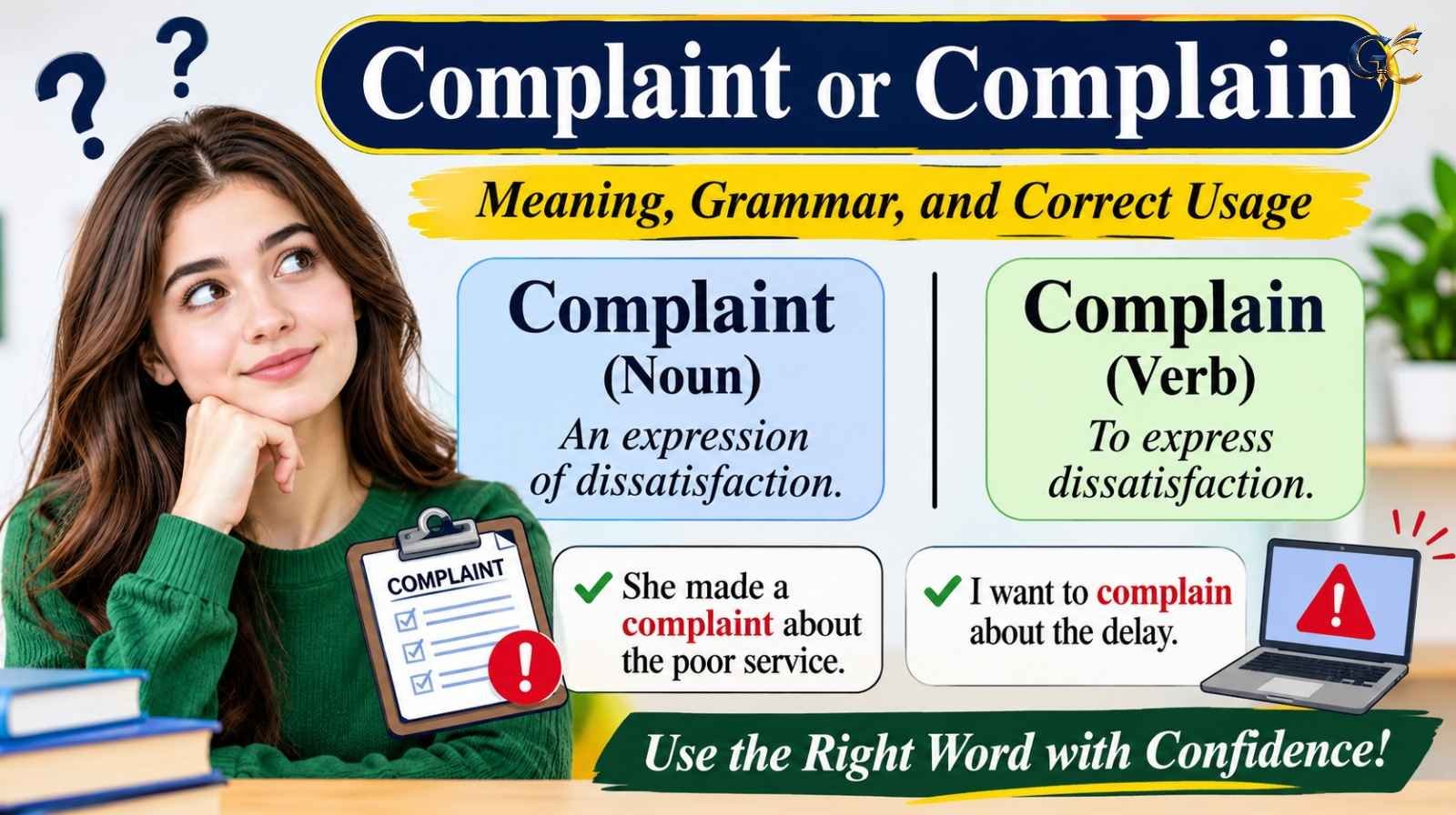
The main difference is simple: complaint is a noun, while complain is a verb. A complaint refers to an expression of dissatisfaction, whereas complain describes the action of expressing dissatisfaction about something.
Although the difference may seem small, understanding how to use each word correctly can improve your English communication. In this article, we will explore the meanings, grammatical rules, sentence structures, and practical examples of complaint and complain so you can use both words confidently.
Complaint or Complain: Which One Is Correct?
Both complaint and complain are correct English words. However, they cannot always be used interchangeably because they serve different grammatical purposes.
- Complaint: A noun that refers to an expression of dissatisfaction about a person, situation, product, or service.
- Complain: A verb that means to express dissatisfaction, annoyance, or unhappiness about something.
For example:
- Correct: Sarah made a complaint about the poor customer service.
- Correct: Sarah decided to complain about the poor customer service.
Both sentences are grammatically correct, but they use the words differently.
In the first sentence, complaint identifies the issue Sarah raised. In the second sentence, complain describes the action Sarah took.
Remember this simple rule: If you are talking about the act of expressing dissatisfaction, use complain. If you are talking about the expression or statement of dissatisfaction itself, use complaint.
What Does Complaint Mean?
Complaint is a noun used to describe an expression of dissatisfaction, concern, or unhappiness about something.
People make complaints when they are unhappy with a product, service, workplace situation, or someone’s behaviour. A complaint can be made verbally, through an email, or in a formal written document.
The plural form of complaint is complaints.
Examples of Complaint in Sentences
Here are some examples showing how to use complaint correctly:
- The customer submitted a complaint about the damaged product.
- My manager received a complaint about the employee’s behaviour.
- We received several complaints about the delayed delivery.
- The hotel investigated the guest’s complaint immediately.
- She made a formal complaint against the company.
- The teacher listened carefully to the student’s complaint.
- There was no valid complaint about the quality of the food.
In each example, complaint is used as a noun because it refers to an issue, statement, or expression of dissatisfaction.
Scenario Example: Complaint in a Formal Email
Imagine that you ordered a laptop online, but it arrived with a damaged screen. You want to contact customer support to report the problem.
Here is how you could use complaint in a professional email.
Subject: Formal Complaint Regarding a Damaged Laptop
Dear Mr. James,
I am writing to submit a formal complaint regarding the laptop I recently purchased from your online store. Unfortunately, the product arrived with a damaged screen, which makes it difficult to use. I would appreciate it if your team could investigate this issue and arrange a replacement or refund. Thank you for your attention to this matter. I look forward to your response.
Best regards,
Daniel Smith
Notice that complaint is used as a noun because Daniel is referring to the formal expression of his dissatisfaction.
What Does Complain Mean?
Complain is a verb that means to express dissatisfaction, annoyance, or unhappiness about something.
When someone complains, they communicate that something is wrong, disappointing, uncomfortable, or unfair.
Unlike complaint, which is a noun, complain describes an action.
For example:
- I want to complain about the poor service.
- Employees sometimes complain about long working hours.
- The customers complained about the delayed orders.
The word complain can also change its form depending on the tense of the sentence.
Examples of Complain in Sentences
Here are some everyday examples of using complain correctly:
- Customers often complain about high delivery charges.
- My brother always complains about waking up early.
- She decided to complain to the manager.
- Several passengers complained about the uncomfortable seats.
- Please do not complain without explaining the problem.
- He has started to complain about his new job.
- The students complained because the classroom was too hot.
These sentences use complain as a verb because it describes what someone does.
Scenario Example: Complain in a Workplace Conversation
Imagine that an employee named Michael is unhappy because his office has poor internet connectivity. He decides to speak with his supervisor about the issue.
Conversation:
Michael: Good morning, Mr. Robert. I wanted to discuss an issue with the office internet.
Mr. Robert: Good morning, Michael. What seems to be the problem?
Michael: Several employees complain that the internet connection is too slow, especially during online meetings.
Mr. Robert: Thank you for bringing this to my attention. I will ask the technical team to investigate.
Michael: I appreciate your help.
Here, complain describes the action of expressing dissatisfaction about the internet connection.
Complaint vs Complain: Key Differences
Although these words are closely related, their grammatical functions are different. Understanding these differences will help you avoid common spelling and grammar mistakes.
| Feature | Complaint | Complain |
|---|---|---|
| Part of speech | Noun | Verb |
| Meaning | An expression of dissatisfaction | To express dissatisfaction |
| Usage | Refers to an issue or statement | Describes an action |
| Plural or verb form | Complaints | Complains |
| Past tense | Not applicable | Complained |
| Example | I made a complaint. | I decided to complain. |
Easy Way to Remember the Difference
A simple trick can help you remember when to use each word.
- Complaint = Something you make or submit.
- Complain = Something you do.
For example:
- You make a complaint to customer service.
- You complain to customer service about a problem.
Think of complaint as the name of the issue and complain as the action of expressing dissatisfaction.
Different Forms of the Word Complain
The verb complain changes its form depending on the tense and grammatical structure of a sentence.
Here are its common forms:
| Verb Form | Word | Example |
|---|---|---|
| Base form | Complain | I complain about the noise. |
| Third-person singular | Complains | She complains about everything. |
| Past tense | Complained | He complained yesterday. |
| Present participle | Complaining | They are complaining again. |
| Past participle | Complained | She has complained before. |
Complain in the Present Tense
Use complain when discussing a current or regular action.
Examples:
- I sometimes complain about traffic.
- They complain about the food quality.
- He complains about his workload.
Remember that you should add -s when using complain with he, she, or it in the simple present tense.
Complain in the Past Tense
The past tense of complain is complained.
Examples:
- She complained about the poor customer service yesterday.
- We complained to the hotel manager.
- The students complained about the difficult examination.
Complain in the Present Continuous Tense
Use complaining when describing an action that is happening right now or around the present time.
Examples:
- The customers are complaining about the long waiting time.
- My neighbour is complaining about the loud music.
- The employees are complaining about the new company policy.
Common Grammar Mistakes When Using Complaint and Complain
Many English learners confuse these words because they have similar spellings and meanings. However, using a noun where a verb is required can make a sentence incorrect.
Let’s look at some common mistakes and their corrections.
Mistake 1: Using Complaint Instead of Complain
Incorrect: I want to complaint about the service.
Correct: I want to complain about the service.
Why? After the phrase “want to,” you need the base form of a verb. Therefore, complain is correct.
Mistake 2: Using Complain Instead of Complaint
Incorrect: I submitted a complain to the manager.
Correct: I submitted a complaint to the manager.
Why? The word “a” requires a noun in this sentence. Complaint is the correct choice.
Mistake 3: Confusing Complaint and Complained
Incorrect: She complaint about the noise yesterday.
Correct: She complained about the noise yesterday.
Why? The sentence describes an action that happened in the past, so you need the past-tense verb complained.
Mistake 4: Using the Wrong Plural Form
Incorrect: We received many complain from customers.
Correct: We received many complaints from customers.
Why? The word many requires a plural noun. The plural form of complaint is complaints.
Complaint or Complain in Professional and Everyday Writing
Both words are commonly used in professional communication, customer service, academic writing, and everyday conversations.
However, choosing the right word depends on what you want to communicate.
Using Complaint in Professional Emails
In formal emails, complaint is useful when referring to an official concern or dissatisfaction.
Example:
Subject: Complaint Regarding Delayed Payment
Dear Ms. Olivia,
I would like to raise a complaint regarding the delay in my salary payment. The payment was expected last Friday, but I have not received it yet. Could you please look into this matter and provide an update?
Kind regards,
William Carter
This example uses complaint because the sender is referring to a formal concern.
Using Complain in Everyday Conversations
In casual conversations, complain is commonly used to describe someone’s reaction to an uncomfortable or frustrating situation.
Example:
Conversation:
Emma: Why does David look so upset today?
Sophia: He keeps complaining about the amount of work he has to finish.
Emma: Maybe he should discuss it with the manager.
Here, complaining describes David’s ongoing action.
Using Both Words in One Paragraph
You can also use both words together when the sentence structure requires a noun and a verb.
Example:
“After several customers began to complain about the delayed deliveries, the company received an official complaint and decided to improve its delivery service.”
In this example:
- Complain describes what the customers did.
- Complaint refers to the formal expression of dissatisfaction.
Understanding this distinction makes your writing clearer and more natural.
Frequently Asked Questions
1. Is complaint or complain correct?
Both complaint and complain are correct English words. Complaint is a noun that refers to an expression of dissatisfaction, while complain is a verb that describes the action of expressing dissatisfaction.
2. What is the main difference between complaint and complain?
The main difference is their grammatical function. Complaint is a noun, whereas complain is a verb. For example, you make a complaint, but you complain about a problem.
3. How do you use complaint in a sentence?
You use complaint when referring to an expression of dissatisfaction. For example: “The customer submitted a complaint about the damaged product.”
4. How do you use complain in a sentence?
You use complain when describing the action of expressing dissatisfaction. For example: “I want to complain about the poor customer service.”
5. Is complained the past tense of complain?
Yes. Complained is both the simple past tense and past participle of complain. For example: “She complained about the delay yesterday.”
6. What is the plural of complaint?
The plural of complaint is complaints. For example: “The company received several complaints from its customers.”
7. Is it correct to say make a complaint or make a complain?
The correct expression is make a complaint because complaint is a noun. “Make a complain” is grammatically incorrect.
8. Can complaint and complain be used in the same sentence?
Yes. For example: “The customers decided to complain about the service, so the manager received an official complaint.” Both words are correct because they perform different grammatical functions.
Conclusion
Understanding the difference between complaint and complain is important for writing clear and grammatically correct English.
Although both words are related to expressing dissatisfaction, they have different grammatical roles. Complaint is a noun that refers to an expression of dissatisfaction, while complain is a verb that describes the action of expressing it.
Remember these simple examples:
- Make a complaint about a problem.
- Complain about poor service.
- Submit multiple complaints to the manager.
- Complained about something yesterday.
Once you understand this simple noun-and-verb distinction, choosing between complaint and complain becomes much easier in emails, professional writing, and everyday conversations.
👉 Discover more simple and practical grammar guides on Grammar Clear

Zia Ahmad is the founder of GrammarClear, an educational platform dedicated to making English grammar simple and easy to understand. Through clear explanations and practical examples, he aims to help learners improve their grammar, writing, and communication skills with confidence.

