
Have you ever wondered whether drier or dryer is the correct spelling? You are not alone. These two words look almost identical and are pronounced very similarly, but they usually serve different purposes in a sentence.
The good news is that both “drier” or “dryer” are correct English words. The important question is what you mean.
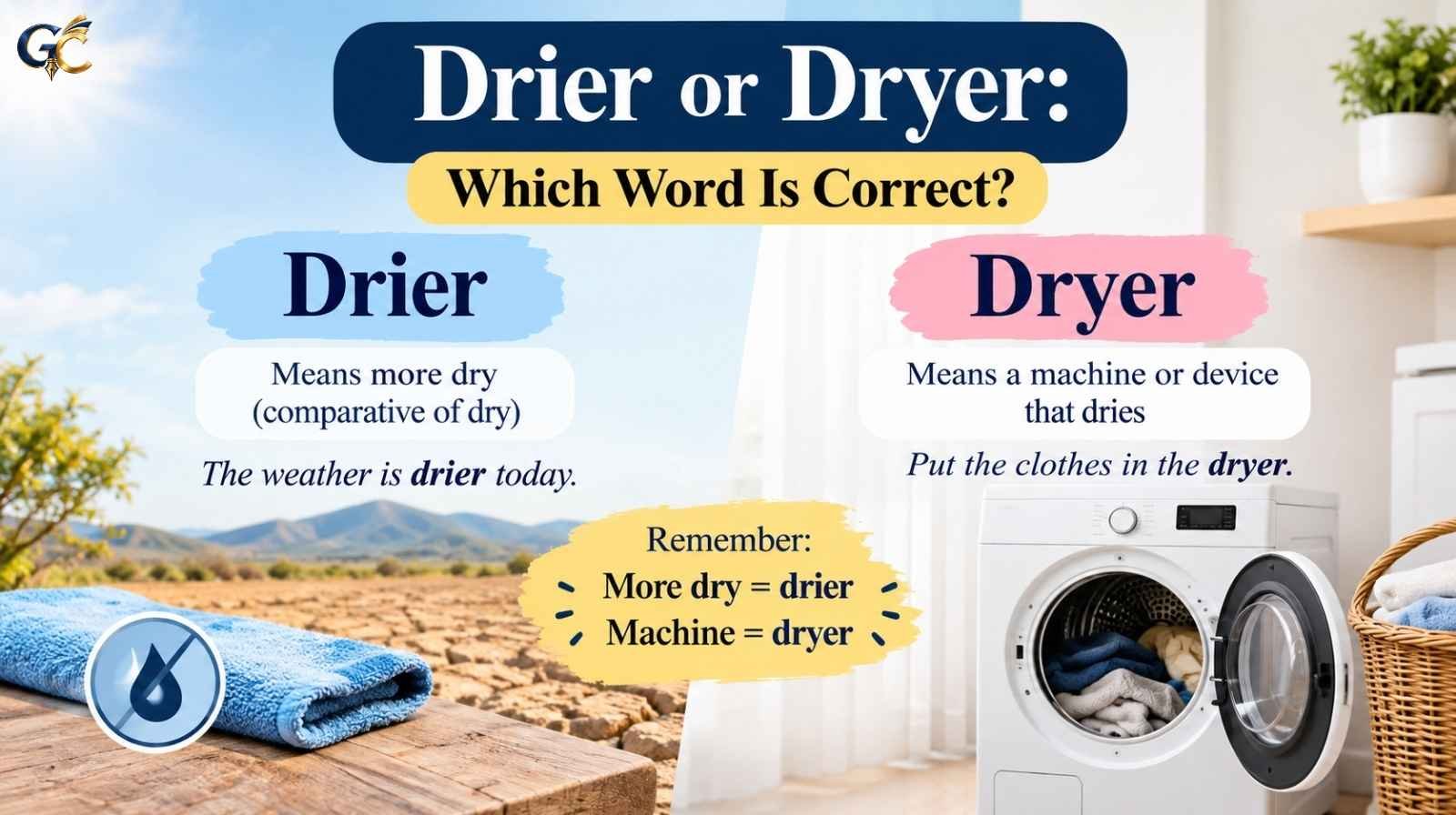
Generally, drier is the comparative form of dry, meaning “more dry,” while dryer is commonly used as a noun for a machine or device that removes moisture. Major dictionaries, including Oxford, Cambridge, and Collins, recognize these uses.
Let’s look at the difference so you can confidently choose the right word.
Drier or Dryer: What Is the Difference?
The easiest way to remember the distinction is this:
Drier = more dry
Dryer = something that dries
However, there is an important detail: drier can also be used as a noun, because dictionaries recognize it as an alternative spelling of dryer. Oxford and Cambridge both list drier as a noun referring to a machine or device that dries something.
When to Use “Drier”
Use drier when you are comparing the dryness of two things.
For example:
- The air is drier today.
- This towel is drier than the other one.
- The climate here is drier in summer.
- My skin feels drier during winter.
Here, drier means more dry.
The word follows the normal comparative pattern:
dry → drier → driest
So if you can replace the word with “more dry,” drier is generally the natural choice.
When to Use “Dryer”
Use dryer when you mean a machine, appliance, or device that dries something.
Examples include:
- I put my clothes in the dryer.
- She bought a new hair dryer.
- The hotel has a clothes dryer.
- The farmer uses a grain dryer.
Oxford defines dryer as a machine for drying something and gives examples such as hair dryer and tumble dryer. Cambridge likewise defines it as a machine that dries things.
Drier Meaning: “More Dry”
The most common grammatical use of drier is as the comparative form of the adjective dry.
If one thing contains less moisture than another, you can describe it as drier.
Examples of “Drier” in Sentences
Consider these examples:
Example 1:
The weather is drier this week than it was last week.
Here, drier compares two periods of weather.
Example 2:
This towel is drier than that one.
The first towel contains less moisture.
Example 3:
Desert regions are generally drier than tropical regions.
Again, drier expresses a comparison.
Example 4:
My hands become drier during cold weather.
The word describes a change toward a condition with less moisture.
Is “Drier” Grammatically Correct?
Yes. Drier is completely correct when it means “more dry.”
Cambridge lists drier as the comparative form of dry, while Collins also identifies it as the comparative form.
A useful pattern is:
| Base word | Comparative | Superlative |
|---|---|---|
| dry | drier | driest |
| cold | colder | coldest |
| warm | warmer | warmest |
| bright | brighter | brightest |
Therefore:
dry → drier → driest
Not:
dry → dryer → dryest
When you’re making a comparison about dryness, drier is the standard spelling.
Dryer Meaning: A Machine or Device
Dryer is commonly used as a noun for something designed to remove moisture.
This can include appliances used at home as well as equipment used in other industries.
Common Types of Dryers
You may encounter dryer in expressions such as:
- clothes dryer
- hair dryer
- hand dryer
- grain dryer
- tumble dryer
- spin dryer
For example:
Please put the wet clothes in the dryer.
Here, dryer is the name of an appliance, not a comparison.
Cambridge specifically lists examples such as hair dryer and grain dryer, while Oxford lists hairdryer, spin dryer, tumble dryer, and washer-dryer.
Is “Drier” Also Possible for a Machine?
Yes, and this is where the confusion becomes understandable.
Some dictionaries recognize drier as an alternative spelling of dryer when it is used as a noun.
For example, Oxford lists drier with the meaning “a machine for drying something,” while Cambridge gives drier as an alternative to dryer.
So:
clothes dryer ✅
clothes drier ✅, though less common in many contexts
For modern everyday writing, dryer is usually the clearest choice when you are naming an appliance.
Drier vs. Dryer: Quick Comparison
The following table makes the difference easy to remember:
| Word | Main meaning | Part of speech | Example |
|---|---|---|---|
| drier | more dry | adjective | The air is drier today. |
| drier | something that dries | noun | The industrial drier removes moisture. |
| dryer | a machine/device that dries | noun | Put the clothes in the dryer. |
| dryer | alternative spelling of drier | noun | A dryer removes moisture. |
The key point is that drier and dryer are not simply “right versus wrong.” Context determines which form is most appropriate.
Drier or Dryer? A Simple Rule to Remember
If you regularly confuse these words, use this simple test.
Ask: “Am I Comparing Dryness?”
If the answer is yes, use drier.
The room is drier than yesterday.
You are saying the room is more dry.
Ask: “Am I Naming a Machine?”
If the answer is yes, use dryer in ordinary modern writing.
The clothes are in the dryer.
You are naming an appliance.
Quick Memory Trick
Remember:
Drier = more dry
Dryer = machine
This isn’t an absolute rule because dictionaries recognize drier as an alternative noun spelling, but it is a very useful rule for everyday writing.
Real-Life Example: Choosing the Right Word
Imagine that Sarah is writing a short email about laundry and weather.
She writes:
“The weather is dryer today, so I think my clothes will dry quickly. After that, I’ll put them in the drier.”
At first glance, the sentence may look reasonable because both spellings are closely related. But Sarah is using the words in two different ways.
The first use describes the weather. She wants to say that the weather is more dry. Therefore, the more standard comparative spelling is:
“The weather is drier today.”
The second use refers to an appliance. In ordinary modern English, the clearest choice is:
“I’ll put them in the dryer.”
The corrected version becomes:
“The weather is drier today, so I think my clothes will dry quickly. After that, I’ll put them in the dryer.”
This example shows why context matters more than simply memorizing two spellings. Drier naturally describes a comparative condition, while dryer commonly identifies a machine. At the same time, dictionaries acknowledge that drier can also be used as a noun for something that dries. Oxford and Cambridge both document this alternative usage.
The practical lesson is simple: when describing something as more dry, choose drier; when referring to a household appliance, dryer will usually make your meaning immediately clear.
2025–2026 Dictionary and Usage Evidence
Because this is a spelling and grammar question rather than a topic with meaningful annual statistics, there is no authoritative 2025–2026 figure showing that a specific percentage of English speakers use one spelling.
However, current dictionary evidence gives us a useful picture of modern usage.
- Collins’ 2025 Webster’s New World College Dictionary identifies drier as the comparative form of dry and also recognizes it as an alternative spelling of dryer.
- Oxford Advanced Learner’s Dictionary lists dryer as a machine for drying and gives drier as an alternative noun spelling.
- Cambridge Dictionary identifies drier as the comparative of dry and dryer as a machine that dries things, while also noting drier as an alternative noun form.
- American Heritage Dictionary similarly defines dryer as an appliance and lists it as a variant of drier.
This evidence supports an important conclusion: both spellings exist in standard English, but their most useful everyday roles are different.
Common Mistakes With Drier and Dryer
Mistake 1: Using “dryer” for a comparison
❌ The climate is dryer than last year.
✅ The climate is drier than last year.
When you mean more dry, use drier.
Mistake 2: Using “drier” for an appliance
❌ Put your clothes in the drier.
✅ Put your clothes in the dryer.
Although drier can appear as an alternative noun spelling in dictionaries, dryer is the familiar choice for an appliance in everyday writing.
Mistake 3: Assuming one spelling is always wrong
Neither word is inherently incorrect.
Drier and dryer are both legitimate English words. The context tells you which form is more appropriate.
Drier or Dryer: Examples at a Glance
Here are some quick examples:
- The desert is drier than the forest. ✅
- My skin feels drier in winter. ✅
- Today’s weather is drier than yesterday’s. ✅
- Put the clothes in the dryer. ✅
- I bought a new hair dryer. ✅
- The hotel has a hand dryer. ✅
- The farmer operates a grain dryer. ✅
- This soil is drier than that soil. ✅
A useful test is to replace drier with “more dry.” If the sentence still makes sense, drier is probably what you need.
FAQs
Q1: Is “drier” or “dryer” correct?
A: Both are correct. Drier is normally the comparative form of dry, meaning “more dry.” Dryer is commonly used for a machine or device that removes moisture. Dictionaries also recognize drier as an alternative noun spelling.
Q2: Is it “drier weather” or “dryer weather”?
A: The standard comparative form is drier weather.
We are expecting drier weather next week.
Here, drier means “more dry.”
Q3: Is it “clothes drier” or “clothes dryer”?
A: Clothes dryer is the familiar modern spelling for the appliance.
However, drier is also documented as an alternative noun spelling in major dictionaries.
Q4: Is “hair drier” correct?
A: Yes. Hair drier is a recognized alternative spelling of hair dryer. However, hair dryer is the more familiar form in everyday English. Oxford and Cambridge both recognize dryer as the machine/device spelling and acknowledge drier as an alternative.
Q5: What is the comparative form of “dry”?
A: The comparative form of dry is drier.
The pattern is:
dry → drier → driest
For example:
Today is drier than yesterday.
Q6: Are “drier” and “dryer” pronounced the same?
A: They are generally pronounced the same or very similarly in common varieties of English. The spelling difference does not normally create a meaningful pronunciation difference.
Q7: Which spelling should I use in formal writing?
A: Use drier when you mean “more dry.” For an appliance, dryer is usually the clearest and most familiar choice.
Q8: Is “dryer” a real English word?
A: Absolutely. Dryer is a standard English noun referring to a person or thing that dries, especially an appliance such as a clothes dryer or hair dryer.
Conclusion:
So, drier or dryer which word is correct?
The answer is both, but they are most commonly used in different ways.
Use drier when you mean “more dry”:
The air is drier today.
Use dryer when referring to a machine or appliance that dries:
Put the clothes in the dryer.
Remember the simple rule:
More dry = drier
Machine = dryer
There are exceptions because drier is also recognized as an alternative noun spelling by major dictionaries. Still, this distinction will help you choose the clearest form in most everyday and formal writing.
👉 Explore more useful grammar tips and guides on Grammar Clear

Zia Ahmad is the founder of GrammarClear, an educational platform dedicated to making English grammar simple and easy to understand. Through clear explanations and practical examples, he aims to help learners improve their grammar, writing, and communication skills with confidence.

