
Have you ever wondered whether to write “awhile” or “a while”? You are not alone. These two expressions sound almost identical and both relate to a period of time, but they serve different grammatical functions.
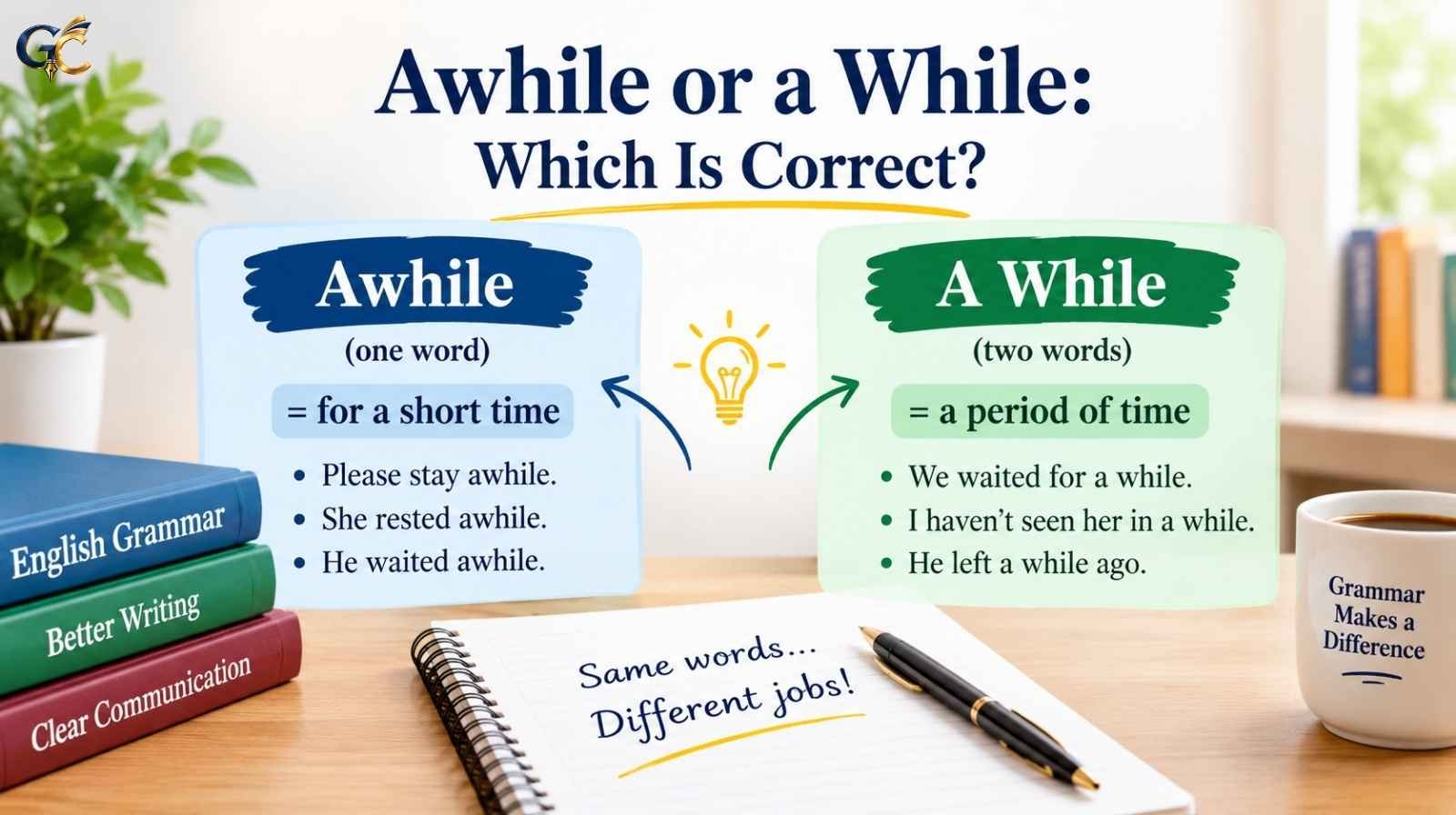
The good news is that the difference between awhile and a while is easier to understand than it first appears. Awhile is generally an adverb meaning “for a short time,” while a while is a noun phrase referring to a period or length of time.
In this guide, you will learn exactly when to use each form, see plenty of examples, discover common mistakes, and get a simple trick for remembering the difference.
Awhile or a While: What Is the Difference?
The main difference between awhile and a while is their grammatical function.
What Does “Awhile” Mean?
Awhile is a one-word adverb. It generally means “for a short time” or “for some time.”
For example:
- Please sit awhile.
- We waited awhile before leaving.
- She stayed awhile to talk.
- You should rest awhile.
- He worked awhile before taking a break.
Cambridge Dictionary defines awhile as an adverb meaning “for a short time.”
A useful way to think about it is:
awhile = for a short time
What Does “A While” Mean?
A while is a two-word noun phrase. Here, a is an article and while is a noun meaning a period or length of time.
Examples include:
- We waited for a while.
- I haven’t seen her in a while.
- He left a while ago.
- Stay here for a while.
- It took a while to finish the project.
Cambridge lists a while as a noun phrase referring to a length of time and gives common expressions such as “for a while,” “in a while,” and “a while ago.”
So, the basic distinction is:
| Form | Grammar | Meaning | Example |
|---|---|---|---|
| awhile | Adverb | for a short time | Stay awhile. |
| a while | Noun phrase | a period of time | Stay for a while. |
When Should You Use “Awhile”?
Use awhile when it functions as an adverb modifying an action.
Awhile After a Verb
One of the easiest places to use awhile is directly after a verb.
Examples:
- Please wait awhile.
- Come in and sit awhile.
- We decided to stay awhile.
- She stopped to rest awhile.
- He continued to read awhile.
In these sentences, awhile describes how long the action takes place.
Awhile or a While After a Verb?
This is where things can become confusing because both forms can sometimes appear after a verb in modern English.
For example:
- Stay awhile.
- Stay a while.
Both can be encountered in normal English. However, the traditional grammatical distinction is useful: awhile functions as an adverb, whereas a while is a noun phrase. Scribbr notes that the two forms are sometimes used interchangeably in informal writing, while traditional style guidance maintains the distinction.
For careful writing, understanding the grammatical role is more useful than simply memorizing one phrase.
When Should You Use “A While”?
Use a while when while is functioning as a noun, especially after a preposition.
“For a While”
This is one of the most common expressions.
Correct examples:
- I stayed there for a while.
- Let’s sit for a while.
- She worked for a while before going home.
- We talked for a while.
In traditional usage, for awhile is generally avoided in edited writing because for already introduces the noun phrase a while.
Therefore:
Correct: We waited for a while.
Preferred: We waited for a while, not for awhile.
“In a While”
Use a while in expressions such as in a while.
Examples:
- I’ll call you in a while.
- The food should be ready in a while.
- He’ll be back in a while.
Here, a while acts as a noun phrase following the preposition in.
“A While Ago”
Another very common expression is a while ago.
Examples:
- I saw him a while ago.
- She called me a while ago.
- We finished the meeting a while ago.
For standard edited English, write a while ago, not awhile ago.
A Simple Trick to Remember Awhile vs. a While
If you regularly confuse these expressions, there is a simple test that can help.
Try Replacing “Awhile” With “For a Short Time”
If for a short time fits naturally, awhile may work when it is functioning as an adverb.
For example:
Please stay awhile.
Replace it:
Please stay for a short time.
The meaning still works.
Now consider:
We stayed for a while.
You would not normally write:
We stayed for a short time while keeping the same grammatical structure as the original phrase.
The two constructions perform different grammatical jobs.
Watch for Prepositions
A particularly useful editing rule is to look for words such as for and in.
| Expression | Standard form |
|---|---|
| for ___ | for a while |
| in ___ | in a while |
| ___ ago | a while ago |
| verb + ___ | awhile can work |
| stay ___ | stay awhile |
| rest ___ | rest awhile |
This is not a rule that covers every possible sentence, but it is an excellent practical shortcut.
Common Mistakes With Awhile and a While
Understanding the difference is easier when you can recognize the mistakes people commonly make.
Mistake 1: “For Awhile”
A frequently seen construction is:
We talked for awhile.
In traditional edited usage, the preferred form is:
We talked for a while.
The reason is grammatical: a while is the noun phrase that follows the preposition for.
Mistake 2: “Awhile Ago”
Another common mistake is:
I saw her awhile ago.
For careful standard usage, write:
I saw her a while ago.
The expression a while ago means some time before now.
Mistake 3: Assuming They Are Always Interchangeable
Although modern usage sometimes treats awhile and a while interchangeably, their traditional grammatical roles are different. Scribbr specifically notes this distinction while also recognizing that informal writing sometimes uses the forms interchangeably.
For professional, academic, or carefully edited writing, knowing the traditional distinction gives you a reliable way to choose the form.
A Real-Life Example: Choosing the Right Form in Everyday Writing
Imagine that Maya is writing an email to a coworker after a long meeting. She wants to say that she will take a short break before starting her next task.
Her first draft says:
“I’m going to rest for awhile and then finish the report.”
The sentence is understandable, and many readers would immediately know what Maya means. However, if she wants to follow the traditional distinction between the two forms, she should write:
“I’m going to rest for a while and then finish the report.”
Why? For is a preposition, and a while functions as the noun phrase following it.
Later, Maya writes another sentence:
“I’ll sit awhile before I start the next section.”
Here, awhile works as an adverb modifying sit, so the one-word form is appropriate under the traditional distinction.
Finally, she writes:
“I finished the first draft a while ago.”
Again, the correct form is a while because a while ago is an established expression referring to a period of time in the past.
This example shows why looking at the entire sentence is more reliable than choosing a spelling simply because the words sound alike. When writing emails, articles, reports, or academic work, identifying the grammatical role of the expression can quickly solve the problem.
What Current 2025–2026 Usage Data Tells Us
There is an important limitation when looking for numerical statistics about awhile vs. a while: publicly available dictionary resources explain the grammatical distinction, but they do not provide a simple 2025–2026 worldwide percentage showing how often each form is used.
Google Trends can be used to compare search interest, but Google explains that Trends data is normalized and scaled from 0 to 100 rather than representing absolute search volume. It also notes that very low-volume searches may appear as zero.
For that reason, it would be misleading to invent a precise “2026 usage percentage” for awhile versus a while.
What current authoritative references do establish is:
- Awhile is treated as an adverb meaning “for a short time.”
- A while functions as a noun phrase referring to a length or period of time.
- Modern informal English sometimes uses the two forms interchangeably, but traditional edited usage still distinguishes their grammatical roles.
- Google Trends data should be interpreted as relative search interest rather than absolute search counts.
This makes the grammatical distinction more useful than an unsupported numerical claim about current usage.
Awhile vs. a While: Quick Comparison Guide
Use this checklist whenever you are unsure.
Choose “Awhile” When:
- You need an adverb.
- It means roughly “for a short time.”
- It directly modifies an action.
- Example: Stay awhile.
- Example: Rest awhile.
Choose “A While” When:
- While functions as a noun.
- It follows a preposition such as for or in.
- You are using a while ago.
- You are referring to a period or length of time.
Examples:
- for a while
- in a while
- a while ago
- after a while
- a long while
FAQs
Q1: Is “awhile” one word or two?
A: Awhile is one word. It is an adverb meaning “for a short time.” A while is two words and functions as a noun phrase referring to a period of time.
Q2: Is “for awhile” correct?
A: In traditional edited English, for a while is the preferred form. The reason is that a while is a noun phrase following the preposition for.
Q3: Is “stay awhile” correct?
A: Yes. Stay awhile is a standard construction in which awhile functions as an adverb meaning “for a short time.” Cambridge gives examples such as “Stay awhile and rest.”
Q4: Is “stay a while” also correct?
A: Yes. Stay a while is also used in English. The traditional distinction is that a while is a noun phrase, while awhile is an adverb.
Q5: Should I write “a while ago” or “awhile ago”?
A: For careful standard usage, write a while ago.
Example:
“I spoke to Sarah a while ago.”
Q6: Which is correct: “in awhile” or “in a while”?
A: The traditional and preferred form is in a while.
Example:
“I’ll be ready in a while.”
Q7: Does “awhile” mean exactly the same amount of time as “a while”?
A: Not necessarily. Both expressions relate to a period of time, but neither specifies an exact number of minutes or hours. Context determines how long the period actually is.
Q8: Are “awhile” and “a while” interchangeable?
A: Sometimes modern informal writing uses them interchangeably, particularly in constructions such as stay awhile and stay a while. However, their traditional grammatical functions are different, so understanding that distinction is helpful for formal and edited writing.
Conclusion:
So, awhile or a while which is correct? The answer depends on how the expression functions in your sentence.
Awhile is a one-word adverb meaning roughly “for a short time.”
Please stay awhile.
A while is a two-word noun phrase meaning “a period of time.”
Please stay for a while.
When you see expressions such as for a while, in a while, after a while, or a while ago, the two-word form is generally the one to use. When awhile directly functions as an adverb after a verb, the one-word form can be appropriate.
The easiest habit is to look at the grammar around the expression rather than relying only on how it sounds.
👉 Explore more useful grammar tips and guides on Grammar Clear

Zia Ahmad is the founder of GrammarClear, an educational platform dedicated to making English grammar simple and easy to understand. Through clear explanations and practical examples, he aims to help learners improve their grammar, writing, and communication skills with confidence.

