
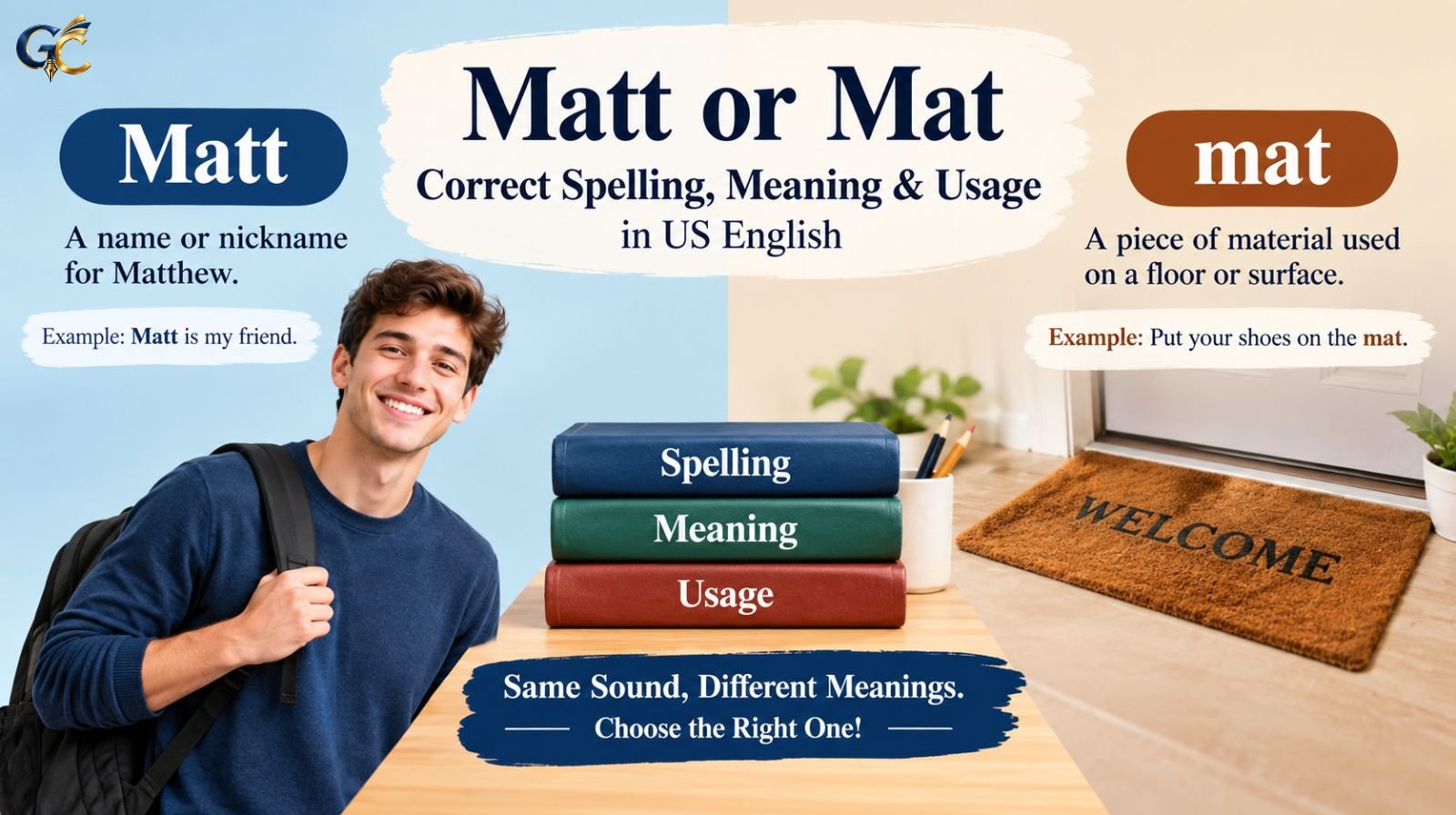
Have you ever wondered whether Matt or Mat is the correct spelling? The answer depends on what you mean. In US English, Matt and mat are both valid spellings, but they are generally used for completely different purposes.
Matt is commonly used as a short form of the personal name Matthew, while mat is an ordinary English noun referring to a piece of material placed on a floor or other surface. Mat can also be used as a short form of Matthew in some naming traditions, but Matt is the much more familiar spelling for the nickname in American English.
In this guide, you’ll learn the difference between Matt or Mat, their meanings, pronunciation, examples, and the easiest way to know which spelling to use.
Matt or Mat: Which Spelling Is Correct?
Both Matt and mat can be correct, but they are not normally interchangeable.
When to Use Matt
Matt is usually a masculine given name or a nickname for Matthew. It begins with a capital letter because names are proper nouns.
For example:
- Matt is my new coworker.
- I spoke with Matt yesterday.
- Matt is coming to the meeting.
- Matt shortened his name from Matthew to Matt.
The name Matt is listed as a short form of Matthew, and naming references identify Mat as another variant.
When to Use mat
Mat is a common noun. It usually means a flat piece of material used on a floor, table, or another surface.
For example:
- Please wipe your shoes on the mat.
- I bought a new bathroom mat.
- She put a yoga mat on the floor.
- The dog is sleeping on the mat.
Cambridge Dictionary defines mat as a piece of material used to cover or protect part of a floor or provide a soft surface. It also gives examples involving table mats and sports mats.
Quick Answer
| Word | Typical meaning | Example |
|---|---|---|
| Matt | A male name or nickname for Matthew | Matt called me yesterday. |
| Mat | A piece of material used on a floor or surface | Put your shoes on the mat. |
| Mat | A less common short form of Matthew | His name is Mat. |
Therefore, if you are talking about a person named Matthew, Matt is usually the expected US English spelling of the nickname.
What Does Matt Mean?
Matt is primarily used as a shortened form of the given name Matthew.
Matt as a Nickname for Matthew
Matthew has traditionally been shortened to Matt, especially in English-speaking countries.
For example:
Matthew → Matt
You might see:
- Matthew Johnson
- Matt Johnson
Both can refer to the same person if that person chooses to use Matt as a short form.
The name Matt is recorded as an English short form of Matthew. Naming references also list Mat, Mattie, and Matty among related forms.
Matt Is a Proper Name
Because Matt is a person’s name, capitalize the first letter:
- Correct: Matt is here.
- Incorrect: matt is here.
Capitalization matters because proper names are normally capitalized in English.
For example:
Correct:
I sent the document to Matt.
Incorrect:
I sent the document to matt.
What Does Mat Mean?
The lowercase word mat has several ordinary English uses, with the most common meaning involving a piece of material placed on a surface.
Mat as a Floor Covering
A mat can be placed near a door, in a bathroom, or elsewhere to protect a surface or help keep an area clean.
Examples:
- There is a mat beside the front door.
- The bathroom mat needs to be washed.
- Please wipe your feet on the mat.
- We bought a new welcome mat.
Cambridge’s American Dictionary specifically defines mat as a flat piece of material that covers and protects part of a floor or provides a soft surface.
Mat in Sports and Exercise
The word mat is also common when talking about exercise, gymnastics, wrestling, and yoga.
Examples:
- She rolled out her yoga mat.
- The children practiced on a soft mat.
- The wrestler returned to the mat.
- I need a thicker exercise mat.
In each example, mat is a common noun, so it remains lowercase unless it begins a sentence.
Mat as a Table Covering
A mat can also protect a table or another surface.
Examples include:
- place mat
- table mat
- protective mat
- desk mat
So, when mat refers to an object rather than a person’s name, lowercase mat is normally appropriate.
Matt or Mat: The Key Difference in US English

The easiest way to remember the difference between Matt or Mat is to ask yourself whether you are talking about a person or an object.
Matt Usually Refers to a Person
Use Matt when it is someone’s name or nickname.
Examples:
- Matt works with me.
- I called Matt this morning.
- Matt is studying at the university.
- Have you met Matt?
Here, the capital M is important because the word is a proper name.
Mat Usually Refers to an Object
Use mat when referring to a floor covering, exercise surface, or protective surface.
Examples:
- The mat is dirty.
- Put the shoes beside the mat.
- I need an exercise mat.
- The yoga mat is on the floor.
What About Mat as a Name?
Mat can also be used as a short form of Matthew. It is a recognized English name form, but in everyday US English, Matt is generally the more familiar spelling when someone means the nickname for Matthew. Naming references list both Mat and Matt as short forms of Matthew.
So if you’re addressing someone personally, follow that person’s preferred spelling.
For example, if someone’s legal or preferred name is Mat, don’t change it to Matt simply because Matt is more common.
Matt or Mat: Common Examples
Seeing the two words in real sentences makes the difference much easier to remember.
Examples With Matt
- Matt will join us for dinner.
- I sent Matt an email.
- Matt is learning Spanish.
- Have you seen Matt today?
- Matt is short for Matthew.
- My friend’s name is Matt.
Examples With mat
- Please leave your shoes on the mat.
- I bought a new yoga mat.
- The dog is lying on the mat.
- The exercise mat is easy to clean.
- Put the hot dish on the mat.
- The front-door mat is wet.
A Simple Memory Trick
Think:
Matt = person
mat = object
This is not an absolute rule because Mat can also be a person’s name, but it works extremely well for ordinary US English writing.
Real-Life Example: Matt as a Short Form of Matthew
A familiar real-world example is the actor Matt Damon. His professional name demonstrates how Matt functions naturally as a personal name in English. Naming references list Matt as a short form of Matthew and identify Matt Damon among notable bearers of the name.
Imagine writing about him in an article. You would write, “Matt Damon starred in the movie,” not “Mat Damon.” The double t is part of the established spelling of his first name. This illustrates an important point about names: spelling is not always something a writer should “correct” according to a general vocabulary rule. A person’s chosen name has its own established spelling.
The same principle applies to ordinary people. If someone introduces himself as Matt, that is the spelling you should use when writing his name. If another person spells his name Mat, then Mat is correct for that individual. Even though Matt is a familiar short form of Matthew in American English, personal names can have different established spellings.
This is why context matters so much when deciding between Matt or Mat. If you’re talking about a floor covering, use lowercase mat. If you’re writing someone’s name, use the spelling that person actually uses.
2025–2026 Data and Usage Snapshot
Current naming data provides useful context for understanding how common Matthew and related names have been in the United States.
Matthew Has a Long History of US Usage
The U.S. Social Security Administration’s data for births from 1926 through 2025 places Matthew at No. 13 among boys’ names, with 1,638,971 occurrences across that 100-year period.
That long-term popularity helps explain why Matt is such a familiar nickname in American English.
What the 2025 Data Shows
The SSA’s latest published data lists Liam, Noah, Oliver, Theodore, and Henry as the top five boys’ names for 2025. Matt does not appear in that top-five list.
The SSA also reports that its 2025 top-1,000 names represented about 71.51% of all names given to U.S. births that year.
These statistics are useful context rather than proof that one spelling is “correct.” Names can be popular or uncommon while still being perfectly valid.
What This Means for Matt vs. Mat
The important takeaway is linguistic rather than statistical:
- Matt is a recognized English short form of Matthew.
- Mat is also a recognized short form, but it is less immediately associated with the nickname in typical US English.
- mat in lowercase is an ordinary English noun.
How to Choose Between Matt and Mat
Use this quick step-by-step guide whenever you’re unsure.
Step 1: Are You Talking About a Person?
If yes, check whether the person’s name is Matt, Mat, or another spelling.
Matt is coming over tonight.
Step 2: Are You Talking About a Floor or Exercise Surface?
If yes, use lowercase mat.
I left my shoes beside the mat.
Step 3: Are You Referring to Matthew?
If you’re shortening Matthew, Matt is the familiar choice in US English.
Matthew → Matt
However, if the individual personally spells the nickname Mat, use Mat.
Step 4: Check Capitalization
Remember:
- Matt = proper name
- Mat = proper name if that is someone’s chosen spelling
- mat = common noun
Common Mistakes With Matt and Mat
Mistake 1: Writing “matt” for Someone’s Name
Names should be capitalized.
Incorrect:
I spoke with matt yesterday.
Correct:
I spoke with Matt yesterday.
Mistake 2: Writing “Matt” for a Floor Mat
A floor covering is normally a lowercase common noun.
Incorrect:
Wipe your shoes on the Matt.
Correct:
Wipe your shoes on the mat.
Mistake 3: Assuming Mat Is Always Wrong
Mat is not automatically a misspelling of Matt.
If a person actually spells their name Mat, that spelling is correct for that person’s name. It is also listed as a short form of Matthew.
Mistake 4: Changing Someone’s Name
If an individual signs an email as Mat, don’t “fix” it to Matt. Personal names should be written according to the person’s established or preferred spelling.
FAQs
Q1: Is Matt or Mat the correct spelling?
A: Both can be correct. Matt is the familiar spelling for the nickname of Matthew in US English, while mat is normally a common noun for a floor covering or similar object. Mat can also be used as a personal name.
Q2: Is Matt short for Matthew?
A: Yes. Matt is a common short form of Matthew.
Q3: Is Mat also short for Matthew?
A: Yes. Mat is also documented as a short form of Matthew. However, Matt is generally the more familiar spelling for the nickname in American English.
Q4: How do you spell the name Matt?
A: The familiar US English spelling is Matt, with two t’s.
Example:
Matt is my friend.
However, always use the spelling the individual prefers.
Q5: What does mat mean in American English?
A: In American English, mat commonly means a flat piece of material placed on a floor or other surface. It can also refer to an exercise, sports, bathroom, or table mat.
Q6: Is “matt” a word?
A: Lowercase matt is not the normal spelling when referring to the common noun mat. Matt with a capital M is commonly a person’s name. If you mean the surface covering, use mat.
Q7: Should Matt always be capitalized?
A: Yes, when Matt is being used as a person’s name, it should be capitalized.
Matt called me.
But the common noun is lowercase:
The dog is sitting on the mat.
Q8: Can a person’s name really be spelled Mat?
A: Yes. Mat is a recognized short form of Matthew. If someone uses Mat as their personal spelling, that is the correct spelling for their name.
Conclusion:
So, Matt or Mat? The correct choice depends on context.
Use Matt when you’re referring to the familiar nickname for Matthew, especially in US English:
Matt is my coworker.
Use mat when you’re talking about a floor covering, exercise surface, or another similar object:
Please wipe your feet on the mat.
Mat can also be a person’s name or a short form of Matthew, so you should always respect an individual’s preferred spelling.
The easiest rule to remember is Matt = commonly a person’s name, mat = commonly an object. When writing for an American audience, this distinction will help you avoid one of the most common spelling and capitalization mistakes involving these two words.
👉 Explore more useful grammar tips and guides on Grammar Clear

Zia Ahmad is the founder of GrammarClear, an educational platform dedicated to making English grammar simple and easy to understand. Through clear explanations and practical examples, he aims to help learners improve their grammar, writing, and communication skills with confidence.

