
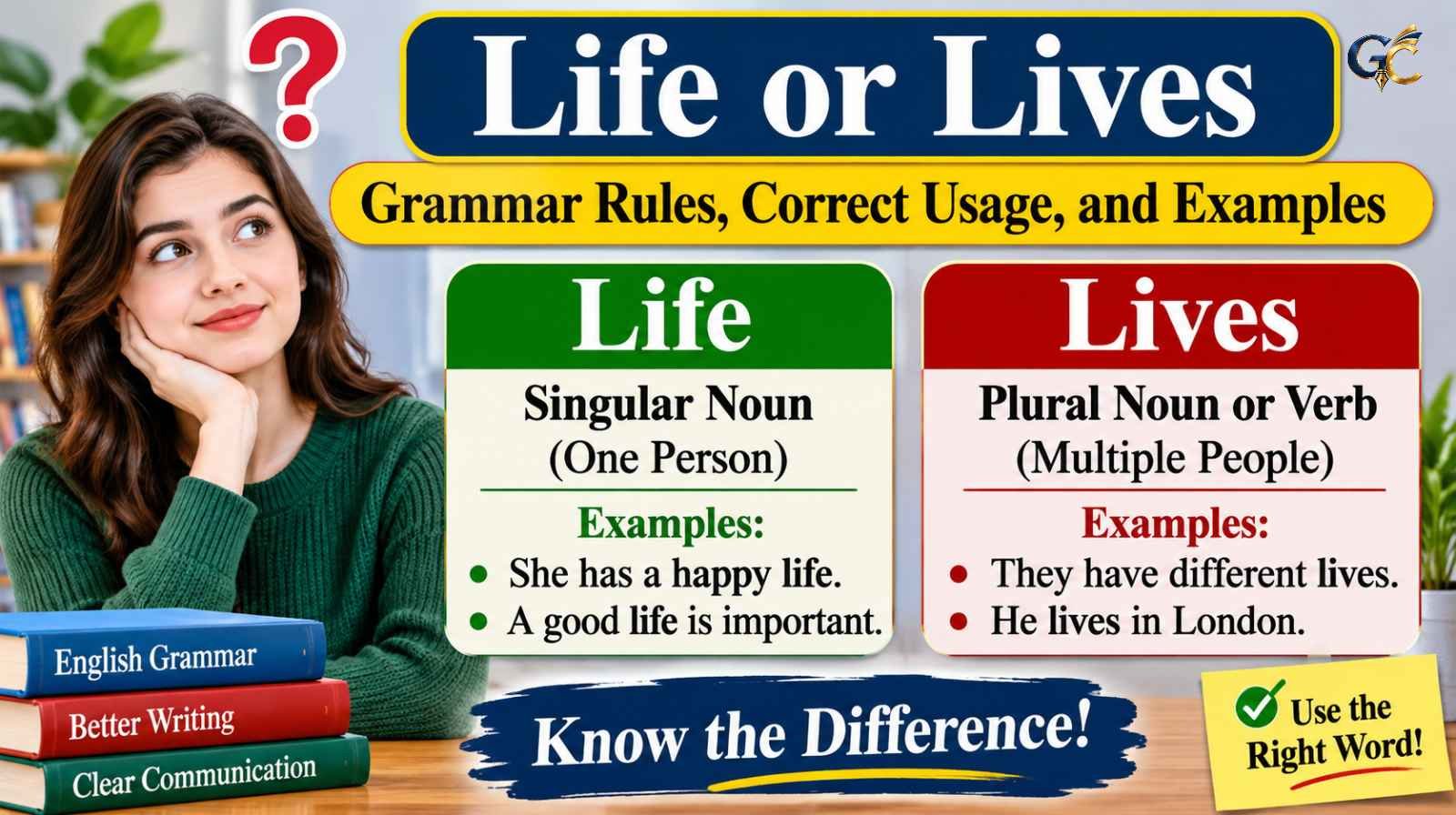
Understanding the difference between Life or Lives can make your English writing clearer and more accurate. Although these two words are closely related, they are used differently depending on the meaning and grammatical context. Many English learners confuse them because lives can be both the plural form of life and the third-person singular form of the verb live.
Whether you are writing an email, preparing an academic assignment, having a conversation, or creating professional content, knowing when to use life or lives is important.
In this guide, you will learn the meanings of both words, their grammar rules, common mistakes, and practical examples to help you use them confidently.
What Is the Difference Between Life and Lives?

The main difference between life and lives is that life is a singular noun, while lives is usually its plural form. However, lives can also function as a verb.
- Life: Refers to the existence or experience of one person, animal, or living thing.
- Lives: Refers to the existence or experiences of two or more people or living things. It can also mean that someone lives somewhere or does something regularly.
For example:
- She has a wonderful life in London.
- They have different lives but share the same dreams.
- He lives in New York.
In the first sentence, life refers to one person’s existence. In the second, lives refers to the experiences of multiple people. In the third, lives is a verb describing where someone resides.
Understanding these differences makes it easier to choose the correct word.
What Does Life Mean?
Life is a singular noun that refers to the condition of being alive. It can also describe someone’s experiences, lifestyle, relationships, or the period between birth and death.
The word is commonly used in everyday conversations, professional writing, books, and educational content.
Examples of Life in Sentences
Here are some examples showing how to use life correctly:
- My life became better after I started exercising regularly.
- Every person deserves a happy life.
- She wants to make a positive difference in someone’s life.
- Education plays an important role in our life.
- His life changed completely after moving abroad.
In these examples, life refers to one person’s existence or personal experiences.
Scenario Example: Using Life in a Personal Email
Imagine that you want to congratulate your friend on a new beginning.
Email Example:
To: Emily Carter
Subject: Congratulations on Your New Beginning
Dear Emily,
Congratulations on starting your new journey! I hope this new chapter brings happiness, success, and wonderful opportunities into your life.
You have worked hard to reach this point, and I truly believe you deserve every bit of success.
Wishing you all the best!
Best regards,
Olivia Bennett
In this email, life is correct because it refers to one person’s overall experience and existence.
What Does Lives Mean?
Lives is the plural form of the noun life. It refers to the existence, experiences, or lifestyles of multiple people or living things.
It is also the third-person singular form of the verb live. In this form, it describes where someone resides or how someone spends their time.
Examples of Lives as a Plural Noun
Here are some examples of lives used as a plural noun:
- Many people have different lives and personal experiences.
- Teachers can positively influence the lives of their students.
- Technology has changed our lives in many ways.
- Their lives became easier after moving to the city.
- Volunteers help improve the lives of people in need.
In these sentences, lives refers to multiple people’s experiences or existences.
Scenario Example: Using Lives in a Workplace Email
Imagine a manager writing to employees about a community support project.
Email Example:
To: All Employees
Subject: Community Support Initiative
Dear Team,
We are pleased to announce our new community support initiative. This project aims to improve the lives of families who need additional assistance.
Your participation can make a meaningful difference in the community. Even a small contribution can bring positive changes to many people’s lives.
Thank you for your continued support.
Kind regards,
Daniel Roberts
Community Relations Manager
Here, lives is correct because the email refers to multiple families and people.

Grammar Rules for Using Life and Lives
Understanding the grammar rules behind these words will help you avoid common mistakes.
Use Life for One Person or Living Thing
When referring to the existence, experiences, or lifestyle of one person or living thing, use life.
Examples:
- My life is full of wonderful memories.
- A healthy life requires good habits.
- The dog has a comfortable life with its owner.
- She enjoys her life in the countryside.
Remember that life is singular, so it generally takes singular determiners and verbs.
For example:
- Correct: Her life is beautiful.
- Incorrect: Her life are beautiful.
Use Lives for Multiple People or Living Things
When discussing the lives or experiences of more than one person or living thing, use lives.
Examples:
- Their lives are completely different.
- Many people’s lives have changed because of technology.
- The organization saves animal lives.
- These decisions affect our lives.
Because lives is plural in these sentences, it generally takes plural verbs.
For example:
- Correct: Their lives are improving.
- Incorrect: Their lives is improving.
Use Lives as a Verb with He, She, and It
The word lives is also used as the third-person singular form of the verb live.
Use it when talking about where someone resides or how someone lives.
Examples:
- My brother lives in Canada.
- She lives with her parents.
- He lives a simple lifestyle.
- The cat lives in our garden.
Remember this important distinction:
- She has a wonderful life. (Noun)
- She lives in a wonderful house. (Verb)
The meaning and grammatical role determine which word you need.

Life vs. Lives: Examples in Different Situations
Both words appear in everyday conversations, professional communication, and academic writing. The following scenarios will help you understand their practical usage.
In Everyday Conversations
When talking about personal experiences, use life for one person’s experience and lives for multiple people’s experiences.
Examples:
- Life: I want to enjoy my life without unnecessary stress.
- Lives: Our lives have become busier since we started working.
- Lives (verb): My cousin lives near the university.
In Professional Communication
In professional settings, these words are often used to discuss personal development, workplace experiences, and social responsibilities.
Examples:
- Life: Maintaining a work-life balance improves your quality of life.
- Lives: Our services make a difference in the lives of customers.
- Lives (verb): Our new employee lives close to the office.
In Academic Writing
Academic writing frequently uses these words when discussing society, education, health, and human experiences.
Examples:
- Life: Education plays a significant role in modern life.
- Lives: Economic changes influence the lives of ordinary citizens.
- Lives (verb): The researcher lives in a rural community.
In Social Media Posts
These words are also common in social media captions and motivational messages.
Examples:
- Life: Enjoy every moment of your life.
- Lives: Kindness can change people’s lives.
- Lives (verb): She lives every day with confidence.
Common Mistakes to Avoid When Using Life or Lives
Even experienced English writers sometimes confuse these words. Here are some common mistakes and their corrections.
| Incorrect Sentence | Correct Sentence |
|---|---|
| Our life are different. | Our lives are different. |
| She have a beautiful lives. | She has a beautiful life. |
| He life in London. | He lives in London. |
| Their life is complicated. | Their lives are complicated. |
| My lives is wonderful. | My life is wonderful. |
Why Do These Mistakes Happen?
Most mistakes happen because people focus on the spelling rather than the grammatical function of the word.
For example, someone might write life when referring to several people or use lives when discussing one person’s existence.
To avoid these errors, ask yourself two questions:
- Am I talking about one person’s existence or experience? Use life.
- Am I talking about multiple people’s experiences or using the verb live with he, she, or it? Use lives.
This simple approach can help you make the right choice.
Life or Lives: Quick Comparison Table
The following table summarizes the differences between these words.
| Feature | Life | Lives |
|---|---|---|
| Word type | Singular noun | Plural noun or verb |
| Meaning | One person’s existence | Multiple people’s existence |
| Verb usage | Not a verb form | Third-person singular of live |
| Example | My life is peaceful. | Their lives are peaceful. |
| Another example | She enjoys life. | He lives in London. |
Tips to Remember the Difference Between Life and Lives
If you frequently confuse these words, the following tips can make learning easier.
Remember the F-to-V Spelling Change
The plural form of life is not lifes. Instead, the letter F changes to V, followed by ES.
- One life
- Two lives
The same spelling pattern appears in other English words, such as:
- Wife → Wives
- Knife → Knives
- Wolf → Wolves
Look at the Subject of the Sentence
Check whether you are referring to one person or multiple people.
- One person: His life is interesting.
- Multiple people: Their lives are interesting.
This is a simple way to identify the correct noun.
Check Whether Lives Is an Action Word
If the sentence describes where someone resides or how someone spends their life, lives may be a verb.
For example:
- Sarah lives in Australia.
- My parents live in Australia.
Notice that lives is used with Sarah (she), while live is used with my parents (they).
Frequently Asked Questions
1. Is it life or lives?
Both life and lives are correct English words. Life is the singular noun, while lives is its plural form. Lives can also be used as the third-person singular form of the verb live.
2. What is the plural of life?
The plural of life is lives. The spelling changes from F to V, followed by ES.
3. When should I use life in a sentence?
Use life when referring to the existence, experiences, or lifestyle of one person or living thing.
4. When should I use lives in a sentence?
Use lives when referring to multiple people’s experiences or existences. It is also used as a verb with he, she, and it.
5. Is lives a singular or plural word?
Lives can be either plural or singular, depending on its grammatical function. As a noun, it is plural. As a verb, it is singular and is used with he, she, or it.
6. Is it people’s life or people’s lives?
People’s lives is generally correct when referring to the experiences or existence of multiple people. People’s is the plural possessive form of person.
7. Is it our life or our lives?
Both expressions can be correct depending on the meaning. Use our life when referring to a shared life or collective experience, and our lives when referring to the individual lives of multiple people.
8. Is lives the same as life’s?
No. Lives is the plural form of life or a verb form of live. Life’s is the possessive form of life or a contraction of life is or life has.
Conclusion
Understanding the difference between life and lives is easier when you remember their grammatical roles. Life is a singular noun used for one person’s existence or experience, while lives is its plural form when discussing multiple people or living things. Additionally, lives can function as a verb when used with he, she, or it.
By learning these simple grammar rules and practicing with everyday examples, professional emails, and conversations, you can use both words confidently. Always consider the meaning and subject of your sentence before choosing between life or lives.
👉 Discover more simple and practical grammar guides on Grammar Clear

Zia Ahmad is the founder of GrammarClear, an educational platform dedicated to making English grammar simple and easy to understand. Through clear explanations and practical examples, he aims to help learners improve their grammar, writing, and communication skills with confidence.

