
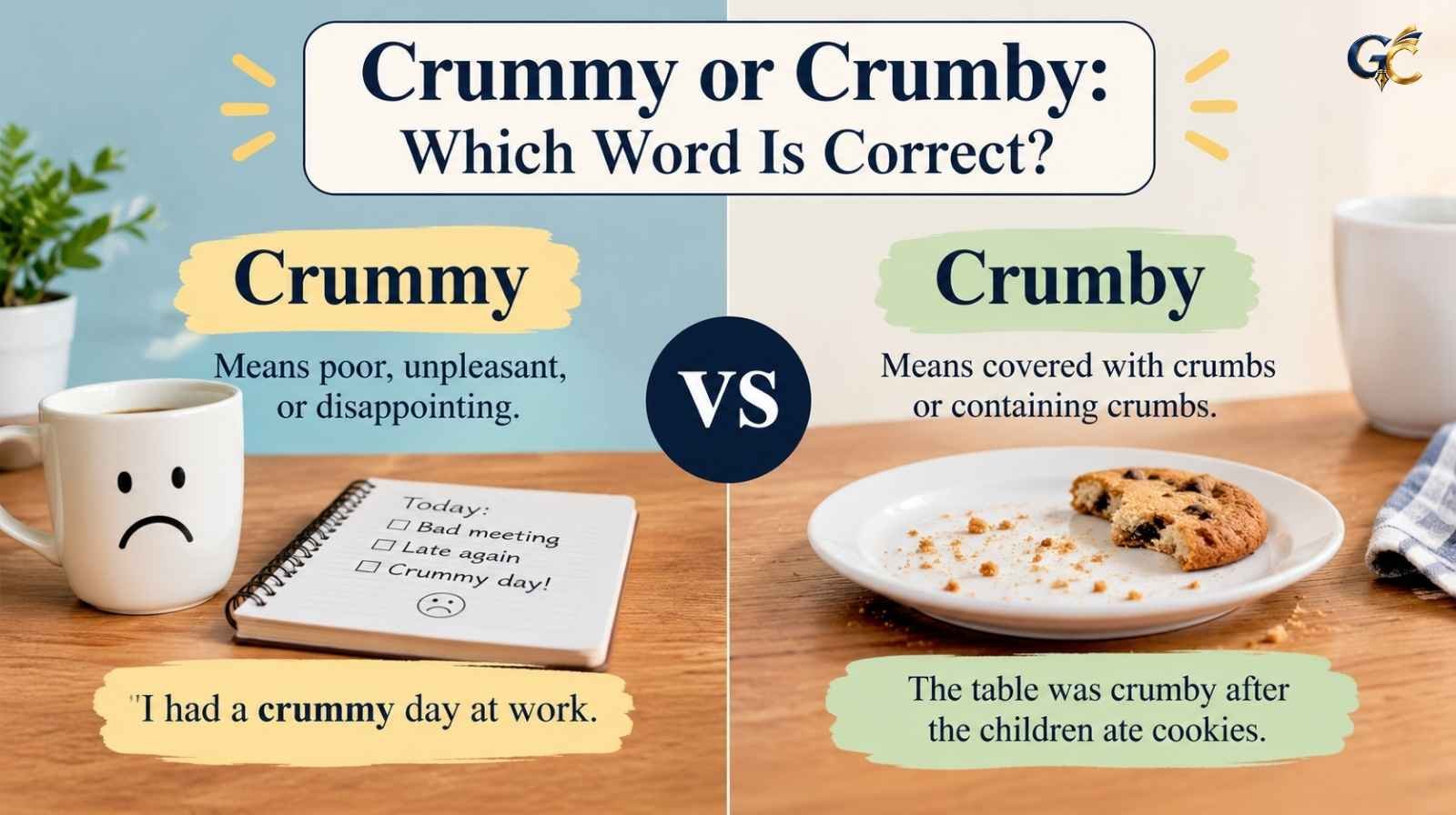
Have you ever wondered whether to write crummy or crumby? These two words look almost identical, and their similar pronunciation can make the choice confusing. However, they have different meanings and are not always interchangeable.
Crummy is the more common word. It usually means something is poor in quality, unpleasant, shabby, or disappointing. Crumby generally means something is full of crumbs or resembles crumbs, although it is much less common.
In this guide, you will learn the meanings of crummy and crumby, understand when to use each spelling, and explore practical examples that make the difference easy to remember.
Understanding Crummy or Crumby: The Main Difference
The easiest way to distinguish crummy from crumby is to focus on what you want to describe. One usually expresses a negative judgment, while the other relates to crumbs.
What Does Crummy Mean?
Crummy is an adjective used to describe something of poor quality, unpleasant, disappointing, or not very good. It is informal and commonly appears in everyday conversations.
Examples:
- I had a crummy day at work.
- The hotel room was small and crummy.
- He felt crummy after catching a cold.
- We received crummy service at the restaurant.
In each example, crummy expresses a negative experience or condition.
What Does Crumby Mean?
Crumby is an adjective related to crumbs, the small pieces that break off bread, cookies, cakes, and similar foods. It can describe something that contains crumbs or is covered with them.
Examples:
- The kitchen counter was crumby after breakfast.
- My shirt became crumby while I was eating cookies.
- The table looked crumby after the children finished their snacks.
Although crumby is a legitimate spelling, it is relatively uncommon in ordinary writing. Depending on the sentence, a more natural alternative might be crumb-covered or full of crumbs.
Quick Comparison Table
| Feature | Crummy | Crumby |
|---|---|---|
| Main meaning | Poor, unpleasant, or disappointing | Containing or resembling crumbs |
| Part of speech | Adjective | Adjective |
| Common usage | Very common in informal English | Uncommon |
| Example | It was a crummy movie. | The table was crumby. |
| Best memory tip | Think of something bad | Think of food crumbs |
Quick answer: Use crummy when describing something bad or unpleasant. Use crumby when referring to crumbs.
Why Are Crummy and Crumby So Often Confused?
The confusion between crummy and crumby comes from their similar pronunciation, shared word history, and overlapping dictionary meanings in some varieties of English.
Are Crummy and Crumby Pronounced the Same?
Yes. In standard English pronunciation, both words are generally pronounced KRUM-ee. The letter b in crumby is silent, just as it is in crumb.
Because they sound alike, you cannot always identify the correct spelling by listening. Instead, you need to understand the meaning of the sentence.
Examples:
- That was a crummy meal. (The meal was disappointing.)
- The table was crumby after the meal. (The table was covered with crumbs.)
Does British English Use These Words Differently?
Yes. In British English, crumby can also be used as a variant spelling of crummy, including the meaning of something inferior or unpleasant.
In American English, the distinction is generally clearer: crummy commonly means poor or unpleasant, while crumby usually refers to crumbs.
Therefore, if you are writing for a broad English-speaking audience, choosing the spelling that clearly communicates your intended meaning is the safest approach.
Which Spelling Is More Common?
Crummy is the more familiar spelling when describing a bad experience, poor service, or something of inferior quality.
For example:
- Correct for the intended meaning: We stayed in a crummy hotel.
- Clearer for the food-related meaning: The table was covered with crumbs.
The Oxford Learner’s Dictionary defines crummy as an informal adjective meaning of very bad quality. Dictionary.com and Collins also recognize the crumb-related meaning of crumby.
How to Use Crummy and Crumby Correctly
Learning a few practical rules can help you avoid spelling mistakes in emails, blog posts, school assignments, and everyday writing.
Rule 1: Use Crummy for Something Bad
Choose crummy when you want to express dissatisfaction, poor quality, or an unpleasant experience.
Examples:
- The restaurant served us crummy food.
- I had a crummy experience with customer service.
- She felt crummy because she had not slept well.
- They bought a crummy phone that stopped working after a week.
Here, the word communicates a negative opinion rather than describing actual crumbs.
Rule 2: Use Crumby for Something Covered with Crumbs
Choose crumby when describing a surface, object, or place containing small pieces of food.
Examples:
- The sofa became crumby after the children ate biscuits.
- I wiped the crumby kitchen counter.
- His trousers were crumby after lunch.
In formal writing, you might prefer expressions such as covered in crumbs because they are more familiar and immediately clear to most readers.
Rule 3: Consider the Meaning Before Choosing the Spelling
When you are unsure which word to use, ask yourself what you are trying to communicate.
| Your intended meaning | Recommended spelling | Example |
|---|---|---|
| Poor quality | Crummy | This is a crummy product. |
| Unpleasant experience | Crummy | We had a crummy day. |
| Covered in crumbs | Crumby | The table is crumby. |
| Full of small food particles | Crumby | The floor became crumby. |
| Poor quality in British English | Crummy or crumby, depending on context | It was a crummy experience. |
This simple comparison can help you select the appropriate word without relying on pronunciation alone.
Real-Life Example: Choosing Between Crummy and Crumby
Imagine that a food blogger named Sarah is writing a review of a small café she visited over the weekend. She wants her readers to understand both the quality of the food and the condition of the table.
The First Draft
Sarah initially writes:
“The café had crumby service, and our table was crummy after we finished eating.”
Although readers might understand her meaning from context, the two words are not the best choices for what she intends to say.
Correcting the Sentences
Sarah revises her review:
“The café had crummy service, and our table was crumby after we finished eating.”
Now, the meanings are clearer.
- Crummy service: The service was poor, disappointing, or unpleasant.
- Crumby table: The table was covered with crumbs left behind after eating.
What Can Writers Learn from This Example?
Sarah’s experience illustrates why understanding word meanings matters more than simply memorizing spellings. Since crummy and crumby sound alike, a spell-checking tool might not flag an incorrect choice in a sentence.
A writer must consider the context, intended meaning, and audience. For example, someone writing a restaurant review would usually choose crummy to criticize poor service. However, someone describing a messy dining table could choose crumby or, for greater clarity, write “covered with crumbs.”
This principle applies to many commonly confused English words. Correct spelling is important, but choosing the word that accurately communicates your meaning is equally essential.
For Grammarclear readers, the main lesson is simple: check the meaning of the word before deciding which spelling belongs in your sentence.
What Dictionaries and Language Research Tell Us
Established dictionaries support the distinction between these words. The Oxford Learner’s Dictionary identifies crummy as an informal adjective meaning very bad quality. Cambridge Dictionary gives similar definitions and examples, including crummy weather and a crummy job.
Dictionary.com and Collins English Dictionary define crumby as meaning full of crumbs, while also recognizing its use as a variant of crummy in certain contexts.
These definitions confirm that both spellings are legitimate English words, but their preferred usage depends on the meaning and, sometimes, regional conventions.
What About 2025–2026 Statistics?
There is no verified, widely accepted 2025–2026 statistic establishing a precise percentage of English speakers who use crummy rather than crumby. Nor is there a reliable current figure demonstrating how often people confuse the two spellings.
Rather than inventing statistics, it is more useful to rely on established dictionary definitions and documented usage distinctions. These sources provide a dependable basis for understanding the words without presenting unsupported numerical claims.
For writers who need additional evidence, searchable language corpora and dated publications can help investigate how a word is used across different regions and periods.
Reliable References for Further Reading
The following established language resources explain the meanings and usage of these words:
- Oxford Learner’s Dictionaries Crummy
- Cambridge Dictionary Crummy
- Collins English Dictionary Crumby
These references are useful when checking definitions, pronunciation, and differences in British and American English.
FAQs
Q1: Is crummy or crumby the correct spelling?
A: Both are correct words. Crummy is the usual choice for something bad, unpleasant, or poor in quality. Crumby generally describes something covered with crumbs.
Q2: Does crumby mean bad?
A: It can. In some varieties of English, particularly British English, crumby is also accepted as a variant of crummy, meaning inferior or unpleasant. In American English, the crumb-related meaning is generally more distinct.
Q3: Is crummy a slang word?
A: Yes. Crummy is an informal adjective commonly used to describe something poor, disappointing, shabby, or unpleasant. For example, “I had a crummy day” means that the day was unpleasant.
Q4: How do you use crumby in a sentence?
A: You can use crumby to describe something containing crumbs. For example: “The kitchen table became crumby after the children ate their cookies.”
Q5: Are crummy and crumby pronounced the same?
A: Yes. Both are generally pronounced KRUM-ee. The b in crumby is silent, so the words sound alike even though their usual meanings differ.
Q6: Is crumby acceptable in American English?
A: Yes. American English recognizes crumby as an adjective meaning full of crumbs. However, crummy is the more familiar spelling when describing poor quality or an unpleasant experience.
Q7: What is the difference between crummy and crumbly?
A: Crummy usually means bad, inferior, or unpleasant. Crumbly means easily breaking into small pieces, such as a crumbly cookie or a crumbly piece of cake. Crumby generally refers to something full of crumbs, although it can have other meanings.
Q8: Which word should I use in formal writing?
A: For formal writing, use crummy only when its informal tone suits the context. When describing food particles, consider clearer alternatives such as “covered with crumbs.” In professional writing, precise wording often communicates your meaning more effectively.
Conclusion:
The difference between crummy or crumby becomes easy to remember when you focus on meaning rather than pronunciation.
Use crummy when describing something poor, unpleasant, disappointing, or inferior. Use crumby when referring to something covered with crumbs or containing small food particles. Remember that British English sometimes uses crumby as an alternative spelling of crummy.
Before publishing an article, writing an email, or completing an assignment, take a moment to check the context. That small step can help you avoid confusion and communicate more clearly.
👉 Discover more simple and practical grammar guides on Grammar Clear

Zia Ahmad is the founder of GrammarClear, an educational platform dedicated to making English grammar simple and easy to understand. Through clear explanations and practical examples, he aims to help learners improve their grammar, writing, and communication skills with confidence.

