
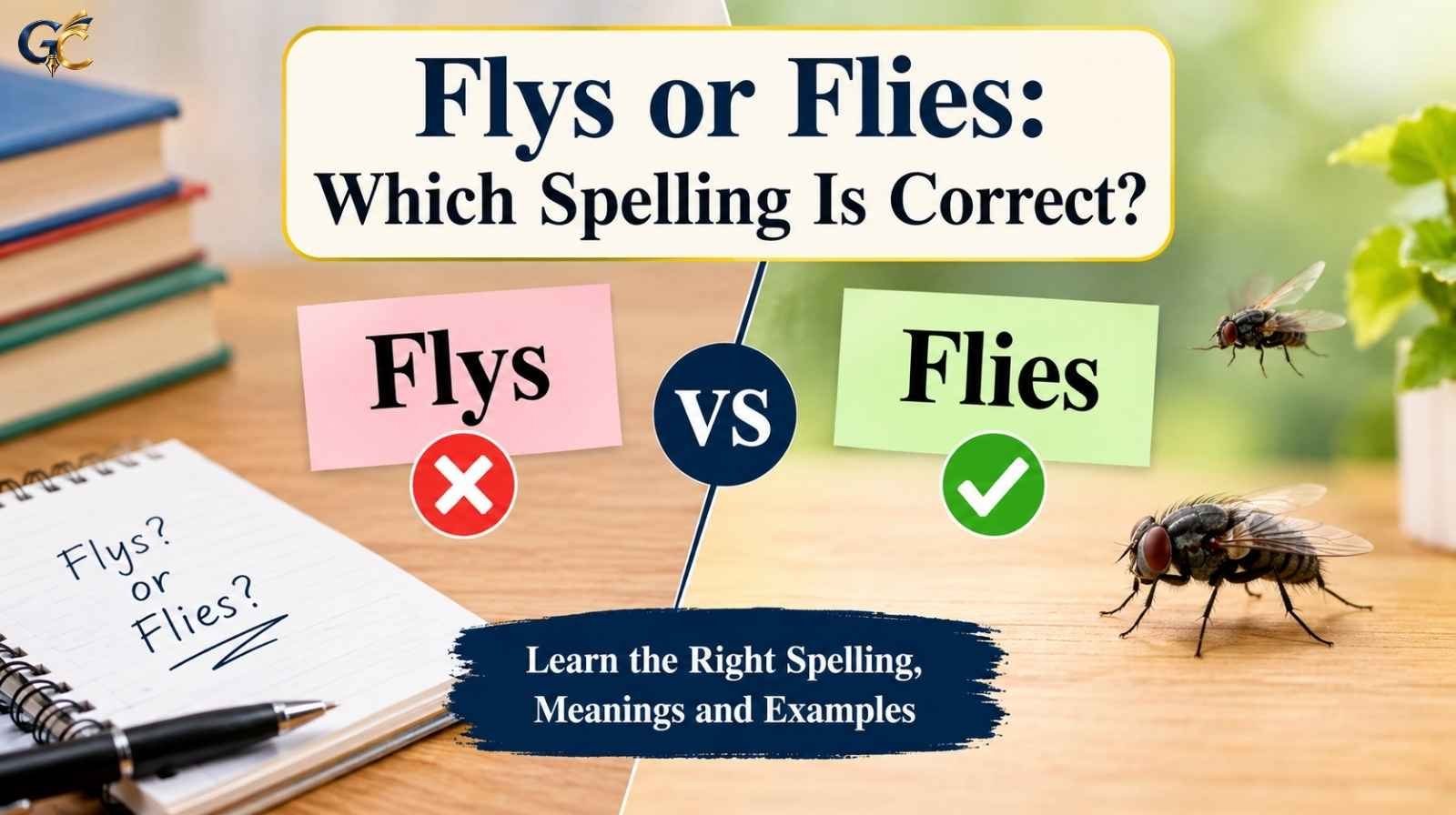
If you are wondering whether “flys” or “flies” is the correct spelling, you are not alone. These words can be confusing because flies can be both a plural noun and a verb, while flys may look like a natural plural form.
The correct spelling in standard English is flies. Flys is generally considered an incorrect spelling when you mean the plural of fly or the third-person singular form of the verb fly. Major dictionaries, including Cambridge and Merriam-Webster, list flies as the standard form.
In this guide, you will learn exactly when to use fly, flies, flew, and flown, with simple examples and an easy rule to remember.
Flys or Flies: Which One Is Correct?
Flies is the standard English spelling. It can have several grammatical uses depending on the sentence.
For example:
- There are several flies in the kitchen.
- The bird flies over the garden.
- A butterfly flies from flower to flower.
- Time flies when you are having fun.
Cambridge Dictionary specifically identifies flies as the plural of fly when referring to the insect.
Merriam-Webster also lists flies as the plural of the noun fly and as the present-tense, third-person singular form of the verb fly.
Why is “flys” incorrect?
The spelling flys does not follow the normal English spelling pattern used when forming the plural of a noun ending in consonant + y.
When a word ends in a consonant followed by y, the y usually changes to i before adding -es.
For example:
| Singular | Plural |
|---|---|
| fly | flies |
| baby | babies |
| city | cities |
| story | stories |
| country | countries |
Therefore, fly → flies, not fly → flys.
What Does “Flies” Mean?
The word flies has more than one grammatical use. Understanding its meaning from context makes the spelling much easier to remember.
Flies as a plural noun
When flies refers to more than one insect, it is the plural form of fly.
Examples:
- The flies are around the food.
- Several flies entered through the window.
- We need to keep the kitchen clean to avoid flies.
- The horse was surrounded by flies.
Cambridge Dictionary defines flies as the plural of fly when referring to the insect.
Flies as a verb
Flies can also be the third-person singular present form of the verb fly.
Examples:
- The bird flies across the sky.
- The eagle flies high above the mountains.
- My father flies to London every month.
- The plane flies over the city.
This follows the same general third-person singular pattern seen in verbs such as:
- try → tries
- cry → cries
- carry → carries
- fly → flies
Merriam-Webster identifies flies as the present-tense third-person singular form of fly.
Fly vs. Flies vs. Flew vs. Flown
One reason learners confuse flys and flies is that the verb fly has several different forms.
| Word | Grammatical use | Example |
|---|---|---|
| fly | Base form | Birds fly south in winter. |
| flies | Third-person singular | The bird flies every morning. |
| flew | Simple past | The bird flew away. |
| flown | Past participle | The bird has flown away. |
| flying | Present participle/gerund | The bird is flying overhead. |
Cambridge lists flew as the past simple form of fly, while its dictionary entry gives flew and flown as the principal past forms.
A simple way to remember them
Think of the forms as a sequence:
fly → flies → flew → flown → flying
For example:
- I fly to work.
- She flies to work.
- She flew yesterday.
- She has flown many times.
- She is flying tomorrow.
The important point is that flys is not one of the standard forms.
Why Do People Write “Flys”?
Although flys is incorrect in standard English, it is easy to see why someone might write it.
Many regular nouns simply add -s to form their plural:
- book → books
- car → cars
- table → tables
- phone → phones
Someone may therefore assume:
fly + s = flys
However, English has a spelling rule for many words ending in consonant + y. The y changes to i, followed by -es.
So:
fly → flies
The same pattern appears in:
- baby → babies
- hobby → hobbies
- puppy → puppies
- family → families
- country → countries
An important exception
Not every word ending in y changes to -ies.
If the letter before y is a vowel, the plural normally takes -s.
For example:
- boy → boys
- toy → toys
- day → days
- key → keys
- journey → journeys
The difference is therefore worth remembering:
consonant + y → ies
vowel + y → ys
Since fly ends in ly, and l is a consonant, the standard plural is flies.
Real-Life Example: Choosing “Flies” in Everyday Writing
Imagine that you are writing a sentence about a picnic. You want to explain that several insects are bothering your family.
You might initially write:
“There are too many flys around the food.”
At first glance, the sentence may seem reasonable because fly is simply followed by s. However, the standard English plural is flies.
The corrected sentence is:
“There are too many flies around the food.”
This small spelling difference matters if you are writing an email, school assignment, blog post, business document, or website article. A reader may understand what you mean either way, but flies is the accepted standard spelling.
Now consider a completely different sentence:
“The bird flies over the lake every morning.”
Here, flies is not a plural noun. It is a verb. The subject is the bird, which is singular, so the present-tense verb becomes flies.
This example shows why context matters. The same spelling, flies, can refer to multiple insects or describe what one person, animal, or thing does.
For anyone learning English, the easiest approach is not to memorize flies as just a plural. Instead, remember that it has two common roles: the plural noun of fly and the third-person singular present form of the verb fly. This distinction makes sentences such as “The flies are annoying” and “The bird flies away” much easier to understand and use correctly.
2025–2026 Reference Check: What Do Major Dictionaries Say?
A useful way to verify a spelling question is to check authoritative dictionaries rather than relying on spell-check suggestions or informal online usage.
As checked against current dictionary resources in 2026, Cambridge Dictionary lists flies as the plural of fly when referring to insects.
Merriam-Webster likewise gives flies as the plural of the noun fly and identifies flies as the third-person singular present form of the verb fly.
This provides a useful 2025–2026 reference point: the standard dictionary form remains flies, not flys.
There is no need to invent a numerical “percentage of people who spell it flys” because authoritative dictionaries do not provide a reliable 2025–2026 statistic of that kind. For a spelling question, dictionary evidence is more useful and trustworthy than an unsupported usage percentage.
What the grammar evidence tells us
English grammar resources also emphasize the importance of choosing the correct verb form and matching the verb to the subject. Purdue OWL identifies subject-verb agreement and verb-form errors as common areas that writers need to check.
Therefore, when you see flies, check the context:
- The flies = plural noun
- She flies = verb
- He flies = verb
- Birds fly = base verb after a plural subject
Flys vs. Flies: Quick Comparison
| Word | Correct? | Meaning/Use | Example |
|---|---|---|---|
| fly | Yes | Singular noun or base verb | I saw a fly. |
| flies | Yes | Plural noun | There are three flies. |
| flies | Yes | Third-person singular verb | The bird flies away. |
| flew | Yes | Past tense | The bird flew away. |
| flown | Yes | Past participle | The bird has flown away. |
| flys | No | Not the standard spelling | ❌ I saw two flys. |
Quick spelling checklist
Before publishing or submitting your writing, ask:
- Am I talking about more than one insect? → flies
- Am I describing what one person or animal does? → flies
- Am I talking about the past? → flew
- Am I using a perfect tense? → flown
- Did I write flys? → Change it to flies in standard English.
FAQs
Q1: Is “flys” a correct spelling?
A: No. Flys is not the standard spelling when you mean the plural of fly or the third-person singular form of the verb fly. The correct form is flies.
Q2: Is it “two flys” or “two flies”?
A: The correct phrase is “two flies.”
Example:
Two flies landed on the table.
Q3: Is “flies” singular or plural?
A: It can be either, depending on how it is used.
As a noun, flies is plural:
The flies are everywhere.
As a verb, flies is singular in the sense that it agrees with a singular third-person subject:
The bird flies over the house.
Q4: Is “flies” a verb?
A: Yes. Flies is the third-person singular present form of the verb fly.
Example:
She flies to New York every month.
Q5: What is the past tense of “fly”?
A: The simple past tense is flew.
Example:
The bird flew across the garden.
Cambridge Dictionary confirms that flew is the past simple form of fly.
Q6: What is the past participle of “fly”?
A: The past participle is flown.
Example:
The plane has flown over the mountains.
Q7: Why does “fly” become “flies”?
A: Because fly ends in a consonant followed by y. In the standard plural spelling and in the third-person singular present verb form, the y changes to i before -es.
Therefore:
fly → flies
Not:
fly → flys
Q8: Is “flies” pronounced differently from “fly”?
A: Yes. Fly is pronounced /flaɪ/, while flies is pronounced /flaɪz/. Cambridge gives these pronunciations in its dictionary entries.
Conclusion:
So, flys or flies which spelling is correct?
The answer is flies.
Use flies when you mean more than one fly, as in “There are flies in the kitchen.” Use flies as the third-person singular present form of fly, as in “The bird flies across the sky.”
Remember the basic pattern:
Fly → Flies → Flew → Flown
The spelling flys is not the standard English form. When in doubt, check the context and remember that words ending in consonant + y often change y to i before -es.
👉 Explore more useful grammar tips and guides on Grammar Clear

Zia Ahmad is the founder of GrammarClear, an educational platform dedicated to making English grammar simple and easy to understand. Through clear explanations and practical examples, he aims to help learners improve their grammar, writing, and communication skills with confidence.

