
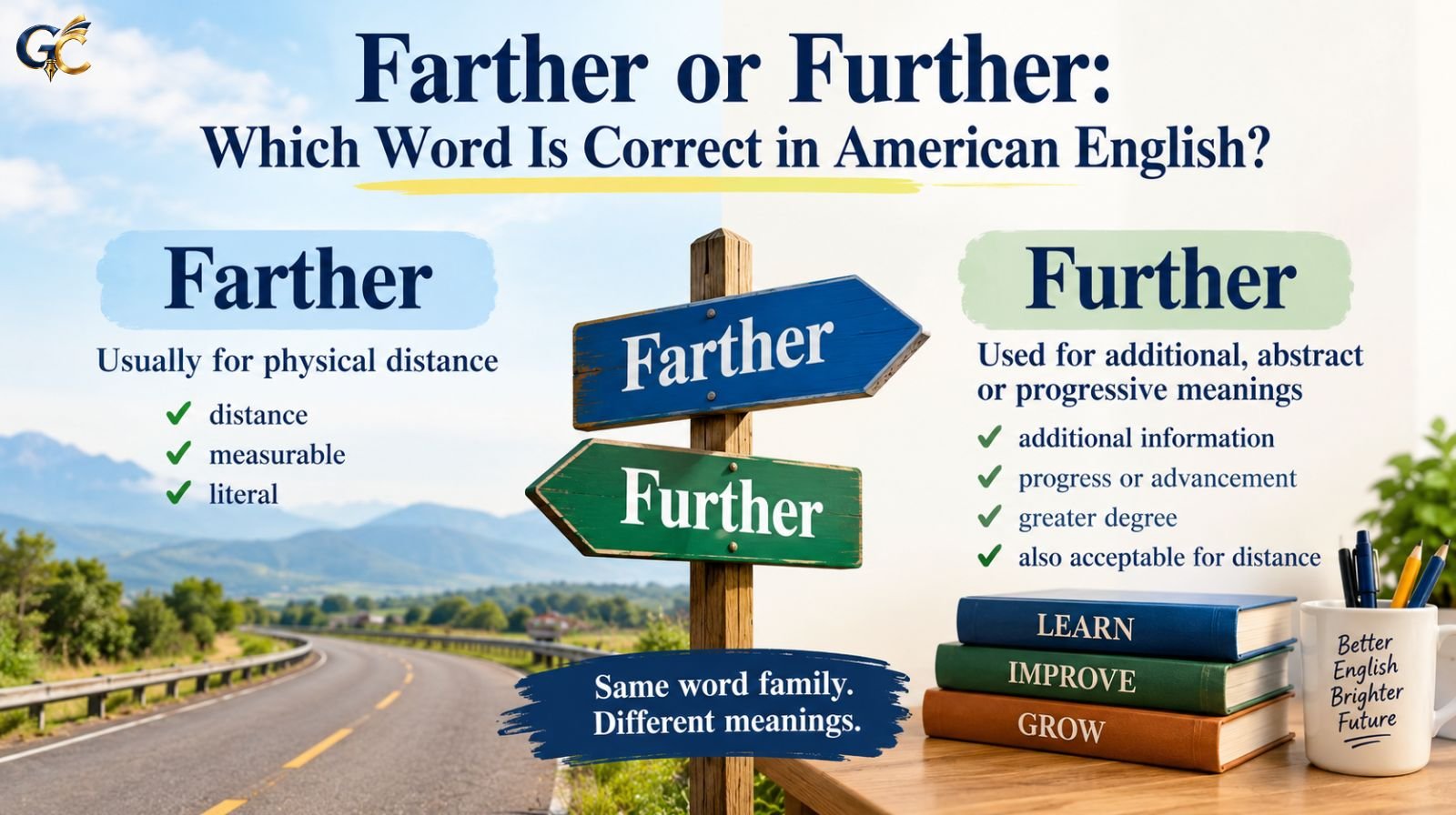
Farther or further which word should you use? If you’re talking about physical distance, farther is usually the preferred choice in American English. If you’re talking about something abstract, additional information, progress, or a greater degree, further is generally the better choice.
However, the distinction isn’t always absolute. Both words can refer to distance, and modern dictionaries recognize considerable overlap between them. That’s why even experienced writers sometimes hesitate.
In this guide, you’ll learn the practical difference between farther and further, when to use each one, common mistakes to avoid, and an easy rule that will help you choose the right word in American English.
Farther vs. Further: The Quick Answer
If you only need the answer quickly, use this rule:
| Word | Usually used for | Example |
|---|---|---|
| Farther | Physical or measurable distance | We drove farther than expected. |
| Further | Additional information, progress, degree, or abstract ideas | We need further information. |
| Further | Can also describe physical distance | We walked further down the road. |
| Further | Verb meaning “advance” or “promote” | The program will further her career. |
So, in careful American English, farther is a useful choice for literal physical distance, while further is the safer choice for figurative or additional meanings.
That said, further is also widely accepted for physical distance, so using it in a sentence such as “We walked further down the road” is not automatically wrong. Oxford specifically notes that both forms can be used for distance, while farther and farthest are more common in North American English.
What Does “Farther” Mean?
Farther is the comparative form of far. In American English, it is especially useful when you’re talking about physical distance that can be imagined or measured.
Farther for Physical Distance
Use farther when something is located at a greater physical distance or when someone travels a greater physical distance.
For example:
- We drove farther than we planned.
- The airport is farther from here than I thought.
- She ran farther than anyone else on the team.
- How much farther is the next town?
- The store is farther away than the library.
A helpful test is to ask yourself:
Can I measure or visualize the distance?
If the answer is yes, farther is often the clearest choice.
For example, you can measure the distance between your home and a store in miles or kilometers:
The new supermarket is farther from my house.
Farther in American English
American English traditionally makes a stronger distinction between farther and further than some other varieties of English.
Oxford’s American English reference says that both words can describe distance but notes that farther and farthest are more common in North American English for distance.
Therefore, if you’re writing an American English article, school assignment, business document, or formal piece of writing, farther is a very safe choice when the meaning is clearly physical distance.
Examples of Farther
Consider these sentences:
The second gas station is farther down the highway.
We walked farther than we expected.
New York is farther from Los Angeles than Chicago is.
I can’t see farther than a few feet in this fog.
In each case, the idea of distance is concrete and easy to visualize.
What Does “Further” Mean?
Further has a broader range of meanings. It can refer to distance, but it is also commonly used to mean additional, more, to a greater degree, or to a more advanced stage.
Further for Additional Information
Use further when you mean additional or more.
For example:
- Please provide further information.
- We need further evidence.
- Do you have any further questions?
- No further action is required.
- The company requested further details.
You would not normally write:
Please provide farther information. ❌
The natural choice is:
Please provide further information. ✅
Cambridge lists further in American English as meaning “more” or “extra,” including expressions such as “further information” and “further questions.”
Further for Abstract Ideas and Progress
Further is also used when you’re talking about ideas, discussions, development, progress, or degrees rather than physical space.
For example:
Let’s discuss the issue further.
We need to investigate the matter further.
The company wants to further its research.
She decided to take her education further.
Here, nobody is talking about physical miles or feet. The meaning is closer to more deeply, to a greater degree, or to a more advanced stage.
Further as a Verb
One important difference is that further can function as a verb, while farther cannot normally be used this way.
As a verb, further means to help something progress, develop, or succeed.
Examples:
The scholarship will further his education.
She took several courses to further her career.
The organization works to further its mission.
This is one of the easiest ways to know that further is correct.
Farther or Further: What’s the Real Difference?
The traditional American English rule is simple:
Farther = physical distance
Further = figurative distance, additional information, progress, or greater degree
But real-world English is slightly more flexible.
Farther vs. Further Examples
Compare these sentences:
We walked farther down the trail.
The emphasis is on physical distance.
We discussed the issue further.
The emphasis is on continuing or deepening a discussion.
Now consider:
We walked further down the trail.
This sentence is also acceptable. Modern dictionaries recognize further as a word that can refer to physical distance. Cambridge explicitly states that farther and further can both be used for distance.
That’s why saying “further is always wrong for physical distance” would be too strict.
A Simple Comparison
| Situation | Preferred Word | Example |
|---|---|---|
| Measurable physical distance | Farther | We drove farther today. |
| Additional information | Further | I need further information. |
| More discussion | Further | Let’s discuss this further. |
| Greater degree | Further | The problem became further complicated. |
| Progress or advancement | Further | This will further our goals. |
| Physical distance where either is accepted | Farther / Further | We walked farther/further down the road. |
| Verb meaning “advance” | Further | This may further her career. |
The Easy Memory Trick
Here’s a simple trick:
Farther contains “far.”
So, when you’re thinking about actual physical distance, farther is easy to remember.
We traveled farther.
For everything involving additional information, progress, degree, or advancement, think further.
We need further information.
This isn’t an absolute grammatical law, but it’s an extremely useful rule for everyday American English writing.
Case Study: Choosing Between Farther and Further in Real Writing
Imagine that an American employee is writing a report about a company’s new delivery system.
The employee wants to say that the new distribution center is located at a greater physical distance from the company’s main office. The original sentence reads:
“The new distribution center is further from our headquarters than the previous location.”
Is this sentence wrong?
No. The sentence is understandable and accepted because further can refer to physical distance. Cambridge and Oxford both recognize this broader use.
However, if the company follows a traditional American English style that prefers farther for physical distance, the editor might change it to:
“The new distribution center is farther from our headquarters than the previous location.”
This version makes the physical-distance meaning especially clear.
Later in the same report, the employee writes:
“The management team requested farther information about delivery costs.”
This time, the editor should change farther to further:
“The management team requested further information about delivery costs.”
Why? Because “information” isn’t a physical distance. Further means “additional” here.
The report might also say:
“The team will investigate the problem further.”
Again, further is correct because the team is continuing an investigation.
Finally, the report could state:
“The new training program is designed to further employee development.”
Here, further is a verb meaning to advance or promote something.
This example shows why the distinction is useful even though English usage overlaps. Instead of treating the words as completely interchangeable, consider what kind of “distance” you mean: physical distance, additional information, or progress.
What Do Current 2025–2026 References Say?
There isn’t a reliable 2025–2026 usage statistic from a major English-language corpus that gives a simple percentage split between farther and further. Therefore, it would be misleading to invent a current percentage.
However, current dictionary and reference evidence gives us a clear picture.
Current Reference Evidence
Oxford Advanced American English: Oxford’s current reference material says that both farther and further can refer to distance, while farther and farthest are more common in North American English. It also says further is preferred for degree or extent and can mean “more” or “additional.”
Collins, 2025 edition: Collins’ American English entry in the Webster’s New World College Dictionary, 5th Digital Edition (2025) recognizes farther as referring to greater distance while noting that further is more commonly used in some adverbial senses.
Cambridge, current 2026 reference: Cambridge explains that farther and further can both describe distance, while further also carries meanings such as “more,” “extra,” and “to a greater degree.”
So, the 2025–2026 evidence supports a flexible but useful distinction, rather than an absolute rule:
- Farther → preferred for clear physical distance in American English.
- Further → preferred for additional, abstract, or progressive meanings.
- Further → also acceptable for physical distance in many contexts.
This approach is more accurate than claiming that one word is always correct and the other is always wrong.
Common Mistakes With Farther and Further
Mistake 1: Using “Farther Information”
A common error is:
Please send me farther information. ❌
Use:
Please send me further information. ✅
Here, further means “additional.”
Mistake 2: Assuming “Further” Is Always Wrong for Distance
Some writers believe:
We walked further down the road. ❌
That’s too strict.
Further can be used for physical distance, and major dictionaries recognize that usage.
However, if you’re deliberately following the traditional American distinction, you can write:
We walked farther down the road. ✅
Mistake 3: Using “Farther” as a Verb
Don’t write:
This program will farther our goals. ❌
Use:
This program will further our goals. ✅
Further can be a verb meaning “advance” or “promote.” Farther does not have this standard verb use.
Mistake 4: Treating the Rule as Absolute
The biggest mistake is believing that English has a perfect dividing line between the two words.
It doesn’t.
Historical and modern usage shows considerable overlap. Collins notes that farther and further have been used interchangeably in many contexts throughout their history.
Therefore, the traditional distinction is best understood as a helpful usage guideline, especially for American English, rather than an unbreakable grammatical law.
How to Choose the Right Word Every Time
Use this three-step method.
Step 1: Ask Whether You’re Talking About Physical Distance
If you’re describing something that can be measured in miles, feet, kilometers, blocks, or similar units, choose farther when you want the clearest traditional American English choice.
The hotel is farther away.
Step 2: Ask Whether You Mean “Additional” or “More”
If the word means additional, more, or to a greater degree, choose further.
We need further evidence.
Let’s discuss the matter further.
Step 3: Check Whether “Further” Is a Verb
If you mean advance, promote, or help develop, the answer is always further.
Education can further your career.
This quick process will solve most farther-versus-further questions.
FAQs
Q1: Is farther or further correct in American English?
A: Both are correct, but they are traditionally used differently. Farther is commonly preferred for physical or measurable distance, while further is preferred for additional information, abstract ideas, degree, and progress. However, further can also describe physical distance.
Q2: Is “farther” only used for physical distance?
A: No. Although farther is strongly associated with physical distance, actual English usage is more flexible. Some dictionaries recognize broader uses. Still, further is generally the better choice for abstract meanings.
Q3: Is “further” correct for physical distance?
A: Yes. Further can refer to physical distance, and modern dictionaries explicitly recognize this use. For example, “We walked further down the road” is acceptable.
Q4: Which is correct: “farther information” or “further information”?
A: Further information is correct.
Please contact us for further information.
Here, further means additional, not physical distance.
Q5: Which is correct: “go farther” or “go further”?
A: Both can be correct. If you’re emphasizing physical distance, go farther is the traditional American English choice:
We need to go farther before we stop.
But go further is also widely used, especially when the meaning involves progressing to another stage or degree.
Q6: Can “further” be a verb?
A: Yes. Further can be a verb meaning to advance, promote, or help something develop.
The program will further scientific research.
There is no corresponding standard verb farther.
Q7: Which sounds more American: farther or further?
A: For physical distance, farther is traditionally more associated with North American English. Oxford specifically notes that farther and farthest are more common in North American English for distance.
Q8: Is there a difference between farther and further in British English?
A: The distinction is generally less strict in British English. Further is commonly used for physical distance as well as abstract meanings. Cambridge notes that the two words can both refer to distance.
Final Verdict:
So, farther or further which word is correct in American English?
The best practical answer is:
Use “farther” for physical or measurable distance, and “further” for additional information, abstract ideas, greater degree, or progress.
For example:
We drove farther than expected.
We need further information.
Let’s discuss the issue further.
The new program will further our research.
But remember that further is also acceptable for physical distance, so sentences such as “We walked further down the road” aren’t automatically incorrect. Current Oxford, Cambridge, and Collins references all reflect this overlap.
If you’re writing specifically for an American English audience and want the clearest traditional distinction, simply remember:
Farther = physical distance.
Further = additional, abstract, or advanced.
That rule will help you make the right choice in most everyday, academic, professional, and online writing situations.
👉 Explore more useful grammar tips and guides on Grammar Clear

Zia Ahmad is the founder of GrammarClear, an educational platform dedicated to making English grammar simple and easy to understand. Through clear explanations and practical examples, he aims to help learners improve their grammar, writing, and communication skills with confidence.

