
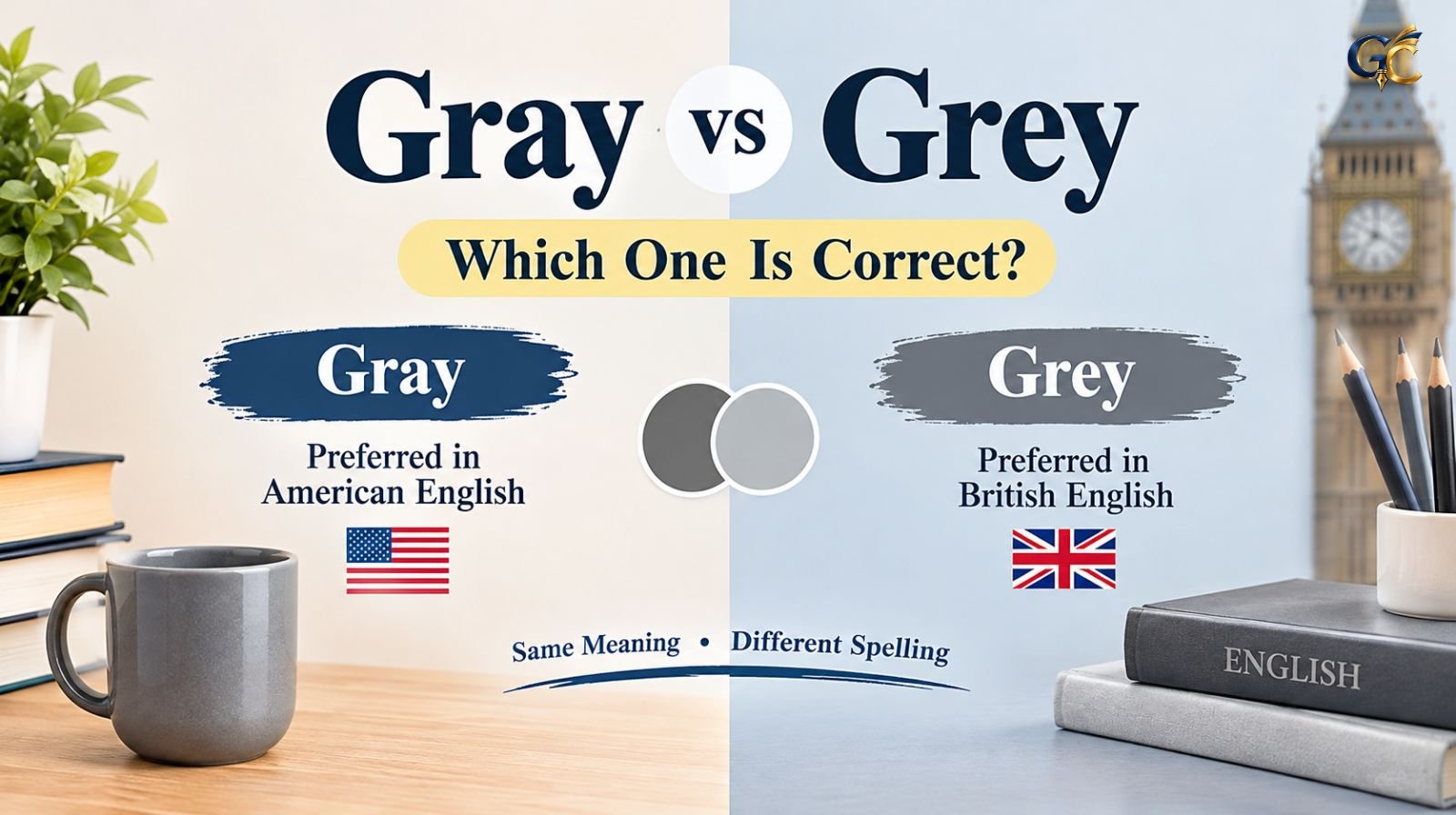
Have you ever wondered whether to write Gray vs Grey You may see both spellings in books, websites, school assignments, and everyday conversations. So, which one is correct?
The answer is simple: both gray and grey are correct spellings of the same color. The main difference is regional. Gray is the standard spelling in American English, while grey is generally preferred in British English and is also common in other varieties of English.
In this guide, you will learn the difference between gray vs grey, understand when to use each spelling, explore practical examples, and discover an easy way to remember the difference.
What Is the Difference Between Gray and Grey?
The difference between gray and grey is primarily a matter of spelling preference, not meaning. Both words describe a color between black and white, and both can be used as nouns, adjectives, and verbs.
Gray Is Preferred in American English
In the United States, gray is the usual spelling. You will commonly find it in American books, newspapers, educational materials, and product descriptions.
Examples:
- The sky turned gray before the storm.
- She bought a gray winter coat.
- His hair is beginning to gray.
If you are writing for an American audience, choosing gray is generally the safest option.
Grey Is Preferred in British English
In British English, grey is generally the preferred spelling. It is also widely used in countries and publications that follow British spelling conventions.
Examples:
- The sky was grey all morning.
- He wore a grey suit to the meeting.
- Her hair began to grey with age.
Both spellings communicate the same idea. The important thing is to follow the spelling convention appropriate for your audience.
Gray vs Grey at a Glance
| Feature | Gray | Grey |
|---|---|---|
| American English | Preferred | Accepted variant |
| British English | Less common | Generally preferred |
| Meaning | Color between black and white | Color between black and white |
| Pronunciation | /ɡreɪ/ | /ɡreɪ/ |
| Correct spelling? | Yes | Yes |
The easiest rule to remember is this: gray for America, grey for Britain.
Why Are Gray and Grey Both Correct?
English spelling developed over centuries, and some words retained different spellings in different regions. Gray and grey are examples of this variation.
A Brief History of the Two Spellings
Both forms have historical roots in older forms of English. Over time, American and British spelling conventions developed different preferences for certain words.
Unlike some spelling differences that involve changes in pronunciation or meaning, gray and grey are pronounced the same way in modern English.
The distinction is therefore mostly a regional spelling preference rather than a difference in definition.
Do Gray and Grey Describe Different Colors?
No. In ordinary modern English, both words refer to the same general color.
For example:
- A gray wall and a grey wall can be exactly the same shade.
- A gray cat and a grey cat have the same description.
- A gray sky and a grey sky both suggest cloudy or dull weather.
Sometimes people associate the two spellings with slightly different shades, but this is not a standard distinction in everyday English.
Are There Exceptions to the Regional Rule?
Yes. Proper names, brand names, titles, and established expressions may use one spelling regardless of the region.
For example, Fifty Shades of Grey is the established title of the novel by E. L. James. Its spelling should remain unchanged when you refer to the book.
Similarly, if a person’s name is spelled Gray or Grey, you should preserve that exact spelling rather than changing it to match a regional convention.
When Should You Use Gray or Grey?

Choosing the right spelling is easy once you know your audience and purpose. The best approach is to follow the spelling standards used by your intended readers.
Use Gray for American English
Choose gray when writing content for readers in the United States, especially when consistency with American English is important.
Examples:
- The gray clouds covered the city.
- I prefer gray furniture for my office.
- The company introduced a new gray smartphone.
- The gray paint matched the kitchen cabinets.
For an American English blog, using gray consistently is a sensible editorial choice.
Use Grey for British English
Choose grey when writing for a British audience or following a style guide that prefers British spelling.
Examples:
- The grey clouds covered London.
- She wore a grey scarf.
- The living room has grey walls.
- The old man had a grey beard.
The same guidance generally applies to other audiences that prefer British spelling, although local conventions can vary.
Follow One Spelling Style Throughout Your Article
Consistency matters more than switching between the two forms unnecessarily.
Imagine writing an article that begins with “gray walls,” later mentions “grey furniture,” and ends with “gray paint.” Unless there is a specific reason for the variation, this can look like an editing mistake.
Use this simple checklist:
- Identify your target audience.
- Choose American or British English.
- Use gray for standard American spelling.
- Use grey for standard British spelling.
- Preserve established spellings in names and titles.
- Check your final draft for consistency.
Following these steps will help your writing look more polished and professional.

Real-Life Example: Choosing Gray vs Grey for a Blog
Consider a blogger who writes home décor articles for an international audience. The blogger plans to publish an article about choosing neutral paint colors for bedrooms, living rooms, and kitchens.
At first, the blogger uses both spellings without a clear plan. One paragraph recommends “gray bedroom walls,” another describes “grey kitchen cabinets,” and a third suggests pairing “gray furniture” with white curtains.
Although the article is understandable, the inconsistent spelling may distract careful readers. The blogger decides to review the target audience before editing the article.
If most readers are in the United States, the blogger chooses gray throughout the article. The revised content includes phrases such as “gray bedroom walls,” “gray kitchen cabinets,” and “gray furniture.” If the same article is adapted for a British publication, the blogger can use grey instead.
However, the blogger does not change proper names or established titles that contain one spelling. For example, a product name officially written as “Grey Mist” should retain that name even in an American article.
The blogger also updates the headings, image captions, and any relevant descriptions to match the chosen spelling style.
The lesson: Good editing is not about treating one spelling as universally correct. It is about understanding regional conventions, respecting established names, and making deliberate choices. This approach makes articles easier to read and helps maintain a consistent editorial voice.
Gray vs Grey: Usage Trends and Reliable References

As of 2026, the standard distinction remains the same: gray is preferred in American English, while grey is generally preferred in British English. Both forms remain valid, so writers do not need to treat either one as a universal spelling error.
Is There Reliable 2025–2026 Search Data?
There is no verified numerical search-volume or spelling-frequency dataset presented here that establishes how many people searched for “gray” versus “grey” during 2025–2026. It would be misleading to invent percentages or claim that one spelling receives more searches without supporting data.
Instead, the following reference-based facts provide a reliable guide:
- American English: Gray is the preferred spelling.
- British English: Grey is generally preferred.
- Pronunciation: Both are pronounced the same way.
- Meaning: Both refer to the same general color.
- Editorial practice: Choose a regional style and apply it consistently.
For writers, these distinctions are more useful than an unsupported claim about which spelling is more popular online.
Trusted Sources for Further Reading
- Oxford English Dictionary: Grey Explains the word’s history and regional spelling differences.
- LanguageTool: Gray or Grey? Provides a practical explanation of American and British usage, with examples.
- Google Search Central: Creating Helpful, Reliable, People-First Content Offers guidance on creating useful, accurate, reader-focused content.
These sources support accurate spelling guidance and good editorial practices. Google does not guarantee rankings for an article simply because it follows a particular word choice or SEO structure.
FAQs
Q1: Is gray or grey correct?
A: Both are correct. Gray is preferred in American English, while grey is generally preferred in British English.
Q2: Is grey the British spelling?
A: Yes. Grey is the generally preferred British spelling, although individual writers and publications may vary.
Q3: Is gray the American spelling?
A: Yes. Gray is the standard American spelling and is the usual choice for writing intended for readers in the United States.
Q4: Do gray and grey mean different things?
A: No. In everyday English, they have the same meaning and describe the same general color. Any distinction between them is primarily regional spelling preference.
Q5: How do you remember gray vs grey?
A: Use this simple memory trick: America has an A, and gray has an A. England has an E, and grey has an E.
This is an easy reminder of the usual regional preferences.
Q6: Is grey acceptable in American English?
A: Yes. Although gray is preferred in American English, grey is also recognized as a variant. However, American writers should generally use gray for consistency.
Q7: Should I use gray or grey in an SEO article?
A: Choose the spelling that matches your target audience. Use gray for standard American English content and grey for standard British English content. You can mention both forms naturally when explaining the difference, but avoid unnecessary repetition.
Q8: Which spelling should I use in school or professional writing?
A: Follow your teacher’s, employer’s, publisher’s, or organization’s style guide. If no specific rule is provided, use the regional spelling convention appropriate for your audience and stay consistent.
Conclusion:
When comparing gray vs grey, remember that both spellings are correct. The difference is mainly regional: gray is preferred in American English, while grey is generally preferred in British English.
If you are writing for an American audience, choose gray. If your readers follow British English conventions, choose grey. In either case, keep your spelling consistent and preserve the original spelling of proper names and titles.
Now that you understand the difference, you can use both forms with confidence.
👉 Discover more simple and practical grammar guides on Grammar Clear

Zia Ahmad is the founder of GrammarClear, an educational platform dedicated to making English grammar simple and easy to understand. Through clear explanations and practical examples, he aims to help learners improve their grammar, writing, and communication skills with confidence.

