
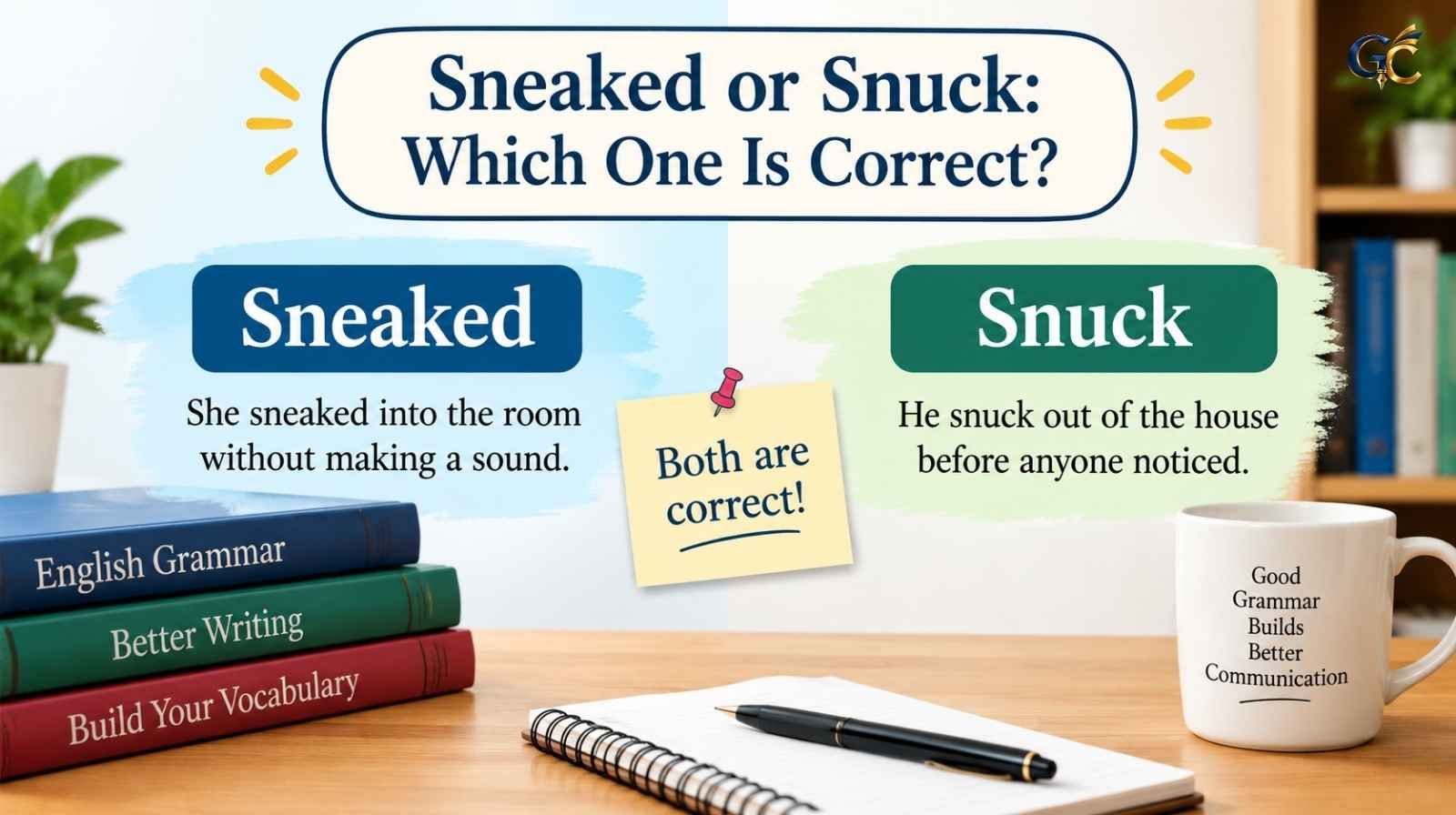
Have you ever wondered whether to write sneaked or snuck when describing someone moving quietly or doing something secretly? Both words are correct, but choosing the right one can sometimes be confusing.
The difference between sneaked and snuck mainly comes down to verb usage, writing style, and regional preferences. Sneaked is the traditional past tense of sneak, while snuck is a widely accepted alternative, especially in American English.
In this guide, you will learn what each word means, how to use them correctly, and which form works best in everyday conversations, professional writing, and different contexts.
What Is the Difference Between Sneaked and Snuck?
Both sneaked and snuck are past-tense forms of the verb sneak. They describe moving quietly, secretly, or carefully to avoid being noticed.
Meaning of Sneaked
Sneaked is the regular past-tense form of sneak. It follows the common English pattern of adding -ed to a verb to describe an action that happened in the past.
Examples:
- She sneaked into the kitchen to get a snack.
- He sneaked out of the house after everyone fell asleep.
- The cat sneaked past the sleeping dog.
In each example, sneaked describes an action that happened in the past.
Meaning of Snuck
Snuck is an alternative past-tense form of sneak. It developed through irregular verb patterns and is especially common in American English.
Examples:
- She snuck into the kitchen to get a snack.
- He snuck out of the house after everyone fell asleep.
- The cat snuck past the sleeping dog.
These sentences have the same meanings as their sneaked versions.
Which Form Should You Remember?
The easiest rule is that both forms are correct. Use sneaked when you prefer the traditional regular form, or choose snuck when it suits your voice and audience.
Neither form changes the basic meaning of the sentence.
Is Snuck Grammatically Correct?
Yes, snuck is grammatically correct in modern English. Although some people once considered it informal or nonstandard, it has become firmly established in everyday usage and is recognized by major dictionaries.
Why Do People Question Snuck?
English learners often expect past-tense verbs to follow predictable patterns. For example, walk becomes walked, and talk becomes talked. Because sneak can become sneaked or snuck, the second form may seem unusual.
However, English contains many irregular verbs, such as take/took, write/wrote, and speak/spoke. The existence of different verb patterns is a normal feature of the language.
Is Snuck Appropriate for Formal Writing?
Yes. Snuck can be appropriate in formal writing, depending on the context and the publication’s style preferences.
For example:
- Conversational: He snuck away before the meeting ended.
- Traditional style: He sneaked away before the meeting ended.
- Professional narrative: The employee sneaked into the restricted area without authorization.
The final example uses sneaked, but snuck would also be grammatically possible. For academic papers or professional publications, follow any applicable style guide and maintain consistency.
What Do Dictionaries Say?
Major dictionaries recognize snuck as a past-tense form of sneak. This supports its status as an established English word rather than a simple grammatical mistake.
For reliable definitions and usage information, consult Merriam-Webster and Cambridge Dictionary.
Sneaked vs. Snuck: Which Is More Common in American and British English?
The choice between sneaked and snuck can depend on the variety of English you use. Both forms are understood, but their popularity and acceptance vary by region and writing style.
Usage in American English
In American English, snuck is widely used in conversation, fiction, journalism, and everyday writing. Sneaked is also correct and remains a natural choice.
Examples:
- I snuck downstairs to get a glass of water.
- I sneaked downstairs to get a glass of water.
- They snuck into the theater just before the movie started.
All three sentences use the verb correctly.
Usage in British English
In British English, sneaked is traditionally the more familiar form, especially in formal writing. However, snuck is also used and understood.
Examples:
- She sneaked out before the guests arrived.
- He sneaked a quick look at the answer.
- They quietly sneaked past the guard.
If you are writing for a British audience, sneaked is a sensible default when you want to follow traditional usage.
Quick Comparison Table
| Feature | Sneaked | Snuck |
|---|---|---|
| Meaning | Moved or acted secretly | Moved or acted secretly |
| Grammar | Regular past-tense form | Alternative irregular past-tense form |
| American English | Correct | Correct and widely used |
| British English | Traditional and common | Used, but less traditional |
| Formal writing | A safe choice | Acceptable, depending on style |
| Past participle | Sneaked | Snuck |
Real-Life Example: Choosing Between Sneaked and Snuck
Imagine a student named Daniel who is writing a short story for his English class. The story describes how a character enters the kitchen late at night without waking anyone.
Daniel writes the following sentence:
Tom snuck into the kitchen and took a piece of cake.
His classmate tells him that snuck is incorrect and that he must write sneaked instead. Daniel becomes confused because he has heard people use both forms in everyday conversations.
To resolve the disagreement, Daniel checks a reputable dictionary. He discovers that both sneaked and snuck are recognized past-tense forms of sneak. He also learns that snuck is particularly associated with American English.
Daniel now has two grammatically acceptable options:
- Tom sneaked into the kitchen and took a piece of cake.
- Tom snuck into the kitchen and took a piece of cake.
Both sentences communicate the same action. Daniel decides to use snuck because his story uses conversational American English throughout. If his teacher’s instructions required traditional verb forms, he could choose sneaked instead.
This example demonstrates an important grammar lesson: a word should not automatically be considered incorrect simply because it differs from a traditional form. Good writing requires understanding accepted usage, considering the audience, and following any relevant style requirements. Consistency matters more than treating one acceptable form as universally wrong.
What Do Usage Evidence and Recent Data Tell Us?
When deciding between two words, it helps to distinguish documented language usage from unsupported claims about popularity.
What Established Research Shows
The historical record offers useful context. Sneaked appeared first, while snuck emerged in American English in the late nineteenth century. Over time, snuck became an established alternative rather than remaining a passing expression.
Dictionary evidence also supports both forms. Cambridge Dictionary lists sneaked and identifies snuck as an American alternative, while Merriam-Webster discusses both forms as standard English usage.
Is There a Reliable 2025–2026 Usage Statistic?
There is no verified 2025–2026 percentage or count available in the sources reviewed here that establishes exactly how often English speakers use each form. Therefore, assigning a numerical popularity rate would be misleading.
For an accurate comparison, researchers would need a clearly defined corpus of recent written or spoken English, with results separated by region and context. A count from American novels, for example, would not necessarily represent British conversation or formal academic writing.
The practical conclusion is straightforward: both forms are established, but sneaked is the traditional form and snuck is particularly common in American English.
How to Choose the Correct Form in Your Writing
Choosing between sneaked and snuck becomes easier when you consider your audience and the purpose of your writing.
- Identify your audience. For traditional British English, consider sneaked. For conversational American English, either form works.
- Check the writing style. If a teacher, editor, or publication specifies a preferred form, follow that guidance.
- Stay consistent. Avoid switching between forms unnecessarily within the same passage.
| Situation | Example sentence | Suggested choice |
|---|---|---|
| School assignment | She sneaked out of the room. | Sneaked |
| American conversation | He snuck a cookie before dinner. | Snuck |
| Traditional British prose | They sneaked through the gate. | Sneaked |
| Casual storytelling | We snuck backstage after the show. | Either |
| Professional report | The visitor sneaked into the restricted area. | Sneaked |
These are practical recommendations, not absolute rules. If your intended audience accepts both forms, choose the one that best fits your writing voice.
FAQs
Q1: Is sneaked or snuck correct?
A: Both sneaked and snuck are correct past-tense forms of sneak. Sneaked is the regular form, while snuck is an established alternative, particularly in American English.
Q2: Is snuck a real word?
A: Yes. Snuck is a recognized English word listed in major dictionaries. It is not simply a spelling mistake or an invented slang term.
Q3: Is snuck grammatically incorrect?
A: No. Although some people prefer sneaked in formal writing, snuck is an accepted form. When a particular style guide or editor specifies a preference, follow that requirement.
Q4: What is the past tense of sneak?
A: The past tense of sneak can be either sneaked or snuck.
Examples:
- Yesterday, I sneaked into the garden.
- Yesterday, I snuck into the garden.
Both sentences are correct.
Q5: Should I use sneaked or snuck in American English?
A: Both forms are suitable in American English. Snuck is particularly common in everyday speech and informal writing, while sneaked is also widely understood and appropriate.
Q6: Do British people say snuck?
A: Yes, some British English speakers use snuck. However, sneaked remains the more traditional choice in British English, especially for formal writing.
Q7: Is sneaked more formal than snuck?
A: Sneaked is often perceived as the more traditional choice and may be preferred in formal or literary writing. Nevertheless, snuck is established English usage, and its suitability depends on the audience and style requirements.
Q8: What is the past participle of sneak?
A: Both sneaked and snuck can function as past participles.
Examples:
- I have sneaked a look at the document.
- I have snuck a look at the document.
Both constructions are accepted, although preferences may differ by region and style.
Conclusion:
When comparing sneaked or snuck, remember that both words are correct. They share the same meaning and describe moving quietly, secretly, or without attracting attention.
Use sneaked if you prefer the traditional regular past-tense form, especially in formal or traditional British English writing. Choose snuck when it suits your audience, particularly in American English and conversational storytelling.
The most important rule is to understand your audience, follow any applicable style guidance, and write consistently.
👉 Discover more simple and practical grammar guides on Grammar Clear

Zia Ahmad is the founder of GrammarClear, an educational platform dedicated to making English grammar simple and easy to understand. Through clear explanations and practical examples, he aims to help learners improve their grammar, writing, and communication skills with confidence.

