
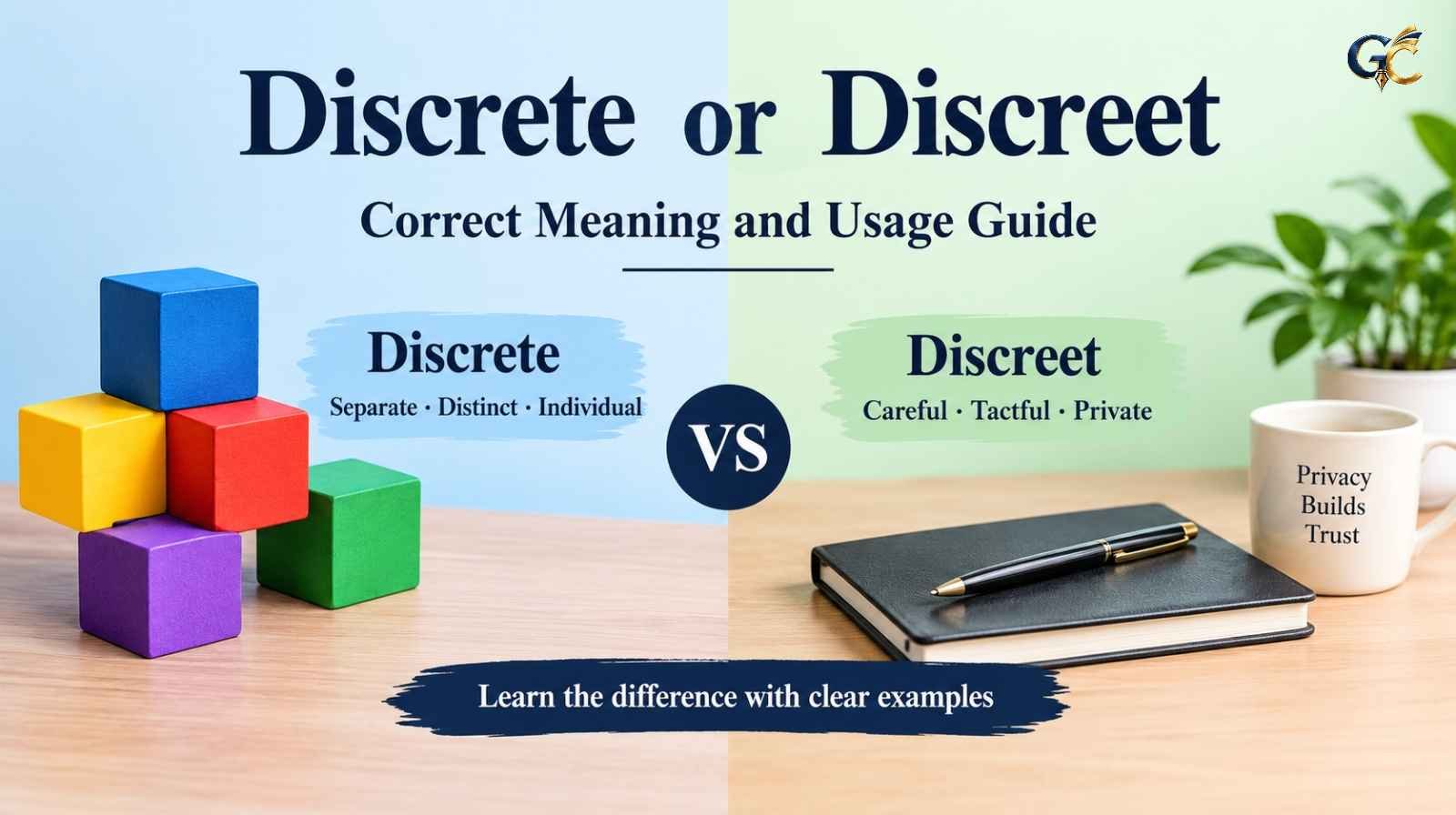
Have you ever confused discrete or discreet while writing an email, completing an assignment, or having a conversation? These two words look and sound almost identical, but they have very different meanings. Choosing the wrong one can change the meaning of your sentence and make your writing less precise.
The difference is simple once you understand their meanings. Discrete means separate, distinct, or individually identifiable, while discreet means careful, tactful, and respectful of privacy.
In this guide, you will learn how to use discrete and discreet correctly, explore practical examples, understand their differences, and discover an easy trick to remember which word belongs in your sentence.
What Is the Difference Between Discrete and Discreet?
The main difference between discrete and discreet is their meaning. Although both words are pronounced the same way in standard English, they serve different purposes in a sentence.
Meaning of Discrete
Discrete is an adjective that describes things that are separate, distinct, or individually distinguishable from one another.
For example:
- The course is divided into five discrete modules.
- The scientist recorded discrete measurements during the experiment.
- Each department operates as a discrete unit within the organization.
In these examples, discrete emphasizes that the modules, measurements, and units are separate or individually identifiable.
Meaning of Discreet
Discreet is an adjective that describes someone who behaves carefully, avoids drawing unnecessary attention, or protects confidential information.
For example:
- Please be discreet about the private conversation.
- The manager was discreet when discussing the employee’s performance.
- She made a discreet inquiry about the job opening.
In each sentence, discreet refers to careful, tactful, or private behavior.
A Quick Comparison
| Word | Meaning | Example |
|---|---|---|
| Discrete | Separate or distinct | The report contains three discrete sections. |
| Discreet | Careful or tactful | He was discreet about the confidential report. |
Quick rule: If you mean separate things, use discrete. If you mean keeping something private or behaving tactfully, use discreet.
When Should You Use Discrete?
Use discrete when discussing individual items, distinct categories, separate stages, or units that can be distinguished from one another. It appears frequently in mathematics, science, technology, education, and everyday writing.
Discrete in Everyday English
In everyday communication, discrete helps explain that several things are separate rather than combined into one.
Examples:
- The project has four discrete stages.
- We identified two discrete problems in the proposal.
- The building contains several discrete office spaces.
- Each student completed a discrete task.
Notice that each sentence emphasizes separation or distinction.
Discrete in Mathematics and Science
The word discrete is especially common in technical contexts.
In mathematics, a discrete variable typically takes distinct, countable values, such as the number of students in a classroom. A continuous variable, by contrast, can take any value within a range, such as a person’s height when measured with sufficient precision.
Examples:
- The survey recorded a discrete number of responses.
- Computer science often uses discrete structures, such as graphs and sets.
- Researchers analyzed discrete data points collected during the study.
These examples demonstrate why discrete is useful when describing individually identifiable values, objects, or categories.
Common Expressions With Discrete
Here are several phrases you may encounter in professional, academic, or technical writing:
- Discrete categories: Separate groups or classifications.
- Discrete variables: Variables that take distinct, countable values in the relevant context.
- Discrete units: Individually distinguishable components.
- Discrete events: Separate occurrences.
- Discrete systems: Systems involving distinct elements or states.
Using discrete correctly makes descriptions more precise and helps readers understand how individual parts relate to a larger whole.
When Should You Use Discreet?
Use discreet when describing a person, action, conversation, or object that avoids unnecessary attention or protects privacy. The word is especially useful in personal communication, professional settings, and situations involving sensitive information.
Discreet in Personal and Professional Situations
Discreet often describes thoughtful behavior that prevents embarrassment or protects someone’s privacy.
Examples:
- Please be discreet about my plans until they are finalized.
- The teacher was discreet when discussing the student’s mistake.
- She asked a discreet question about the company’s hiring process.
- The receptionist handled the visitor’s complaint discreetly.
In professional writing, discreet can communicate respect, confidentiality, and good judgment.
Discreet When Something Is Unnoticeable
Discreet can also describe something designed to avoid attracting attention. It does not always refer to keeping a secret.
Examples:
- The security camera was placed in a discreet location.
- She wore a discreet piece of jewelry to the formal event.
- The hotel provided a discreet entrance for its guests.
- He gave me a discreet signal to leave the room.
In these sentences, discreet means subtle, unobtrusive, or not easily noticed.
Common Expressions With Discreet
These common phrases can help you understand the word more naturally:
- Discreet conversation: A conversation handled privately or carefully.
- Discreet inquiry: A question asked without attracting unnecessary attention.
- Discreet behavior: Conduct that demonstrates tact and good judgment.
- Discreet location: A place that is relatively unobtrusive or private.
- Discreet approach: A careful way of handling a situation.
Remember that discreet describes the manner in which something is done, whereas discrete describes how things are separated or distinguished.
Discrete vs Discreet: Examples, Memory Tricks, and Common Mistakes
Understanding the definitions is helpful, but seeing the words side by side makes the difference even clearer.
| Feature | Discrete | Discreet |
|---|---|---|
| Part of speech | Adjective | Adjective |
| Main meaning | Separate or distinct | Careful or tactful |
| Common context | Mathematics, data, categories | Privacy, behavior, communication |
| Related adverb | Discretely | Discreetly |
| Related noun | Discreteness | Discretion |
| Example | The data contains discrete values. | She handled the matter discreetly. |
Both words are homophones, meaning they are pronounced alike but have different meanings and spellings. Their distinction is well established in dictionaries such as Merriam-Webster and the Cambridge Dictionary.
An Easy Trick to Remember Discrete or Discreet
Try this simple spelling trick:
- DiscrEte: The letter T separates the two E’s. Think of separate or distinct things.
- DiscrEet: The two E’s sit together. Think of being careful, discreet, and respectful of privacy.
Another useful method is to substitute a synonym.
If separate fits your sentence, choose discrete. If tactful, private, or unobtrusive fits, choose discreet.
For example:
- The company has three separate divisions. → Discrete.
- The company handled the complaint tactfully. → Discreetly.
Common Mistakes to Avoid
Here are some frequent errors and their corrections.
| Incorrect sentence | Correct sentence | Why? |
|---|---|---|
| Please be discrete about my secret. | Please be discreet about my secret. | The sentence concerns privacy. |
| The experiment used discreet data points. | The experiment used discrete data points. | The points are distinct. |
| He made a discrete inquiry about her salary. | He made a discreet inquiry about her salary. | The inquiry was tactful. |
| The system contains discreet components. | The system contains discrete components. | The components are separate. |
A useful final check is to identify what the adjective describes. If it describes separate parts or values, use discrete. If it describes careful behavior or something unobtrusive, use discreet.
A Real-Life Example: How One Letter Changes the Meaning
Imagine that Sarah works as an administrative assistant at a growing company. Her manager asks her to prepare a report containing information about three departments: sales, marketing, and customer support.
Sarah writes, “The company has three discreet departments.” Although the sentence may sound reasonable, she has selected the wrong word for her intended meaning. She wants to explain that the departments are separate organizational units, so the correct sentence is, “The company has three discrete departments.”
Later that afternoon, Sarah receives a confidential email about a possible management change. Her colleague asks whether she knows anything about the situation. Sarah replies that she must be careful because the information is private. In this situation, her manager advises her to be discreet when discussing the matter.
The distinction becomes even clearer when Sarah prepares her final report. She writes that the company’s departments operate as discrete units, each with its own responsibilities. She also explains that management handled the proposed changes discreetly to avoid unnecessary speculation among employees.
In this example, both words are correct, but each serves a different purpose. Discrete describes the organizational structure, while discreetly describes how management handles sensitive information.
The lesson is practical: choosing the correct word depends on the meaning you want to communicate, not merely on how the word sounds. By checking whether you mean separation or tact, you can avoid this mistake in emails, reports, assignments, and everyday conversations.
What Current Language References Tell Us (2025–2026)
When learning commonly confused words, reliable dictionary definitions are more useful than unsupported claims about how often people make mistakes.
What the Available Evidence Shows
As of 2026, the established meanings of discrete and discreet remain distinct in major English dictionaries. Cambridge defines discrete in terms of separation and discreet in terms of careful behavior that avoids embarrassment or unwanted attention.
The following points summarize the reliable evidence relevant to this topic:
- Pronunciation: Both words are generally pronounced /dɪˈskriːt/ in standard English.
- Meaning: Discrete means separate or distinct; discreet means tactful, cautious, or unobtrusive.
- Grammar: Both words are adjectives, but their meanings determine which nouns they can appropriately describe.
- Related forms: Discretely and discreteness derive from discrete, while discreetly and discretion are associated with discreet.
Is There a Verified 2025–2026 Statistic About These Words?
There is no verified, authoritative 2025–2026 statistic established here that measures how frequently English writers confuse these exact two words. Therefore, it would be misleading to invent a percentage, search-volume figure, or error rate.
For accurate definitions and additional examples, consult these credible references:
- Merriam-Webster — When to Use Discrete vs. Discreet.
- Cambridge Dictionary — Definition of discrete and Definition of discreet.
- Oxford Learner’s Dictionaries — Definition and examples of discreet.
These references support the definitions and usage guidance in this article. They are more appropriate sources for understanding the words than unverified statistics or general claims about search trends.
FAQs
Q1: What is the main difference between discrete and discreet?
A: Discrete means separate, distinct, or individually identifiable. Discreet means careful, tactful, or respectful of privacy.
Example: “The project has four discrete stages” describes separate stages, while “Please be discreet about the project” asks someone to avoid sharing sensitive information.
Q2: Are discrete and discreet pronounced the same?
A: Yes. In standard English, both words are pronounced /dɪˈskriːt/. They are homophones, so you generally cannot identify which word someone means from pronunciation alone. You must use the context to determine the intended meaning.
Q3: Is it discreet or discrete when talking about privacy?
A: Use discreet when talking about privacy, confidentiality, or tactful behavior.
Correct example: “The employee was discreet about the confidential discussion.”
Use discrete only if you mean separate or distinct.
Q4: What is a discrete example?
A: A discrete example describes something separate or individually distinguishable.
For example: “The researcher divided the participants into three discrete groups.”
The word discrete emphasizes that the groups are distinct from one another.
Q5: What does discreet mean in simple words?
A: Discreet means being careful about what you say or do so you do not reveal private information, embarrass someone, or attract unnecessary attention.
Example: “She was discreet when discussing her friend’s personal problems.”
Q6: What is the difference between discreet and discrete data?
A: Discrete data consists of distinct, countable values, such as the number of books on a shelf. Discreet data is not the usual term for a statistical data type; discreet instead describes careful or unobtrusive behavior.
For example, a researcher may collect discrete data while being discreet about participants’ private information.
Q7: What are the correct adverbs: discretely or discreetly?
A: Both words are correct, but they have different meanings.
- Discretely: Separately or distinctly. Example: “The components were arranged discretely.”
- Discreetly: Carefully or without attracting attention. Example: “She discreetly asked for assistance.”
Choose the adverb according to the meaning of your sentence.
Q8: How can I remember when to use discrete or discreet?
A: Remember that the T in discrete separates the two E’s, helping you associate the word with separation. Discreet has two E’s together and refers to tact, privacy, or careful behavior.
If you are unsure, replace the word with separate or tactful. The synonym that fits your intended meaning will help you choose correctly.
Conclusion:
Choosing between discrete or discreet becomes easy when you focus on the meaning of your sentence.
Use discrete when you mean separate, distinct, or individually identifiable. Use discreet when you mean careful, tactful, private, or unobtrusive.
For example, a company can have discrete departments while its employees remain discreet about confidential discussions. Both words are correct in this sentence because they describe different things.
Before publishing an article, sending a professional email, or completing an assignment, take a moment to check which meaning you intend. This small habit can make your writing clearer, more accurate, and more professional.
👉 Discover more simple and practical grammar guides on Grammar Clear

Zia Ahmad is the founder of GrammarClear, an educational platform dedicated to making English grammar simple and easy to understand. Through clear explanations and practical examples, he aims to help learners improve their grammar, writing, and communication skills with confidence.

