
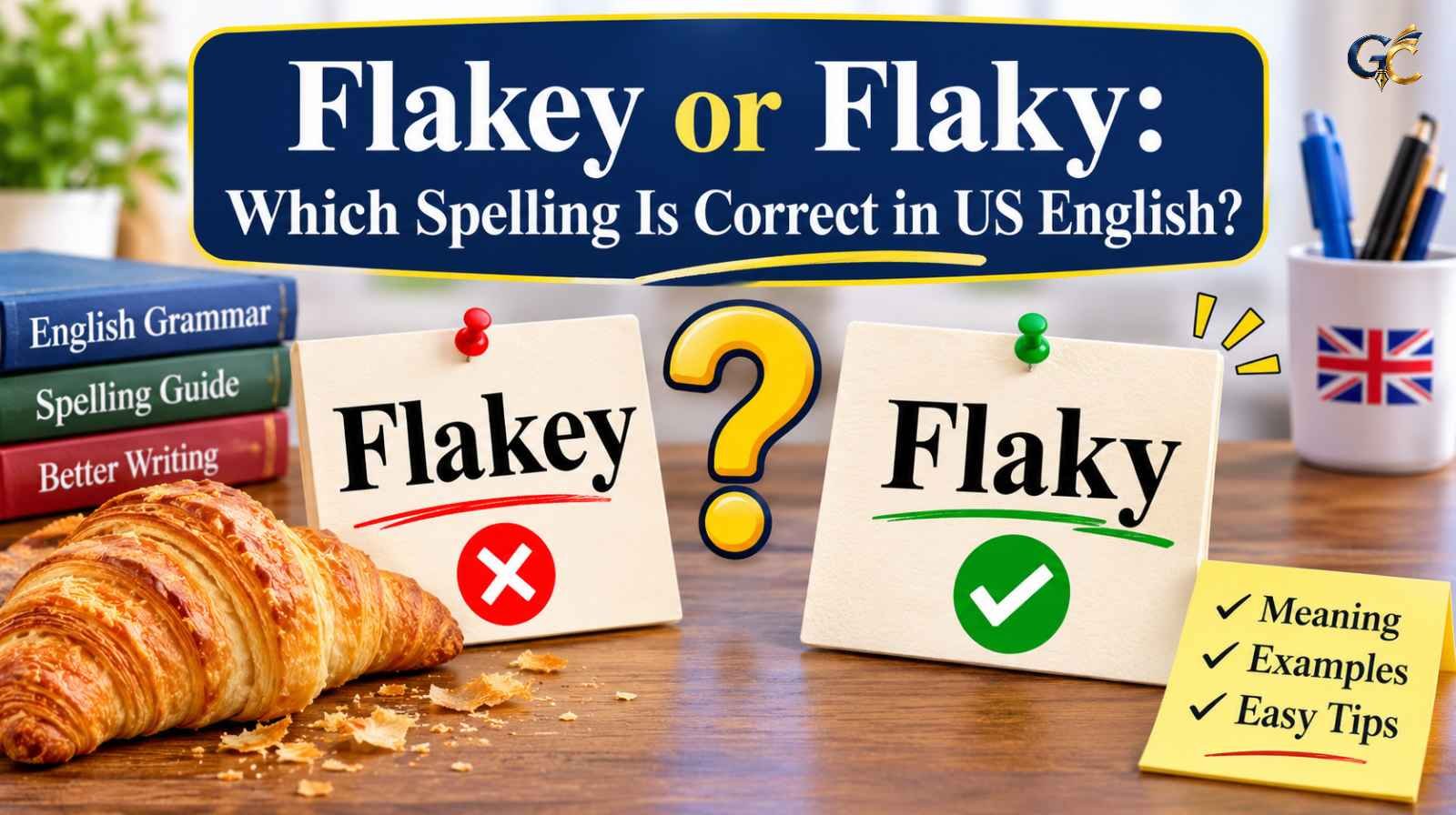
When writing in English, small spelling differences can sometimes create confusion. One common example is flakey or flaky. Both spellings appear in online conversations, informal messages, and everyday writing, but are they equally correct?
If you are writing an email, preparing a report, or describing someone’s unreliable behaviour, choosing the correct spelling helps make your writing clear and professional.
In American English, flaky is the standard and preferred spelling. Although flakey is sometimes used informally, it is generally considered a less common variant.
Let’s explore the meanings, spelling rules, differences, and practical examples to understand when and how to use each form.
Flaky or Flakey: Which Spelling Is Correct?
The correct and preferred spelling in US English is flaky.
The word flaky is commonly used to describe something that breaks into small, thin pieces, has a light and crumbly texture, or refers to someone who behaves unpredictably or cannot be relied upon.
The spelling flakey is occasionally found in informal writing, but it is not the standard choice in American English.
For example:
- Correct: The bakery sells delicious flaky pastries.
- Less common: The bakery sells delicious flakey pastries.
If you want to follow standard American English spelling conventions, always choose flaky.
What Does Flaky Mean?
Flaky is an adjective with several meanings depending on the situation. It can describe the texture of food, the condition of a surface, or a person’s behaviour.
Here are the most common meanings.
Flaky Means Easily Breaking into Thin Pieces
When describing food or other materials, flaky refers to something that separates or breaks into small, thin layers or pieces.
For example:
- The chef prepared a flaky pie crust for dessert.
- These biscuits have a light and flaky texture.
- The pastry was so flaky that it broke apart when I touched it.
In cooking, this word is particularly common when discussing pastries, biscuits, croissants, and pie crusts.
Flaky Means Unreliable or Inconsistent
The word flaky can also describe someone who frequently cancels plans, forgets commitments, or behaves unpredictably.
For example:
- Daniel is a little flaky because he often forgets our meetings.
- My neighbour is friendly but sometimes unreliable.
- I stopped making plans with him because his behaviour was too flaky.
This meaning is generally informal and is commonly used in everyday American conversations.
Flaky Describes Something Unstable or Unpredictable
Sometimes, flaky describes technology, systems, or situations that do not work consistently.
For example:
- The office Wi-Fi connection has been flaky all morning.
- We cannot depend on this flaky software during important meetings.
- The internet connection becomes flaky whenever it rains.
In these situations, the word suggests that something works occasionally but cannot be trusted to perform consistently.
What Does Flakey Mean?
Flakey is a less common spelling variant of flaky. It is sometimes used in informal writing, but it is not the preferred spelling in standard American English.
Its intended meaning is generally the same as flaky. However, using flakey in professional, academic, or formal writing is not recommended.
For example:
- The restaurant serves flaky biscuits.
- The restaurant serves flakey biscuits.
Both versions may be understood, but flaky is the standard spelling.
If you are writing a business email, school assignment, article, or professional document, choosing flaky is the safer option.
Flaky vs Flakey: What Is the Difference?

The main difference between flaky and flakey is their spelling and standard usage.
Both forms are associated with the same meaning, but they are not equally preferred in modern American English.
| Feature | Flaky | Flakey |
|---|---|---|
| Standard US spelling | Yes | No |
| Meaning | Crumbly or unreliable | Generally the same |
| Formal writing | Recommended | Not recommended |
| Informal writing | Common | Occasionally used |
| Preferred choice | Yes | No |
The important thing to remember is that flaky is the standard spelling.
You do not need to change the meaning of your sentence when choosing between these forms. Simply use the accepted spelling to make your writing more consistent.
Why Is Flaky the Correct Spelling in American English?
English spelling contains many words that end in -y, even when their root words have different endings.
For example:
- Flake → Flaky
- Smoke → Smoky
- Ice → Icy
- Grease → Greasy
- Shine → Shiny
The word flaky follows a familiar English spelling pattern.
It comes from the noun flake, which refers to a small, thin piece of something. By adding the suffix -y, the word becomes an adjective describing something that has flakes or a flaky quality.
This is why flaky is the established spelling.
Although people sometimes add an extra letter e and write flakey, this does not make it the preferred standard form.
Real-Life Examples of Flaky in Different Situations
Understanding a word becomes easier when you see how people use it in everyday situations.
Here are some realistic examples of flaky in different contexts.
Using Flaky in a Business Email
Imagine that an employee needs to inform a colleague about an unreliable internet connection during an online meeting.
Hi Michael,
I wanted to let you know that our office internet connection has been quite flaky this morning. I experienced several interruptions during the team meeting, which made it difficult to follow the discussion. Hopefully, the connection will become stable soon. I’ll share the meeting notes once everything is back to normal.
Best regards,
Emily Carter
In this example, flaky describes an internet connection that does not work consistently.
Using Flaky When Talking About Food
Imagine that Sarah is reviewing a bakery after trying one of its freshly baked croissants.
For example:
“Yesterday, I visited a new bakery downtown. Their croissants were delicious, with a beautifully flaky exterior and a soft, buttery centre. I would definitely recommend trying them.”
Here, flaky describes the light, layered texture of the croissants.
Using Flaky in Everyday Conversation
Imagine that two friends are discussing someone who frequently cancels plans.
For example:
Olivia: Are you still meeting James this evening?
Emma: I’m not sure. He’s been quite flaky lately and has cancelled our last two plans.
Olivia: Hopefully, he shows up this time!
In this conversation, flaky describes someone who is unreliable about keeping plans.
Using Flaky in a School Assignment
A student is writing a short paragraph about baking techniques.
For example:
“A good pie crust should have a light and flaky texture. Using cold butter and handling the dough gently can help create delicate layers.”
In this example, the word describes the texture of a properly prepared pie crust.
Using Flaky When Describing Technology
Imagine that a company employee is explaining a technical problem to the IT department.
For example:
“Hello David,
The application has been quite flaky since the latest update. Sometimes it opens normally, but other times it freezes without warning. Could you please investigate the issue?
Thank you,
Robert”
Here, flaky means that the application behaves inconsistently and does not work reliably.

Common Mistakes to Avoid When Using Flaky and Flakey
Even though these two spellings look almost identical, choosing the standard form is important for clear writing.
Here are some common mistakes to avoid.
Using Flakey in Formal Writing
One common mistake is choosing flakey in professional documents or academic assignments.
Incorrect choice: The company has been dealing with a flakey internet connection.
Better choice: The company has been dealing with a flaky internet connection.
Use flaky to follow standard American English spelling.
Assuming Both Spellings Are Equally Preferred
Just because a spelling appears online does not mean it is the standard form.
Although flakey may appear in informal conversations, flaky remains the preferred spelling.
Confusing Flaky with Similar Words
Some writers confuse flaky with words such as fragile, crumbly, and unreliable.
Although these words can have related meanings, they are not always interchangeable.
- Flaky: Something that breaks into thin pieces or behaves unreliably.
- Fragile: Something easily damaged or broken.
- Crumbly: Something that breaks into small crumbs.
- Unreliable: Someone or something that cannot be depended upon.
Choosing the right word depends on the context of your sentence.
Synonyms of Flaky
Learning synonyms can help you express yourself more clearly and avoid repeating the same word.
Here are some useful alternatives to flaky.
| Synonym | Meaning |
|---|---|
| Crumbly | Easily breaking into small pieces |
| Crispy | Having a firm, crunchy texture |
| Layered | Made up of several layers |
| Fragile | Easily broken or damaged |
| Unreliable | Not dependable |
| Inconsistent | Not behaving or performing regularly |
| Unpredictable | Difficult to anticipate |
For example:
- The pastry has a crumbly texture.
- The computer system is unreliable.
- Her behaviour has been inconsistent lately.
Remember that the best synonym depends on whether you are describing texture, behaviour, or performance.
How to Remember the Correct Spelling: Flaky or Flakey?

If you frequently confuse these spellings, a simple memory trick can help.
Remember this rule:
Flake + Y = Flaky
The original word is flake. When you add -y, you get flaky.
You can also remember these similar spelling patterns:
- Flake → Flaky
- Smoke → Smoky
- Ice → Icy
- Grease → Greasy
Notice that the final e is generally dropped before adding -y in these examples.
This simple pattern can help you remember why flaky is the preferred spelling.
Frequently Asked Questions
1. Is it flaky or flakey?
The standard and preferred spelling in American English is flaky. Flakey is a less common spelling variant, but it is not recommended for formal writing.
2. Is flaky correct in US English?
Yes. Flaky is the correct and standard spelling in US English. It can describe crumbly food, unreliable people, or inconsistent systems.
3. What does flaky mean?
Flaky means easily breaking into thin pieces or layers. It can also describe someone or something that is unreliable, inconsistent, or unpredictable.
4. Is flakey a real word?
Flakey is an occasionally used spelling variant of flaky. However, flaky is the established standard spelling and is the better choice in everyday and professional writing.
5. What is the plural of flaky?
Flaky is an adjective, so it does not have a regular plural form. Its spelling remains the same regardless of whether you describe one or several things.
For example: The bakery sells several flaky pastries.
6. Can I use flaky to describe a person?
Yes. Flaky can describe someone who frequently cancels plans, forgets commitments, or behaves unpredictably.
For example: “Tom is friendly, but he can be quite flaky when making plans.”
7. What is the opposite of flaky?
The opposite depends on the context. When describing a person, possible opposites include reliable, dependable, and consistent. When describing food, the opposite might be soft or smooth, depending on its texture.
8. Is flaky formal or informal?
Flaky is acceptable in standard English, but its use to describe an unreliable person is generally informal. It is also commonly used in food descriptions and technical conversations.
Conclusion:
When deciding between flaky or flakey, remember that flaky is the standard and preferred spelling in American English.
The word can describe food that breaks into delicate layers, a person who frequently cancels plans, or technology that does not work consistently.
Although flakey occasionally appears in informal writing, it is better to use flaky in emails, articles, school assignments, business documents, and everyday communication.
The easiest way to remember the correct spelling is flake + y = flaky.
So, whenever you are unsure which spelling to choose, go with flaky. It is the reliable choice for clear and correct American English.
👉 Discover more simple and practical grammar guides on Grammar Clear

Zia Ahmad is the founder of GrammarClear, an educational platform dedicated to making English grammar simple and easy to understand. Through clear explanations and practical examples, he aims to help learners improve their grammar, writing, and communication skills with confidence.

