
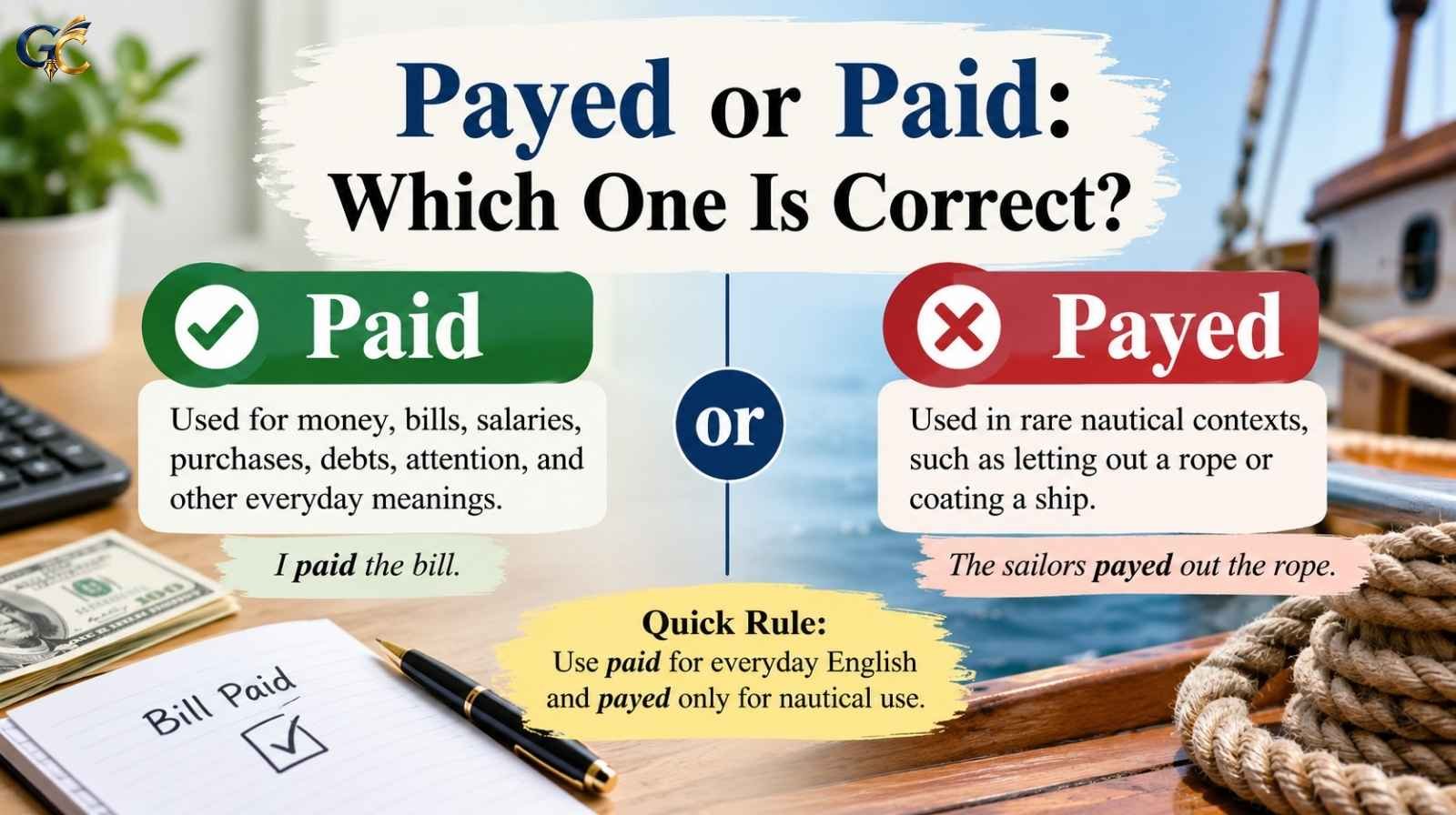
If you are wondering whether payed or paid is the correct spelling, you are not alone. These two words look almost identical and sound the same, so it is easy to assume that payed is simply the regular past tense of pay. However, English has an important exception here.
In everyday English, paid is the correct spelling when you are talking about money, bills, salaries, purchases, debts, attention, or similar meanings. Payed does exist, but it is a rare and specialized form mainly associated with nautical language, such as letting out a rope or coating part of a ship.
So, if you wrote “I payed the bill,” the correct sentence is “I paid the bill.”
This guide explains the difference between payed and paid, shows when each word is used, and gives you an easy rule to remember.
What Is the Correct Spelling: Payed or Paid?
The answer is simple for almost all everyday situations:
Paid is the correct past tense and past participle of “pay” when you mean giving or receiving money or dealing with the ordinary meanings of “pay.”
For example:
- I paid the bill yesterday.
- She paid for dinner.
- We have paid the fee.
- He paid his employees on Friday.
- They paid attention during the meeting.
The verb pay is irregular. Instead of adding -ed to form payed, its ordinary past form changes to paid.
Paid Is the Standard Everyday Form
Use paid when talking about financial transactions, compensation, debts, expenses, or common expressions involving pay.
For example:
Maria paid for the groceries.
Not:
Maria payed for the groceries.
Similarly:
The company paid its workers on time.
Not:
The company payed its workers on time.
Cambridge Dictionary identifies paid as the past simple and past participle of pay, while Oxford also lists paid as the past form of the verb pay.
Why Does “Payed” Look Correct?
The confusion is understandable. Many English verbs form their past tense by adding -ed:
- work → worked
- walk → walked
- play → played
- clean → cleaned
Therefore, it may seem logical that:
- pay → payed
But pay is an irregular verb in its ordinary meanings:
- pay → paid
- paid → paid
That is why “I payed the bill” is incorrect in standard everyday English.
When Should You Use Paid?
The word paid has several common uses. Knowing these patterns makes it much easier to choose the right spelling.
Paid for Goods or Services
Use paid when someone gives money in exchange for something.
Examples:
- I paid for the new laptop.
- She paid for the meal.
- We paid for our hotel room.
- They paid the contractor yesterday.
The same rule applies whether the payment is made with cash, a card, a bank transfer, or another method.
Paid a Bill, Debt, or Fee
Paid is also used when someone settles an amount they owe.
Examples:
- I paid my electricity bill.
- He paid his credit card balance.
- She paid the school fee.
- We finally paid the outstanding debt.
A useful pattern to remember is:
pay → paid
So:
I pay the bill every month.
becomes:
I paid the bill last month.
Paid Attention
One of the most common mistakes is writing payed attention.
The correct expression is always:
She paid attention to the teacher.
Not:
She payed attention to the teacher.
Here, paid does not refer directly to money. The phrase pay attention means to give your attention or focus to something.
Other common expressions include:
- paid attention
- paid a compliment
- paid a visit
- paid respect
- paid the price
In these ordinary expressions, use paid, not payed.
Is Payed Ever Correct?
Yes. This is where the payed or paid question becomes more interesting.
Although paid is the correct form in normal everyday English, payed is a real word in certain specialized nautical contexts.
Payed in Nautical Language
In nautical terminology, payed can be used when pay has a specialized meaning involving a ship, rope, cable, or similar equipment.
For example:
The sailors payed out the rope slowly.
Here, payed out means that the rope was allowed to run out or was released gradually.
Another specialized use involves coating or sealing parts of a ship with a substance such as tar or pitch.
This meaning is extremely uncommon in ordinary modern writing. Most people will never need to use payed unless they are reading or writing about sailing, ships, maritime history, or technical nautical subjects.
Payed vs. Paid in a Simple Table
| Word | Main use | Example |
|---|---|---|
| Paid | Money and ordinary meanings of pay | I paid the bill. |
| Paid | Attention or other common expressions | She paid attention. |
| Paid | Salary or compensation | He was paid on Friday. |
| Payed | Specialized nautical use | The crew payed out the rope. |
| Payed | Specialized ship-coating meaning | The sailors payed the seams with tar. |
The key point is that payed is not the normal alternative spelling of paid.
Payed or Paid: A 2025–2026 Reference Check
Current dictionary references continue to support the same basic distinction.
What Major Dictionaries Show
A review of current reference sources gives a consistent picture:
- Cambridge Dictionary lists paid as the past simple and past participle of pay.
- Oxford Learner’s Dictionaries lists paid as the past tense and past participle of pay.
- American Heritage Dictionary also records payed, reflecting the existence of specialized forms of the verb rather than treating it as a general replacement for paid.
A separate 2026 spelling-index analysis based on Wiktionary data lists payed at frequency rank #30,911 among its indexed English headwords, illustrating how uncommon the form is compared with ordinary vocabulary. This is an index statistic rather than a measurement of spoken or written usage, so it should not be interpreted as a precise percentage of English texts.
The practical conclusion from the 2025–2026 reference check is straightforward: use paid for normal English; reserve payed for its specialized nautical meanings.
Real-Life Example: Choosing the Correct Word
Imagine that Daniel is writing an email to his manager about a business expense.
He writes:
“I payed the company invoice yesterday.”
Before sending the email, Daniel checks the verb pay. He remembers that many English verbs form their past tense with -ed, so payed initially seems reasonable.
However, the sentence is about money and an invoice. There is no nautical meaning involved. Therefore, Daniel should change the sentence to:
“I paid the company invoice yesterday.”
Now imagine a completely different situation. Daniel is reading a historical book about sailing. The book says that a sailor gradually released a rope from a ship.
In that specialized context, he might encounter:
“The sailor payed out the rope.”
Here, payed can be appropriate because the verb has a specialized nautical meaning.
This example demonstrates why simply memorizing “payed is wrong” is not quite accurate. The better rule is: paid is the standard form for ordinary meanings of pay, while payed survives in a few specialized nautical uses.
For students, employees, bloggers, and everyday writers, this distinction is easy to apply. If your sentence is about a bill, salary, purchase, fee, debt, attention, or ordinary payment, choose paid.
Common Mistakes With Paid and Payed
Understanding the most frequent mistakes can help you avoid them quickly.
Mistake 1: I Payed the Bill
Incorrect:
I payed the bill yesterday.
Correct:
I paid the bill yesterday.
The sentence describes an ordinary financial payment, so paid is required.
Mistake 2: She Payed Attention
Incorrect:
She payed attention in class.
Correct:
She paid attention in class.
The fixed expression is pay attention, and its past form is paid attention.
Mistake 3: They Have Payed the Money
Incorrect:
They have payed the money.
Correct:
They have paid the money.
Remember that paid functions as both the simple past and past participle of pay in ordinary usage.
A Quick Way to Remember
Use this simple three-step rule:
- Talking about money? → Paid
- Talking about attention or an ordinary expression with pay? → Paid
- Talking about a specialized nautical use involving a rope, cable, or ship? → Payed may be correct
If you are unsure and your sentence is ordinary everyday English, paid is almost certainly the form you need.
Paid or Payed: Step-by-Step Guide
When proofreading your sentence, follow these steps.
Step 1: Find the Meaning of “Pay”
Ask yourself what pay means in your sentence.
Does it mean giving money, settling a debt, receiving compensation, giving attention, or using another ordinary expression?
If yes, continue with paid.
Step 2: Check Whether the Sentence Is Nautical
Is the sentence about:
- a ship?
- sailing?
- a rope or cable?
- letting out a line?
- sealing or coating part of a vessel?
If not, paid is normally the correct choice.
Step 3: Replace Payed With Paid
If you wrote payed in an ordinary sentence, replace it with paid.
For example:
I payed for the ticket.
becomes:
I paid for the ticket.
Step 4: Read the Sentence Again
Finally, check whether the sentence sounds natural.
For most everyday writing, these forms are correct:
- paid the bill
- paid the fee
- paid for lunch
- paid the employee
- paid attention
- paid the debt
- paid the price
FAQs
Q1: Is “payed” a correct word?
A: Yes, payed can be a correct word in certain specialized nautical contexts. However, it is not the normal past tense of pay when talking about money or everyday payments.
Q2: Is “paid” or “payed” correct?
A: Paid is correct for almost all ordinary uses of pay. Use payed only for specific specialized nautical meanings.
Q3: What is the past tense of “pay”?
A: The ordinary past tense of pay is paid.
Example:
I paid the bill yesterday.
Q4: Is “I payed the bill” correct?
A: No. The correct sentence is:
I paid the bill.
Because the sentence refers to an ordinary financial payment, paid is the correct form.
Q5: Is “paid attention” correct?
A: Yes. Paid attention is the correct expression.
Example:
The students paid attention during the lesson.
“Payed attention” is incorrect in standard everyday English.
Q6: When is “payed” correct?
A: Payed can be correct in specialized nautical contexts, particularly when referring to letting out a rope or cable or certain ship-coating operations.
Q7: Are “paid” and “payed” pronounced the same?
A: In ordinary English, they are generally pronounced the same, which is one reason the spelling can be confusing. The distinction is mainly in spelling, meaning, and context.
Q8: Is “paid” an irregular verb form?
A: Yes. The ordinary verb forms are:
- Present: pay
- Past: paid
- Past participle: paid
- Present participle: paying
Therefore, payed should not be used as the ordinary past form.
Conclusion:
So, payed or paid which one is correct?
For everyday English, the answer is paid.
Use paid when talking about money, bills, salaries, purchases, debts, fees, attention, and other ordinary meanings of pay. For example, write “I paid the bill,” not “I payed the bill.”
Payed is a real but rare form that appears mainly in specialized nautical contexts, such as letting out a rope or cable or certain ship-related uses.
The easiest rule to remember is:
Pay → paid → paid
When you are writing a school assignment, email, article, business document, or everyday message, paid is almost always the spelling you want.
If you often confuse similar English words, keep this rule handy and check the meaning before choosing the spelling. A small distinction like this can make your writing clearer, more accurate, and more professional.
Authority references used: Cambridge Dictionary confirms paid as the past and past-participle form of pay; Oxford Learner’s Dictionaries gives the same verb form; American Heritage records the specialized payed forms.
👉 Explore more useful grammar tips and guides on Grammar Clear

Zia Ahmad is the founder of GrammarClear, an educational platform dedicated to making English grammar simple and easy to understand. Through clear explanations and practical examples, he aims to help learners improve their grammar, writing, and communication skills with confidence.

