
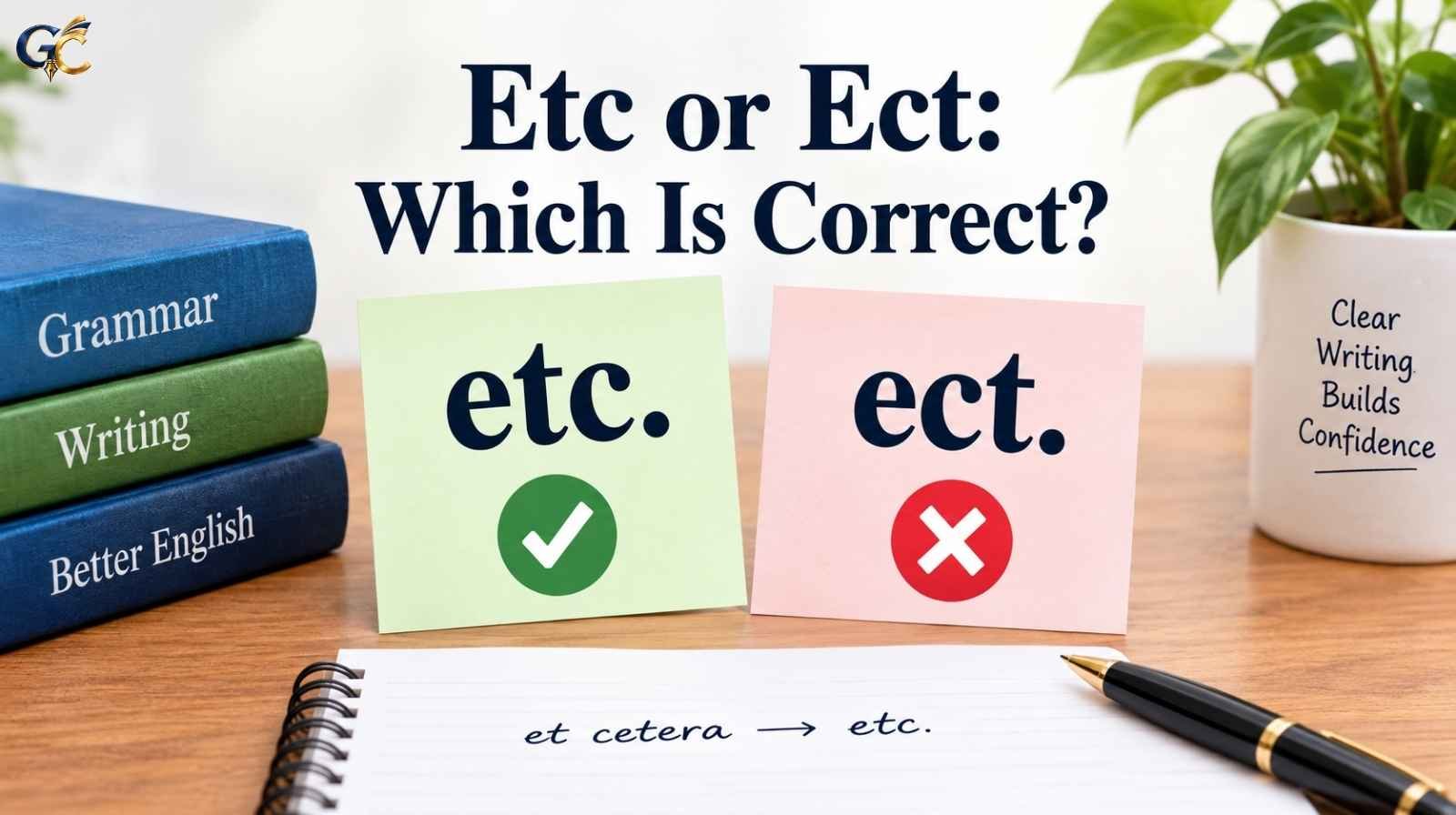
If you have everwondered whether etc or ect is correct, you are not alone. These two forms look very similar, so it is easy to accidentally switch the last two letters. However, when you mean “and so on” or “and other similar things,” the correct abbreviation is etc., not ect.
Etc. is short for the Latin phrase et cetera, which means “and the rest” or “and other similar things.” It is commonly placed at the end of a list when you do not want to name every item.
So, if you are choosing between etc. and ect., remember this simple rule:
Etc. is correct. Ect. is a misspelling when you mean et cetera.
In this guide, you will learn what etc. means, why ect. is incorrect, how to use the abbreviation properly, and which punctuation rules to follow.
What Does Etc. Mean?
Etc. is an abbreviation of the Latin expression et cetera. Cambridge Dictionary defines etc. as an abbreviation meaning “and other similar things.” It is used when a writer wants to avoid giving a complete list.
For example:
- I bought pens, pencils, notebooks, etc.
- We need food, water, blankets, etc.
- She enjoys reading, writing, drawing, etc.
In each sentence, etc. tells the reader that the list could continue.
Why Does Etc. Have a “C”?
The easiest way to remember the spelling is to connect the abbreviation to its original phrase:
et cetera → etc.
The abbreviation takes the first letters of the words:
- et → e + t
- cetera → c
That gives you:
etc.
The spelling ect. reverses the final two letters and does not represent the standard abbreviation of et cetera. The Language Portal of Canada specifically identifies ect. as a common misspelling and states that etc. is the abbreviation.
Etc or Ect: Which Is Correct?
When you mean “and so on,” “and the rest,” or “and other similar things,” use etc.
Correct:
We packed shirts, trousers, shoes, socks, etc.
Incorrect:
We packed shirts, trousers, shoes, socks, ect.
Another example:
The store sells books, magazines, newspapers, etc.
Not:
The store sells books, magazines, newspapers, ect.
The distinction is straightforward: etc. is the standard abbreviation; ect. is a spelling error in this context.
Is “Ect.” Ever Correct?
If you are using ect. to mean et cetera, no. It is not the standard English abbreviation.
The confusion usually comes from the fact that people pronounce etc. quickly, which can make the abbreviation sound different from how it is spelled. The written form, however, remains etc.
| Form | Correct for “and so on”? | Meaning |
|---|---|---|
| etc. | ✅ Yes | and so on; and other similar things |
| ect. | ❌ No | Common misspelling of etc. |
| et cetera | ✅ Yes | Full expression |
| etcetera | ✅ Yes | One-word spelling also accepted in some style guides |
The Language Portal of Canada notes that et cetera is usually written as two words in Canadian English, while etcetera is also correct.
How to Use Etc. Correctly
The main purpose of etc. is to show that a list continues.
For example:
You can bring fruit such as apples, oranges, bananas, etc.
The reader understands that other fruits could also be included.
You can also use it with people:
The meeting included teachers, students, parents, administrators, etc.
Here, etc. means that there were other people in similar categories who were not individually named.
Put a Comma Before Etc.
When etc. appears at the end of a list, it is normally preceded by a comma.
Correct:
We bought bread, milk, eggs, etc.
When etc. occurs in the middle of a sentence, it can also be followed by a comma when the sentence grammar requires one.
For example:
Books, magazines, newspapers, etc., are available in the library.
The Language Portal of Canada recommends a comma before et cetera or etc. and explains how punctuation works when it appears within a sentence.
Etc. Already Contains a Period
Because etc. is an abbreviation, the period is part of its standard written form.
Write:
pens, pencils, rulers, etc.
Not:
pens, pencils, rulers, etc
However, if etc. comes at the end of a sentence, you do not normally need two periods:
We bought pens, pencils, rulers, etc.
The period in etc. also serves as the sentence-ending period. The Language Portal of Canada specifically addresses this punctuation rule.
Common Mistakes With Etc.
This is the most important mistake to avoid.
❌ I bought apples, oranges, bananas, ect.
✅ I bought apples, oranges, bananas, etc.
Remember:
et cetera → etc.
Not:
et cetera → ect.
Mistake 2: Writing “Etc Etc.”
Sometimes writers repeat etc. unnecessarily.
For example:
❌ We sell books, magazines, newspapers, etc., etc.
In ordinary writing, one etc. is enough.
Mistake 3: Using Etc. After “Such As”
Another common problem is redundancy.
For example:
❌ We sell fruits such as apples, oranges, and bananas, etc.
The phrase such as already introduces examples. Adding etc. can make the sentence unnecessarily repetitive.
Better:
✅ We sell fruits such as apples, oranges, and bananas.
Or:
✅ We sell fruits: apples, oranges, bananas, etc.
The Language Portal of Canada similarly advises against using et cetera after expressions such as for example and such as, because those expressions already signal that the list is incomplete.
Etc. in Formal and Professional Writing
Yes, etc. is a standard English abbreviation, but that does not mean it is always the clearest choice.
In formal writing, consider whether the reader would benefit from a more specific description.
For example:
The package includes cables, adapters, manuals, etc.
This is understandable, but a more precise sentence might be:
The package includes cables, adapters, manuals, and other accessories.
The second version tells the reader more clearly what kind of additional items are included.
When Should You Avoid Etc.?
You may want to avoid etc. when:
- The missing items are important to your argument.
- The reader needs a complete list.
- You are writing instructions that require precision.
- The unspecified items could cause confusion.
- A more descriptive phrase would be clearer.
For example, instead of:
Submit your ID, application, photographs, etc.
you could write:
Submit your ID, completed application form, two photographs, and proof of address.
Specific writing is often more useful than leaving the reader to guess what etc. includes.
A Real-Life Example: Why the Difference Matters
Imagine that a university student is preparing an assignment about study materials. While reviewing the final draft, the student writes:
Students should bring pens, notebooks, calculators, ect.
At first glance, the sentence may look perfectly understandable. The reader can probably figure out what the writer intended. However, ect. is still incorrect when it is intended to mean et cetera.
During proofreading, the student checks the expression against a reliable dictionary and style resource. The correction is simple:
Students should bring pens, notebooks, calculators, etc.
This small change matters because the purpose of proofreading is not only to make writing understandable. It also helps ensure that standard spelling, punctuation, and usage conventions are followed.
The lesson is particularly useful for students and English learners: when two forms look nearly identical, checking the original expression can solve the problem. Here, remembering et cetera → etc. provides a reliable spelling cue.
The same principle applies to emails, blog posts, reports, resumes, school assignments, and professional documents. A writer who repeatedly uses ect. may unintentionally signal a lack of proofreading, even though the intended meaning is obvious. In professional communication, small written details can contribute to the overall impression of clarity and care.
The important takeaway is not to memorize etc. as an isolated spelling. Instead, connect it to its source: et cetera. Once that connection becomes familiar, the correct order e-t-c is much easier to remember.
2025–2026 Data: Why Small Writing Errors Still Matter
There is no reliable global statistic specifically measuring how many people write “ect.” instead of “etc.” Therefore, it would be misleading to invent a percentage for this particular spelling mistake.
However, recent research shows that accuracy in written communication remains relevant.
A 2025 analysis from Resumeble reviewed 1,571 resumes and reported that nearly 74% contained spelling and grammar errors. The analysis also reported that more than one-third contained inconsistent punctuation. Because this was a resume-review sample rather than a random sample of all writers, its results should not be treated as a measure of the entire population.
More recent 2026 research from IELTS.international examined 667 IELTS Writing Task 2 practice essays submitted by 484 learners. Its analysis found spelling errors in 31% of the essays, while punctuation errors appeared in 64%. The researchers also emphasized that these were practice essays evaluated using their own methodology, not official IELTS scores or a measurement of English proficiency worldwide.
Google’s current Search Central guidance also emphasizes that high-quality content should avoid spelling and stylistic problems and should provide accurate, trustworthy information. Google explicitly says its systems are designed to prioritize helpful, reliable, people-first content rather than content created primarily to manipulate search rankings.
These findings do not prove that using ect. will hurt a website’s Google ranking by itself. Rather, they reinforce a broader writing principle: accurate spelling and careful editing contribute to clear, professional content.
Quick Checklist: Etc. vs. Ect.
Use this checklist whenever you are unsure:
- Use etc. when you mean “and so on.”
- Remember that etc. comes from et cetera.
- Put a comma before etc. when it follows a list.
- Keep the period in etc.
- Avoid unnecessary repetition such as “etc., etc.”
- Avoid using etc. after such as when it adds unnecessary redundancy.
- Use a more specific phrase when the omitted information is important.
- Do not write ect. as the abbreviation of et cetera.
FAQs
Q1: Is “etc.” or “ect.” correct?
A: Etc. is correct when you mean et cetera, meaning “and so on” or “and other similar things.” Ect. is a common misspelling in this context.
Q2: What does “etc.” stand for?
A: Etc. stands for the Latin phrase et cetera, meaning “and the rest” or “and other similar things.”
Q3: Is “ect.” a word?
A: Ect. is not the standard abbreviation for et cetera. If you intend to write “and so on,” use etc.
Q4: Does “etc.” need a period?
A: Yes. In standard English usage, etc. is written with a period because it is an abbreviation. If it ends a sentence, the same period can serve as the sentence-ending period.
Q5: Should there be a comma before “etc.”?
A: Generally, yes, when etc. follows a list:
I bought paper, pens, folders, etc.
The Language Portal of Canada recommends a comma before et cetera and its abbreviation.
Q6: Can I use “etc.” in formal writing?
A: Yes, etc. is a standard abbreviation, but it should be used thoughtfully. If a complete or more specific list is important, spelling out the relevant information can make your writing clearer.
Q7: Can “et cetera” be written as one word?
A: Yes. Et cetera is commonly written as two words, while etcetera is also an accepted spelling in some English usage. The abbreviation remains etc.
Q8: What is an easy way to remember “etc.”?
A: Think of the original phrase:
ET CETERA → ETC.
The first letters give you e + t + c = etc. This is easier to remember than trying to memorize the abbreviation by itself.
Conclusion:
So, etc or ect: which is correct? The answer is simple: etc. is correct when you mean et cetera, or “and so on.” Ect. is a common spelling mistake caused by switching the final two letters.
Remember the source phrase:
et cetera → etc.
When using etc., place it after an incomplete list, normally with a comma before it, and keep its period. Also, avoid using it when a more specific explanation would make your writing clearer.
👉 Explore more useful grammar tips and guides on Grammar Clear

Zia Ahmad is the founder of GrammarClear, an educational platform dedicated to making English grammar simple and easy to understand. Through clear explanations and practical examples, he aims to help learners improve their grammar, writing, and communication skills with confidence.

